{"title":"利用质子添加剂实现无枝晶锌阳极的高锌(002)优先取向","authors":"Yating Li, Xiaohui Ma, Xi Zhang, Fengyi Zhang, Qiong Wang, Qiang Guo, Jinlong Liu, Yonggang Wang, Jianhang Huang and Yongyao Xia","doi":"10.1039/D4EE03276D","DOIUrl":null,"url":null,"abstract":"<p >Although zinc-based batteries have long been considered as one of the most promising technologies for large-scale energy storage, their development has been seriously hindered by dendrite formation. Constructing highly (002)-textured Zn electrodes to guide Zn deposition has been demonstrated as an effective approach for dendrite suppression due to the lowest surface energy and closest packing morphology of the Zn(002) texture. Herein, a cation additive (proton) is reported for the first time as a universal strategy to effectively promote the formation of Zn(002) texture. A high Zn(002)-preferential orientation was obtained in a simple ZnSO<small><sub>4</sub></small> + H<small><sub>2</sub></small>SO<small><sub>4</sub></small> electrolyte, which effectively suppressed the formation of dendrite and side reactions. The Zn(002)||Zn(002) symmetric cell can cycle stably for an unprecedented 1900 hours under a practical deposition capacity of 5 mA h cm<small><sup>−2</sup></small> with a current density of 5 mA cm<small><sup>−2</sup></small>. The morphology evolution and formation mechanism of Zn (002) texture in electrolytes with a proton additive were also systematically investigated. This cation texturing strategy may provide novel insights into constructing high (002)-preferential orientation of metallic Zn.</p>","PeriodicalId":72,"journal":{"name":"Energy & Environmental Science","volume":" 23","pages":" 9205-9214"},"PeriodicalIF":30.5000,"publicationDate":"2024-10-16","publicationTypes":"Journal Article","fieldsOfStudy":null,"isOpenAccess":false,"openAccessPdf":"","citationCount":"0","resultStr":"{\"title\":\"High Zn(002)-preferential orientation enabled by a proton additive for dendrite-free zinc anodes†\",\"authors\":\"Yating Li, Xiaohui Ma, Xi Zhang, Fengyi Zhang, Qiong Wang, Qiang Guo, Jinlong Liu, Yonggang Wang, Jianhang Huang and Yongyao Xia\",\"doi\":\"10.1039/D4EE03276D\",\"DOIUrl\":null,\"url\":null,\"abstract\":\"<p >Although zinc-based batteries have long been considered as one of the most promising technologies for large-scale energy storage, their development has been seriously hindered by dendrite formation. Constructing highly (002)-textured Zn electrodes to guide Zn deposition has been demonstrated as an effective approach for dendrite suppression due to the lowest surface energy and closest packing morphology of the Zn(002) texture. Herein, a cation additive (proton) is reported for the first time as a universal strategy to effectively promote the formation of Zn(002) texture. A high Zn(002)-preferential orientation was obtained in a simple ZnSO<small><sub>4</sub></small> + H<small><sub>2</sub></small>SO<small><sub>4</sub></small> electrolyte, which effectively suppressed the formation of dendrite and side reactions. The Zn(002)||Zn(002) symmetric cell can cycle stably for an unprecedented 1900 hours under a practical deposition capacity of 5 mA h cm<small><sup>−2</sup></small> with a current density of 5 mA cm<small><sup>−2</sup></small>. The morphology evolution and formation mechanism of Zn (002) texture in electrolytes with a proton additive were also systematically investigated. This cation texturing strategy may provide novel insights into constructing high (002)-preferential orientation of metallic Zn.</p>\",\"PeriodicalId\":72,\"journal\":{\"name\":\"Energy & Environmental Science\",\"volume\":\" 23\",\"pages\":\" 9205-9214\"},\"PeriodicalIF\":30.5000,\"publicationDate\":\"2024-10-16\",\"publicationTypes\":\"Journal Article\",\"fieldsOfStudy\":null,\"isOpenAccess\":false,\"openAccessPdf\":\"\",\"citationCount\":\"0\",\"resultStr\":null,\"platform\":\"Semanticscholar\",\"paperid\":null,\"PeriodicalName\":\"Energy & Environmental Science\",\"FirstCategoryId\":\"88\",\"ListUrlMain\":\"https://pubs.rsc.org/en/content/articlelanding/2024/ee/d4ee03276d\",\"RegionNum\":1,\"RegionCategory\":\"材料科学\",\"ArticlePicture\":[],\"TitleCN\":null,\"AbstractTextCN\":null,\"PMCID\":null,\"EPubDate\":\"\",\"PubModel\":\"\",\"JCR\":\"Q1\",\"JCRName\":\"CHEMISTRY, MULTIDISCIPLINARY\",\"Score\":null,\"Total\":0}","platform":"Semanticscholar","paperid":null,"PeriodicalName":"Energy & Environmental Science","FirstCategoryId":"88","ListUrlMain":"https://pubs.rsc.org/en/content/articlelanding/2024/ee/d4ee03276d","RegionNum":1,"RegionCategory":"材料科学","ArticlePicture":[],"TitleCN":null,"AbstractTextCN":null,"PMCID":null,"EPubDate":"","PubModel":"","JCR":"Q1","JCRName":"CHEMISTRY, MULTIDISCIPLINARY","Score":null,"Total":0}
High Zn(002)-preferential orientation enabled by a proton additive for dendrite-free zinc anodes†
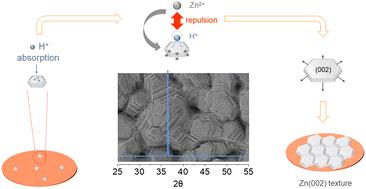
Although zinc-based batteries have long been considered as one of the most promising technologies for large-scale energy storage, their development has been seriously hindered by dendrite formation. Constructing highly (002)-textured Zn electrodes to guide Zn deposition has been demonstrated as an effective approach for dendrite suppression due to the lowest surface energy and closest packing morphology of the Zn(002) texture. Herein, a cation additive (proton) is reported for the first time as a universal strategy to effectively promote the formation of Zn(002) texture. A high Zn(002)-preferential orientation was obtained in a simple ZnSO4 + H2SO4 electrolyte, which effectively suppressed the formation of dendrite and side reactions. The Zn(002)||Zn(002) symmetric cell can cycle stably for an unprecedented 1900 hours under a practical deposition capacity of 5 mA h cm−2 with a current density of 5 mA cm−2. The morphology evolution and formation mechanism of Zn (002) texture in electrolytes with a proton additive were also systematically investigated. This cation texturing strategy may provide novel insights into constructing high (002)-preferential orientation of metallic Zn.
期刊介绍:
Energy & Environmental Science, a peer-reviewed scientific journal, publishes original research and review articles covering interdisciplinary topics in the (bio)chemical and (bio)physical sciences, as well as chemical engineering disciplines. Published monthly by the Royal Society of Chemistry (RSC), a not-for-profit publisher, Energy & Environmental Science is recognized as a leading journal. It boasts an impressive impact factor of 8.500 as of 2009, ranking 8th among 140 journals in the category "Chemistry, Multidisciplinary," second among 71 journals in "Energy & Fuels," second among 128 journals in "Engineering, Chemical," and first among 181 scientific journals in "Environmental Sciences."
Energy & Environmental Science publishes various types of articles, including Research Papers (original scientific work), Review Articles, Perspectives, and Minireviews (feature review-type articles of broad interest), Communications (original scientific work of an urgent nature), Opinions (personal, often speculative viewpoints or hypotheses on current topics), and Analysis Articles (in-depth examination of energy-related issues).




 京公网安备 11010802042870号
京ICP备2023020795号-1
京公网安备 11010802042870号
京ICP备2023020795号-1

 分享
分享
 求助内容:
求助内容: 应助结果提醒方式:
 扫码关注我们
