Lihui Wang, Han Xiao, Lei Yang, Jiaxing Li, Jiangzhi Zi, Zichao Lian
{"title":"利用光多重反射和 Z 型机制实现中空纳米盒状 Cu2-xS@ZnxCd1-xS 异质结,从而提高光催化制氢能力","authors":"Lihui Wang, Han Xiao, Lei Yang, Jiaxing Li, Jiangzhi Zi, Zichao Lian","doi":"10.1002/adfm.202416358","DOIUrl":null,"url":null,"abstract":"<p>Achieving efficient spatial photoinduced charge separation and light utilization for improving the high photocatalytic activity is still a major obstacle. Here, a Cu<sub>2-x</sub>S@Zn<sub>x</sub>Cd<sub>1-x</sub>S (Cu<sub>2-x</sub>S@ZnCdS) heterojunction is reported featuring a distinctive core–shell hollow nanobox structure. The Cu<sub>2-x</sub>S@Zn<sub>x</sub>Cd<sub>1-x</sub>S exhibits high photocatalytic activity in hydrogen evolution reaction (HER) at the rate of 8175 µmol∙g<sup>−1</sup>∙h<sup>−1</sup> under visible light irradiation, outperforming pristine ZnCdS nanoparticles and Cu<sub>2-x</sub>S hollow nanoboxes. The remarkable activity and outstanding stability of Cu<sub>2-x</sub>@ZnCdS are attributed to the development of robust interfacial electric fields, and improved light multireflection absorption efficiency as well as the Z-scheme mechanism. The electron paramagnetic resonance (EPR) and in situ X-ray photoelectron spectroscopy (XPS) measurements gave the direct evidence of the formation of the Z-scheme, which maintained the high redox potentials of each ZnCdS and Cu<sub>2-x</sub>S. This study gives the guideline for the design of heterojunction with the Z-scheme mechanism, leading to the high photocatalytic performance and remarkable stability.</p>","PeriodicalId":112,"journal":{"name":"Advanced Functional Materials","volume":"35 9","pages":""},"PeriodicalIF":19.0000,"publicationDate":"2024-10-18","publicationTypes":"Journal Article","fieldsOfStudy":null,"isOpenAccess":false,"openAccessPdf":"","citationCount":"0","resultStr":"{\"title\":\"Hollow Nanobox-Shaped Cu2-xS@ZnxCd1-xS Heterojunction by Light Multireflection with Z-Scheme Mechanism for Enhanced Photocatalytic Hydrogen Production\",\"authors\":\"Lihui Wang, Han Xiao, Lei Yang, Jiaxing Li, Jiangzhi Zi, Zichao Lian\",\"doi\":\"10.1002/adfm.202416358\",\"DOIUrl\":null,\"url\":null,\"abstract\":\"<p>Achieving efficient spatial photoinduced charge separation and light utilization for improving the high photocatalytic activity is still a major obstacle. Here, a Cu<sub>2-x</sub>S@Zn<sub>x</sub>Cd<sub>1-x</sub>S (Cu<sub>2-x</sub>S@ZnCdS) heterojunction is reported featuring a distinctive core–shell hollow nanobox structure. The Cu<sub>2-x</sub>S@Zn<sub>x</sub>Cd<sub>1-x</sub>S exhibits high photocatalytic activity in hydrogen evolution reaction (HER) at the rate of 8175 µmol∙g<sup>−1</sup>∙h<sup>−1</sup> under visible light irradiation, outperforming pristine ZnCdS nanoparticles and Cu<sub>2-x</sub>S hollow nanoboxes. The remarkable activity and outstanding stability of Cu<sub>2-x</sub>@ZnCdS are attributed to the development of robust interfacial electric fields, and improved light multireflection absorption efficiency as well as the Z-scheme mechanism. The electron paramagnetic resonance (EPR) and in situ X-ray photoelectron spectroscopy (XPS) measurements gave the direct evidence of the formation of the Z-scheme, which maintained the high redox potentials of each ZnCdS and Cu<sub>2-x</sub>S. This study gives the guideline for the design of heterojunction with the Z-scheme mechanism, leading to the high photocatalytic performance and remarkable stability.</p>\",\"PeriodicalId\":112,\"journal\":{\"name\":\"Advanced Functional Materials\",\"volume\":\"35 9\",\"pages\":\"\"},\"PeriodicalIF\":19.0000,\"publicationDate\":\"2024-10-18\",\"publicationTypes\":\"Journal Article\",\"fieldsOfStudy\":null,\"isOpenAccess\":false,\"openAccessPdf\":\"\",\"citationCount\":\"0\",\"resultStr\":null,\"platform\":\"Semanticscholar\",\"paperid\":null,\"PeriodicalName\":\"Advanced Functional Materials\",\"FirstCategoryId\":\"88\",\"ListUrlMain\":\"https://advanced.onlinelibrary.wiley.com/doi/10.1002/adfm.202416358\",\"RegionNum\":1,\"RegionCategory\":\"材料科学\",\"ArticlePicture\":[],\"TitleCN\":null,\"AbstractTextCN\":null,\"PMCID\":null,\"EPubDate\":\"\",\"PubModel\":\"\",\"JCR\":\"Q1\",\"JCRName\":\"CHEMISTRY, MULTIDISCIPLINARY\",\"Score\":null,\"Total\":0}","platform":"Semanticscholar","paperid":null,"PeriodicalName":"Advanced Functional Materials","FirstCategoryId":"88","ListUrlMain":"https://advanced.onlinelibrary.wiley.com/doi/10.1002/adfm.202416358","RegionNum":1,"RegionCategory":"材料科学","ArticlePicture":[],"TitleCN":null,"AbstractTextCN":null,"PMCID":null,"EPubDate":"","PubModel":"","JCR":"Q1","JCRName":"CHEMISTRY, MULTIDISCIPLINARY","Score":null,"Total":0}
引用次数: 0
摘要
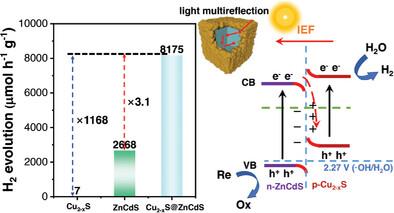
实现高效的空间光诱导电荷分离和光利用以提高光催化活性仍然是一个主要障碍。本文报告了一种 Cu2-xS@ZnxCd1-xS (Cu2-xS@ZnCdS)异质结,具有独特的核壳中空纳米盒结构。在可见光照射下,Cu2-xS@ZnxCd1-xS 在氢进化反应(HER)中表现出 8175 µmol∙g-1∙h-1 的高光催化活性,优于原始 ZnCdS 纳米颗粒和 Cu2-xS 中空纳米盒。Cu2-x@ZnCdS 的卓越活性和出色稳定性归功于强大的界面电场、更高的光多重反射吸收效率以及 Z 型机制。电子顺磁共振(EPR)和原位 X 射线光电子能谱(XPS)测量直接证明了 Z 型结构的形成,它维持了 ZnCdS 和 Cu2-xS 的高氧化还原电位。这项研究为设计具有 Z 型机制的异质结提供了指导,从而使异质结具有较高的光催化性能和显著的稳定性。
Hollow Nanobox-Shaped Cu2-xS@ZnxCd1-xS Heterojunction by Light Multireflection with Z-Scheme Mechanism for Enhanced Photocatalytic Hydrogen Production
Achieving efficient spatial photoinduced charge separation and light utilization for improving the high photocatalytic activity is still a major obstacle. Here, a Cu2-xS@ZnxCd1-xS (Cu2-xS@ZnCdS) heterojunction is reported featuring a distinctive core–shell hollow nanobox structure. The Cu2-xS@ZnxCd1-xS exhibits high photocatalytic activity in hydrogen evolution reaction (HER) at the rate of 8175 µmol∙g−1∙h−1 under visible light irradiation, outperforming pristine ZnCdS nanoparticles and Cu2-xS hollow nanoboxes. The remarkable activity and outstanding stability of Cu2-x@ZnCdS are attributed to the development of robust interfacial electric fields, and improved light multireflection absorption efficiency as well as the Z-scheme mechanism. The electron paramagnetic resonance (EPR) and in situ X-ray photoelectron spectroscopy (XPS) measurements gave the direct evidence of the formation of the Z-scheme, which maintained the high redox potentials of each ZnCdS and Cu2-xS. This study gives the guideline for the design of heterojunction with the Z-scheme mechanism, leading to the high photocatalytic performance and remarkable stability.
期刊介绍:
Firmly established as a top-tier materials science journal, Advanced Functional Materials reports breakthrough research in all aspects of materials science, including nanotechnology, chemistry, physics, and biology every week.
Advanced Functional Materials is known for its rapid and fair peer review, quality content, and high impact, making it the first choice of the international materials science community.




 京公网安备 11010802042870号
京ICP备2023020795号-1
京公网安备 11010802042870号
京ICP备2023020795号-1

 分享
分享
 求助内容:
求助内容: 应助结果提醒方式:
 扫码关注我们
