Guan-Lin Lu, Shih-Ting Chiu, Po-Heng Lin and Jérôme Long
{"title":"通过配位阴离子调节线性四核镝(III)配合物的磁各向异性","authors":"Guan-Lin Lu, Shih-Ting Chiu, Po-Heng Lin and Jérôme Long","doi":"10.1039/D4DT01949K","DOIUrl":null,"url":null,"abstract":"<p >We report the synthesis, structures, and magnetic properties of two novel linear tetranuclear complexes with the general formula [Dy<small><sub>4</sub></small>(Hheb)<small><sub>2</sub></small>(heb)<small><sub>4</sub></small>X<small><sub>2</sub></small>(MeOH)<small><sub>4</sub></small>] (X<small><sup>−</sup></small> = NO<small><sub>3</sub></small><small><sup>−</sup></small>, OAc<small><sup>−</sup></small>; H<small><sub>2</sub></small>heb = (<em>E</em>)-<em>N</em>′-(1-(2-hydroxyphenyl)ethylidene)benzohydrazide, OAc<small><sup>−</sup></small> = acetate). The rigid ligands (Hheb<small><sup>−</sup></small>/heb<small><sup>2−</sup></small>) incorporate phenoxide groups and bridge the Dy<small><sup>3+</sup></small> ions in an unusual tetranuclear linear assembly. Notably, we demonstrate through magnetic measurements and theoretical calculations how the anion (X) coordinated at the peripheral Dy<small><sup>3+</sup></small> centers acts as a switch, significantly changing the magnetic anisotropy of the entire complex. This control over magnetic anisotropy through the selection of the coordinated anion offers a promising avenue for tailoring the functionality of single-molecule magnets.</p>","PeriodicalId":71,"journal":{"name":"Dalton Transactions","volume":" 46","pages":" 18575-18584"},"PeriodicalIF":3.3000,"publicationDate":"2024-10-22","publicationTypes":"Journal Article","fieldsOfStudy":null,"isOpenAccess":false,"openAccessPdf":"","citationCount":"0","resultStr":"{\"title\":\"Modulating magnetic anisotropy in linear tetranuclear dysprosium(iii) complexes via coordinated anions†\",\"authors\":\"Guan-Lin Lu, Shih-Ting Chiu, Po-Heng Lin and Jérôme Long\",\"doi\":\"10.1039/D4DT01949K\",\"DOIUrl\":null,\"url\":null,\"abstract\":\"<p >We report the synthesis, structures, and magnetic properties of two novel linear tetranuclear complexes with the general formula [Dy<small><sub>4</sub></small>(Hheb)<small><sub>2</sub></small>(heb)<small><sub>4</sub></small>X<small><sub>2</sub></small>(MeOH)<small><sub>4</sub></small>] (X<small><sup>−</sup></small> = NO<small><sub>3</sub></small><small><sup>−</sup></small>, OAc<small><sup>−</sup></small>; H<small><sub>2</sub></small>heb = (<em>E</em>)-<em>N</em>′-(1-(2-hydroxyphenyl)ethylidene)benzohydrazide, OAc<small><sup>−</sup></small> = acetate). The rigid ligands (Hheb<small><sup>−</sup></small>/heb<small><sup>2−</sup></small>) incorporate phenoxide groups and bridge the Dy<small><sup>3+</sup></small> ions in an unusual tetranuclear linear assembly. Notably, we demonstrate through magnetic measurements and theoretical calculations how the anion (X) coordinated at the peripheral Dy<small><sup>3+</sup></small> centers acts as a switch, significantly changing the magnetic anisotropy of the entire complex. This control over magnetic anisotropy through the selection of the coordinated anion offers a promising avenue for tailoring the functionality of single-molecule magnets.</p>\",\"PeriodicalId\":71,\"journal\":{\"name\":\"Dalton Transactions\",\"volume\":\" 46\",\"pages\":\" 18575-18584\"},\"PeriodicalIF\":3.3000,\"publicationDate\":\"2024-10-22\",\"publicationTypes\":\"Journal Article\",\"fieldsOfStudy\":null,\"isOpenAccess\":false,\"openAccessPdf\":\"\",\"citationCount\":\"0\",\"resultStr\":null,\"platform\":\"Semanticscholar\",\"paperid\":null,\"PeriodicalName\":\"Dalton Transactions\",\"FirstCategoryId\":\"92\",\"ListUrlMain\":\"https://pubs.rsc.org/en/content/articlelanding/2024/dt/d4dt01949k\",\"RegionNum\":3,\"RegionCategory\":\"化学\",\"ArticlePicture\":[],\"TitleCN\":null,\"AbstractTextCN\":null,\"PMCID\":null,\"EPubDate\":\"\",\"PubModel\":\"\",\"JCR\":\"Q2\",\"JCRName\":\"CHEMISTRY, INORGANIC & NUCLEAR\",\"Score\":null,\"Total\":0}","platform":"Semanticscholar","paperid":null,"PeriodicalName":"Dalton Transactions","FirstCategoryId":"92","ListUrlMain":"https://pubs.rsc.org/en/content/articlelanding/2024/dt/d4dt01949k","RegionNum":3,"RegionCategory":"化学","ArticlePicture":[],"TitleCN":null,"AbstractTextCN":null,"PMCID":null,"EPubDate":"","PubModel":"","JCR":"Q2","JCRName":"CHEMISTRY, INORGANIC & NUCLEAR","Score":null,"Total":0}
Modulating magnetic anisotropy in linear tetranuclear dysprosium(iii) complexes via coordinated anions†
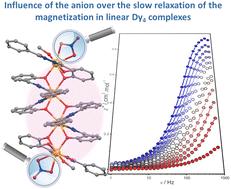
We report the synthesis, structures, and magnetic properties of two novel linear tetranuclear complexes with the general formula [Dy4(Hheb)2(heb)4X2(MeOH)4] (X− = NO3−, OAc−; H2heb = (E)-N′-(1-(2-hydroxyphenyl)ethylidene)benzohydrazide, OAc− = acetate). The rigid ligands (Hheb−/heb2−) incorporate phenoxide groups and bridge the Dy3+ ions in an unusual tetranuclear linear assembly. Notably, we demonstrate through magnetic measurements and theoretical calculations how the anion (X) coordinated at the peripheral Dy3+ centers acts as a switch, significantly changing the magnetic anisotropy of the entire complex. This control over magnetic anisotropy through the selection of the coordinated anion offers a promising avenue for tailoring the functionality of single-molecule magnets.
期刊介绍:
Dalton Transactions is a journal for all areas of inorganic chemistry, which encompasses the organometallic, bioinorganic and materials chemistry of the elements, with applications including synthesis, catalysis, energy conversion/storage, electrical devices and medicine. Dalton Transactions welcomes high-quality, original submissions in all of these areas and more, where the advancement of knowledge in inorganic chemistry is significant.




 京公网安备 11010802042870号
京ICP备2023020795号-1
京公网安备 11010802042870号
京ICP备2023020795号-1

 分享
分享
 求助内容:
求助内容: 应助结果提醒方式:
 扫码关注我们
