{"title":"用于氟离子电池的高可逆转换型 CoSn2 阴极。","authors":"Shun Sasano, Ryo Ishikawa, Kazuaki Kawahara, Naoya Shibata, Yuichi Ikuhara","doi":"10.1002/smll.202408023","DOIUrl":null,"url":null,"abstract":"<p>An all-solid-state fluoride-ion battery (FIB) is one of the promising candidates for the next-generation battery owing to its high energy density and high safety. For the practical application of FIBs, it is an urgent task to operate FIBs at lower temperatures. However, there are still two major difficulties in conventional conversion-type pure metal cathodes: low F<sup>−</sup> ion conductivities and poor cycle stabilities. Here, the conversion-type Sn-based intermetallic alloy is proposed as a new cathode that can overcome the above issues. The present CoSn<sub>2</sub> cathode retains the discharge capacity of 229 mAh g<sup>−1</sup> after 250 cycles, even at 60 °C. CoSn<sub>2</sub> is decomposed into CoF<sub>2</sub> and SnF<sub>2</sub> nanocrystals in the charging process, and the nanoscale network structure of SnF<sub>2</sub> provides the fast F<sup>−</sup> ion conduction path throughout the cathode, facilitating the battery operation at lower temperatures. Moreover, the formed CoF<sub>2</sub> and SnF<sub>2</sub> phases are merged into the original CoSn<sub>2</sub> phase in the discharging process, leading to a highly reversible redox reaction and the high cycle stability of CoSn<sub>2</sub>. These findings should pave the way to enhance the performance of all-solid-state FIBs at lower temperatures.</p>","PeriodicalId":228,"journal":{"name":"Small","volume":"21 1","pages":""},"PeriodicalIF":12.1000,"publicationDate":"2024-10-22","publicationTypes":"Journal Article","fieldsOfStudy":null,"isOpenAccess":false,"openAccessPdf":"","citationCount":"0","resultStr":"{\"title\":\"Highly Reversible Conversion-Type CoSn2 Cathode for Fluoride-Ion Batteries\",\"authors\":\"Shun Sasano, Ryo Ishikawa, Kazuaki Kawahara, Naoya Shibata, Yuichi Ikuhara\",\"doi\":\"10.1002/smll.202408023\",\"DOIUrl\":null,\"url\":null,\"abstract\":\"<p>An all-solid-state fluoride-ion battery (FIB) is one of the promising candidates for the next-generation battery owing to its high energy density and high safety. For the practical application of FIBs, it is an urgent task to operate FIBs at lower temperatures. However, there are still two major difficulties in conventional conversion-type pure metal cathodes: low F<sup>−</sup> ion conductivities and poor cycle stabilities. Here, the conversion-type Sn-based intermetallic alloy is proposed as a new cathode that can overcome the above issues. The present CoSn<sub>2</sub> cathode retains the discharge capacity of 229 mAh g<sup>−1</sup> after 250 cycles, even at 60 °C. CoSn<sub>2</sub> is decomposed into CoF<sub>2</sub> and SnF<sub>2</sub> nanocrystals in the charging process, and the nanoscale network structure of SnF<sub>2</sub> provides the fast F<sup>−</sup> ion conduction path throughout the cathode, facilitating the battery operation at lower temperatures. Moreover, the formed CoF<sub>2</sub> and SnF<sub>2</sub> phases are merged into the original CoSn<sub>2</sub> phase in the discharging process, leading to a highly reversible redox reaction and the high cycle stability of CoSn<sub>2</sub>. These findings should pave the way to enhance the performance of all-solid-state FIBs at lower temperatures.</p>\",\"PeriodicalId\":228,\"journal\":{\"name\":\"Small\",\"volume\":\"21 1\",\"pages\":\"\"},\"PeriodicalIF\":12.1000,\"publicationDate\":\"2024-10-22\",\"publicationTypes\":\"Journal Article\",\"fieldsOfStudy\":null,\"isOpenAccess\":false,\"openAccessPdf\":\"\",\"citationCount\":\"0\",\"resultStr\":null,\"platform\":\"Semanticscholar\",\"paperid\":null,\"PeriodicalName\":\"Small\",\"FirstCategoryId\":\"88\",\"ListUrlMain\":\"https://onlinelibrary.wiley.com/doi/10.1002/smll.202408023\",\"RegionNum\":2,\"RegionCategory\":\"材料科学\",\"ArticlePicture\":[],\"TitleCN\":null,\"AbstractTextCN\":null,\"PMCID\":null,\"EPubDate\":\"\",\"PubModel\":\"\",\"JCR\":\"Q1\",\"JCRName\":\"CHEMISTRY, MULTIDISCIPLINARY\",\"Score\":null,\"Total\":0}","platform":"Semanticscholar","paperid":null,"PeriodicalName":"Small","FirstCategoryId":"88","ListUrlMain":"https://onlinelibrary.wiley.com/doi/10.1002/smll.202408023","RegionNum":2,"RegionCategory":"材料科学","ArticlePicture":[],"TitleCN":null,"AbstractTextCN":null,"PMCID":null,"EPubDate":"","PubModel":"","JCR":"Q1","JCRName":"CHEMISTRY, MULTIDISCIPLINARY","Score":null,"Total":0}
Highly Reversible Conversion-Type CoSn2 Cathode for Fluoride-Ion Batteries
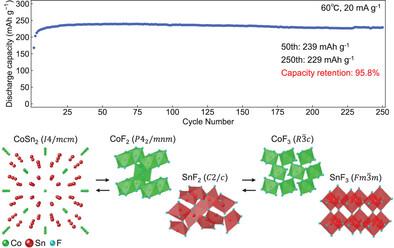
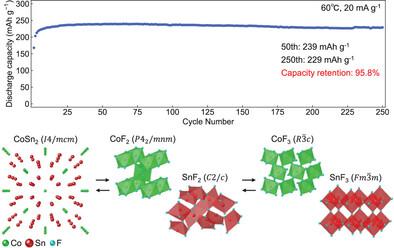
An all-solid-state fluoride-ion battery (FIB) is one of the promising candidates for the next-generation battery owing to its high energy density and high safety. For the practical application of FIBs, it is an urgent task to operate FIBs at lower temperatures. However, there are still two major difficulties in conventional conversion-type pure metal cathodes: low F− ion conductivities and poor cycle stabilities. Here, the conversion-type Sn-based intermetallic alloy is proposed as a new cathode that can overcome the above issues. The present CoSn2 cathode retains the discharge capacity of 229 mAh g−1 after 250 cycles, even at 60 °C. CoSn2 is decomposed into CoF2 and SnF2 nanocrystals in the charging process, and the nanoscale network structure of SnF2 provides the fast F− ion conduction path throughout the cathode, facilitating the battery operation at lower temperatures. Moreover, the formed CoF2 and SnF2 phases are merged into the original CoSn2 phase in the discharging process, leading to a highly reversible redox reaction and the high cycle stability of CoSn2. These findings should pave the way to enhance the performance of all-solid-state FIBs at lower temperatures.
期刊介绍:
Small serves as an exceptional platform for both experimental and theoretical studies in fundamental and applied interdisciplinary research at the nano- and microscale. The journal offers a compelling mix of peer-reviewed Research Articles, Reviews, Perspectives, and Comments.
With a remarkable 2022 Journal Impact Factor of 13.3 (Journal Citation Reports from Clarivate Analytics, 2023), Small remains among the top multidisciplinary journals, covering a wide range of topics at the interface of materials science, chemistry, physics, engineering, medicine, and biology.
Small's readership includes biochemists, biologists, biomedical scientists, chemists, engineers, information technologists, materials scientists, physicists, and theoreticians alike.




 京公网安备 11010802042870号
京ICP备2023020795号-1
京公网安备 11010802042870号
京ICP备2023020795号-1

 分享
分享
 求助内容:
求助内容: 应助结果提醒方式:
 扫码关注我们
