{"title":"脱乙酰氰化:硫氰酸盐和氰化物的无氰途径","authors":"Si Yeon Kim , Hee Nam Lim","doi":"10.1039/d4cc04539d","DOIUrl":null,"url":null,"abstract":"<div><div>The use of <em>N</em>-hydroxy-2-oxopropanimidoyl chloride as a latent cyanide transfer agent is reported. This easy-to-handle, scalable, and operationally simple agent can be installed on common nucleophiles, including thiols and secondary amines, affording synthetically useful thiocyanates and cyanamides. This method complements conventional approaches that use poisonous and volatile cyanogen halides.</div></div>","PeriodicalId":67,"journal":{"name":"Chemical Communications","volume":"60 92","pages":"Pages 13542-13545"},"PeriodicalIF":4.2000,"publicationDate":"2024-10-21","publicationTypes":"Journal Article","fieldsOfStudy":null,"isOpenAccess":false,"openAccessPdf":"","citationCount":"0","resultStr":"{\"title\":\"Deacetylative cyanation: a cyanide-free route to thiocyanates and cyanamides†\",\"authors\":\"Si Yeon Kim , Hee Nam Lim\",\"doi\":\"10.1039/d4cc04539d\",\"DOIUrl\":null,\"url\":null,\"abstract\":\"<div><div>The use of <em>N</em>-hydroxy-2-oxopropanimidoyl chloride as a latent cyanide transfer agent is reported. This easy-to-handle, scalable, and operationally simple agent can be installed on common nucleophiles, including thiols and secondary amines, affording synthetically useful thiocyanates and cyanamides. This method complements conventional approaches that use poisonous and volatile cyanogen halides.</div></div>\",\"PeriodicalId\":67,\"journal\":{\"name\":\"Chemical Communications\",\"volume\":\"60 92\",\"pages\":\"Pages 13542-13545\"},\"PeriodicalIF\":4.2000,\"publicationDate\":\"2024-10-21\",\"publicationTypes\":\"Journal Article\",\"fieldsOfStudy\":null,\"isOpenAccess\":false,\"openAccessPdf\":\"\",\"citationCount\":\"0\",\"resultStr\":null,\"platform\":\"Semanticscholar\",\"paperid\":null,\"PeriodicalName\":\"Chemical Communications\",\"FirstCategoryId\":\"92\",\"ListUrlMain\":\"https://www.sciencedirect.com/org/science/article/pii/S1359734524024704\",\"RegionNum\":2,\"RegionCategory\":\"化学\",\"ArticlePicture\":[],\"TitleCN\":null,\"AbstractTextCN\":null,\"PMCID\":null,\"EPubDate\":\"2024/10/23 0:00:00\",\"PubModel\":\"Epub\",\"JCR\":\"Q2\",\"JCRName\":\"CHEMISTRY, MULTIDISCIPLINARY\",\"Score\":null,\"Total\":0}","platform":"Semanticscholar","paperid":null,"PeriodicalName":"Chemical Communications","FirstCategoryId":"92","ListUrlMain":"https://www.sciencedirect.com/org/science/article/pii/S1359734524024704","RegionNum":2,"RegionCategory":"化学","ArticlePicture":[],"TitleCN":null,"AbstractTextCN":null,"PMCID":null,"EPubDate":"2024/10/23 0:00:00","PubModel":"Epub","JCR":"Q2","JCRName":"CHEMISTRY, MULTIDISCIPLINARY","Score":null,"Total":0}
Deacetylative cyanation: a cyanide-free route to thiocyanates and cyanamides†
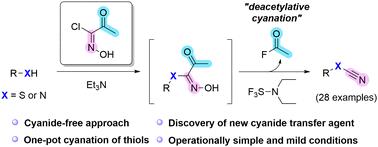
The use of N-hydroxy-2-oxopropanimidoyl chloride as a latent cyanide transfer agent is reported. This easy-to-handle, scalable, and operationally simple agent can be installed on common nucleophiles, including thiols and secondary amines, affording synthetically useful thiocyanates and cyanamides. This method complements conventional approaches that use poisonous and volatile cyanogen halides.
期刊介绍:
ChemComm (Chemical Communications) is renowned as the fastest publisher of articles providing information on new avenues of research, drawn from all the world''s major areas of chemical research.




 京公网安备 11010802042870号
京ICP备2023020795号-1
京公网安备 11010802042870号
京ICP备2023020795号-1

 分享
分享
 求助内容:
求助内容: 应助结果提醒方式:
 扫码关注我们
