{"title":"用于检测组胺的快速、灵敏和特异性微生物全细胞生物传感器:一种潜在的食物毒素","authors":"Ankita Bhatt, Shubham Jain, Naveen K. Navani","doi":"10.1021/acs.jafc.4c06315","DOIUrl":null,"url":null,"abstract":"Histamine is a biogenic amine; its level indicates food quality, as elevated levels cause food poisoning. Therefore, monitoring food at each step during processing until it reaches the consumer is crucial, but current techniques are complicated and time-consuming. Here, we designed a <i>Pseudomonas putida</i> whole-cell biosensor using a histamine-responsive genetic element expressing a fluorescent protein in the presence of the cognate target. We improved the performance of the proposed biosensor by optimizing the chassis, genetic regulatory element, and reporter gene. A sensitive and rapid biosensor variant was obtained with a limit of detection (LOD) of 0.39 ppm, manifesting a linear response (<i>R</i><sup>2</sup> = 0.98) from 0.28 to 18 ppm in 90 min. The biosensor showed minimal cross-reactivity with other biogenic amines and amino acids prevalent in food, making it highly specific. The biosensor effectively quantified histamine in spiked fish, prawn, and wine samples with a satisfactory recovery. Additionally, a colorimetric sensor variant P<sub>A</sub><i>lacZ</i> was developed enabling histamine quantification in seafood via a smartphone application, with an LOD<sub>gray</sub> of 0.23 ppm, exhibiting a linear response from 0 to 2.24 ppm. Overall, this study reports an efficient, specific, and highly sensitive biosensor with strong potential for the on-site detection of histamine, ensuring food safety.","PeriodicalId":41,"journal":{"name":"Journal of Agricultural and Food Chemistry","volume":"1 1","pages":""},"PeriodicalIF":6.7000,"publicationDate":"2024-10-23","publicationTypes":"Journal Article","fieldsOfStudy":null,"isOpenAccess":false,"openAccessPdf":"","citationCount":"0","resultStr":"{\"title\":\"Rapid, Sensitive, and Specific Microbial Whole-Cell Biosensor for the Detection of Histamine: A Potential Food Toxin\",\"authors\":\"Ankita Bhatt, Shubham Jain, Naveen K. Navani\",\"doi\":\"10.1021/acs.jafc.4c06315\",\"DOIUrl\":null,\"url\":null,\"abstract\":\"Histamine is a biogenic amine; its level indicates food quality, as elevated levels cause food poisoning. Therefore, monitoring food at each step during processing until it reaches the consumer is crucial, but current techniques are complicated and time-consuming. Here, we designed a <i>Pseudomonas putida</i> whole-cell biosensor using a histamine-responsive genetic element expressing a fluorescent protein in the presence of the cognate target. We improved the performance of the proposed biosensor by optimizing the chassis, genetic regulatory element, and reporter gene. A sensitive and rapid biosensor variant was obtained with a limit of detection (LOD) of 0.39 ppm, manifesting a linear response (<i>R</i><sup>2</sup> = 0.98) from 0.28 to 18 ppm in 90 min. The biosensor showed minimal cross-reactivity with other biogenic amines and amino acids prevalent in food, making it highly specific. The biosensor effectively quantified histamine in spiked fish, prawn, and wine samples with a satisfactory recovery. Additionally, a colorimetric sensor variant P<sub>A</sub><i>lacZ</i> was developed enabling histamine quantification in seafood via a smartphone application, with an LOD<sub>gray</sub> of 0.23 ppm, exhibiting a linear response from 0 to 2.24 ppm. Overall, this study reports an efficient, specific, and highly sensitive biosensor with strong potential for the on-site detection of histamine, ensuring food safety.\",\"PeriodicalId\":41,\"journal\":{\"name\":\"Journal of Agricultural and Food Chemistry\",\"volume\":\"1 1\",\"pages\":\"\"},\"PeriodicalIF\":6.7000,\"publicationDate\":\"2024-10-23\",\"publicationTypes\":\"Journal Article\",\"fieldsOfStudy\":null,\"isOpenAccess\":false,\"openAccessPdf\":\"\",\"citationCount\":\"0\",\"resultStr\":null,\"platform\":\"Semanticscholar\",\"paperid\":null,\"PeriodicalName\":\"Journal of Agricultural and Food Chemistry\",\"FirstCategoryId\":\"97\",\"ListUrlMain\":\"https://doi.org/10.1021/acs.jafc.4c06315\",\"RegionNum\":1,\"RegionCategory\":\"农林科学\",\"ArticlePicture\":[],\"TitleCN\":null,\"AbstractTextCN\":null,\"PMCID\":null,\"EPubDate\":\"\",\"PubModel\":\"\",\"JCR\":\"Q1\",\"JCRName\":\"AGRICULTURE, MULTIDISCIPLINARY\",\"Score\":null,\"Total\":0}","platform":"Semanticscholar","paperid":null,"PeriodicalName":"Journal of Agricultural and Food Chemistry","FirstCategoryId":"97","ListUrlMain":"https://doi.org/10.1021/acs.jafc.4c06315","RegionNum":1,"RegionCategory":"农林科学","ArticlePicture":[],"TitleCN":null,"AbstractTextCN":null,"PMCID":null,"EPubDate":"","PubModel":"","JCR":"Q1","JCRName":"AGRICULTURE, MULTIDISCIPLINARY","Score":null,"Total":0}
Rapid, Sensitive, and Specific Microbial Whole-Cell Biosensor for the Detection of Histamine: A Potential Food Toxin
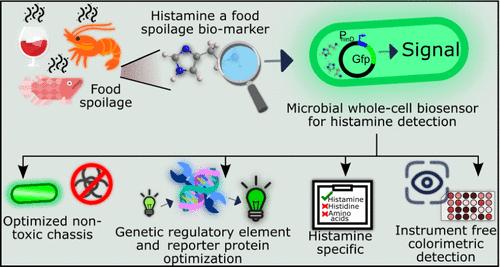
Histamine is a biogenic amine; its level indicates food quality, as elevated levels cause food poisoning. Therefore, monitoring food at each step during processing until it reaches the consumer is crucial, but current techniques are complicated and time-consuming. Here, we designed a Pseudomonas putida whole-cell biosensor using a histamine-responsive genetic element expressing a fluorescent protein in the presence of the cognate target. We improved the performance of the proposed biosensor by optimizing the chassis, genetic regulatory element, and reporter gene. A sensitive and rapid biosensor variant was obtained with a limit of detection (LOD) of 0.39 ppm, manifesting a linear response (R2 = 0.98) from 0.28 to 18 ppm in 90 min. The biosensor showed minimal cross-reactivity with other biogenic amines and amino acids prevalent in food, making it highly specific. The biosensor effectively quantified histamine in spiked fish, prawn, and wine samples with a satisfactory recovery. Additionally, a colorimetric sensor variant PAlacZ was developed enabling histamine quantification in seafood via a smartphone application, with an LODgray of 0.23 ppm, exhibiting a linear response from 0 to 2.24 ppm. Overall, this study reports an efficient, specific, and highly sensitive biosensor with strong potential for the on-site detection of histamine, ensuring food safety.
期刊介绍:
The Journal of Agricultural and Food Chemistry publishes high-quality, cutting edge original research representing complete studies and research advances dealing with the chemistry and biochemistry of agriculture and food. The Journal also encourages papers with chemistry and/or biochemistry as a major component combined with biological/sensory/nutritional/toxicological evaluation related to agriculture and/or food.




 京公网安备 11010802042870号
京ICP备2023020795号-1
京公网安备 11010802042870号
京ICP备2023020795号-1

 分享
分享
 求助内容:
求助内容: 应助结果提醒方式:
 扫码关注我们
