Tom van Gils, Hans Törnblom, Jóhann P. Hreinsson, Börje Jonefjäll, Hans Strid, Magnus Simrén
{"title":"活动期和静止期溃疡性结肠炎患者腹痛的相关因素:一项多队列研究","authors":"Tom van Gils, Hans Törnblom, Jóhann P. Hreinsson, Börje Jonefjäll, Hans Strid, Magnus Simrén","doi":"10.1111/apt.18344","DOIUrl":null,"url":null,"abstract":"<div>\n \n \n <section>\n \n <h3> Background</h3>\n \n <p>Abdominal pain can be an overlooked symptom in patients with ulcerative colitis (UC).</p>\n </section>\n \n <section>\n \n <h3> Aims</h3>\n \n <p>The aim of this study was to investigate the prevalence and factors associated with abdominal pain in active and quiescent UC.</p>\n </section>\n \n <section>\n \n <h3> Methods</h3>\n \n <p>Three study cohorts of adult UC patients were used. Cross-sectional cohorts I and II included 130 (46 active) and 288 (156 active) patients. Longitudinal cohort III included 83 patients with active disease at diagnosis that reached deep remission during follow-up. The Gastrointestinal Symptom Rating Scale was used to assess abdominal pain and other validated questionnaires to assess psychological distress, fatigue and quality of life (QoL).</p>\n </section>\n \n <section>\n \n <h3> Results</h3>\n \n <p>In the two cross-sectional cohorts, 63% and 58% of the active vs. 54% and 33% of the quiescent UC patients reported abdominal pain (both <i>p</i> ≤ 0.02). In the longitudinal cohort, 71% had abdominal pain at diagnosis vs. 46% when in remission (<i>p</i> < 0.001). In multivariable models, symptoms of anxiety were associated with higher abdominal pain levels in both cross-sectional cohorts (OR 1.75 [IQR 1.11–2.76] and OR 1.99 [1.45–2.73]), whereas in cohort II, active disease (OR 2.68 [1.61–4.45]) and female sex (OR 2.03 [1.21–3.41]) were also associated with pain. QoL was negatively correlated with higher levels of abdominal pain, both in active and quiescent disease.</p>\n </section>\n \n <section>\n \n <h3> Conclusions</h3>\n \n <p>Abdominal pain in UC is prevalent and associated with lower QoL in both active and quiescent disease. Associated factors are active disease, female sex and psychological symptoms, especially anxiety. We suggest considering a holistic approach when treating UC patients with abdominal pain.</p>\n </section>\n </div>","PeriodicalId":121,"journal":{"name":"Alimentary Pharmacology & Therapeutics","volume":"61 2","pages":"268-277"},"PeriodicalIF":6.8000,"publicationDate":"2024-10-23","publicationTypes":"Journal Article","fieldsOfStudy":null,"isOpenAccess":false,"openAccessPdf":"https://onlinelibrary.wiley.com/doi/epdf/10.1111/apt.18344","citationCount":"0","resultStr":"{\"title\":\"Factors Associated With Abdominal Pain in Patients With Active and Quiescent Ulcerative Colitis: A Multicohort Study\",\"authors\":\"Tom van Gils, Hans Törnblom, Jóhann P. Hreinsson, Börje Jonefjäll, Hans Strid, Magnus Simrén\",\"doi\":\"10.1111/apt.18344\",\"DOIUrl\":null,\"url\":null,\"abstract\":\"<div>\\n \\n \\n <section>\\n \\n <h3> Background</h3>\\n \\n <p>Abdominal pain can be an overlooked symptom in patients with ulcerative colitis (UC).</p>\\n </section>\\n \\n <section>\\n \\n <h3> Aims</h3>\\n \\n <p>The aim of this study was to investigate the prevalence and factors associated with abdominal pain in active and quiescent UC.</p>\\n </section>\\n \\n <section>\\n \\n <h3> Methods</h3>\\n \\n <p>Three study cohorts of adult UC patients were used. Cross-sectional cohorts I and II included 130 (46 active) and 288 (156 active) patients. Longitudinal cohort III included 83 patients with active disease at diagnosis that reached deep remission during follow-up. The Gastrointestinal Symptom Rating Scale was used to assess abdominal pain and other validated questionnaires to assess psychological distress, fatigue and quality of life (QoL).</p>\\n </section>\\n \\n <section>\\n \\n <h3> Results</h3>\\n \\n <p>In the two cross-sectional cohorts, 63% and 58% of the active vs. 54% and 33% of the quiescent UC patients reported abdominal pain (both <i>p</i> ≤ 0.02). In the longitudinal cohort, 71% had abdominal pain at diagnosis vs. 46% when in remission (<i>p</i> < 0.001). In multivariable models, symptoms of anxiety were associated with higher abdominal pain levels in both cross-sectional cohorts (OR 1.75 [IQR 1.11–2.76] and OR 1.99 [1.45–2.73]), whereas in cohort II, active disease (OR 2.68 [1.61–4.45]) and female sex (OR 2.03 [1.21–3.41]) were also associated with pain. QoL was negatively correlated with higher levels of abdominal pain, both in active and quiescent disease.</p>\\n </section>\\n \\n <section>\\n \\n <h3> Conclusions</h3>\\n \\n <p>Abdominal pain in UC is prevalent and associated with lower QoL in both active and quiescent disease. Associated factors are active disease, female sex and psychological symptoms, especially anxiety. We suggest considering a holistic approach when treating UC patients with abdominal pain.</p>\\n </section>\\n </div>\",\"PeriodicalId\":121,\"journal\":{\"name\":\"Alimentary Pharmacology & Therapeutics\",\"volume\":\"61 2\",\"pages\":\"268-277\"},\"PeriodicalIF\":6.8000,\"publicationDate\":\"2024-10-23\",\"publicationTypes\":\"Journal Article\",\"fieldsOfStudy\":null,\"isOpenAccess\":false,\"openAccessPdf\":\"https://onlinelibrary.wiley.com/doi/epdf/10.1111/apt.18344\",\"citationCount\":\"0\",\"resultStr\":null,\"platform\":\"Semanticscholar\",\"paperid\":null,\"PeriodicalName\":\"Alimentary Pharmacology & Therapeutics\",\"FirstCategoryId\":\"3\",\"ListUrlMain\":\"https://onlinelibrary.wiley.com/doi/10.1111/apt.18344\",\"RegionNum\":1,\"RegionCategory\":\"医学\",\"ArticlePicture\":[],\"TitleCN\":null,\"AbstractTextCN\":null,\"PMCID\":null,\"EPubDate\":\"\",\"PubModel\":\"\",\"JCR\":\"Q1\",\"JCRName\":\"GASTROENTEROLOGY & HEPATOLOGY\",\"Score\":null,\"Total\":0}","platform":"Semanticscholar","paperid":null,"PeriodicalName":"Alimentary Pharmacology & Therapeutics","FirstCategoryId":"3","ListUrlMain":"https://onlinelibrary.wiley.com/doi/10.1111/apt.18344","RegionNum":1,"RegionCategory":"医学","ArticlePicture":[],"TitleCN":null,"AbstractTextCN":null,"PMCID":null,"EPubDate":"","PubModel":"","JCR":"Q1","JCRName":"GASTROENTEROLOGY & HEPATOLOGY","Score":null,"Total":0}
Factors Associated With Abdominal Pain in Patients With Active and Quiescent Ulcerative Colitis: A Multicohort Study
Background
Abdominal pain can be an overlooked symptom in patients with ulcerative colitis (UC).
Aims
The aim of this study was to investigate the prevalence and factors associated with abdominal pain in active and quiescent UC.
Methods
Three study cohorts of adult UC patients were used. Cross-sectional cohorts I and II included 130 (46 active) and 288 (156 active) patients. Longitudinal cohort III included 83 patients with active disease at diagnosis that reached deep remission during follow-up. The Gastrointestinal Symptom Rating Scale was used to assess abdominal pain and other validated questionnaires to assess psychological distress, fatigue and quality of life (QoL).
Results
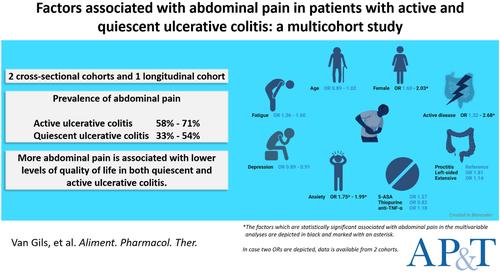
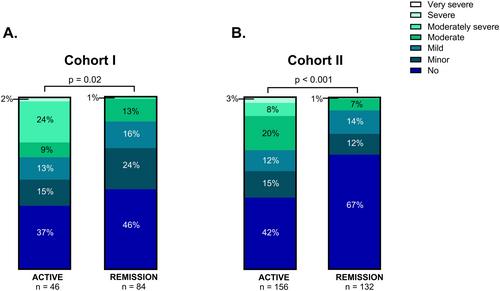
In the two cross-sectional cohorts, 63% and 58% of the active vs. 54% and 33% of the quiescent UC patients reported abdominal pain (both p ≤ 0.02). In the longitudinal cohort, 71% had abdominal pain at diagnosis vs. 46% when in remission (p < 0.001). In multivariable models, symptoms of anxiety were associated with higher abdominal pain levels in both cross-sectional cohorts (OR 1.75 [IQR 1.11–2.76] and OR 1.99 [1.45–2.73]), whereas in cohort II, active disease (OR 2.68 [1.61–4.45]) and female sex (OR 2.03 [1.21–3.41]) were also associated with pain. QoL was negatively correlated with higher levels of abdominal pain, both in active and quiescent disease.
Conclusions
Abdominal pain in UC is prevalent and associated with lower QoL in both active and quiescent disease. Associated factors are active disease, female sex and psychological symptoms, especially anxiety. We suggest considering a holistic approach when treating UC patients with abdominal pain.
期刊介绍:
Alimentary Pharmacology & Therapeutics is a global pharmacology journal focused on the impact of drugs on the human gastrointestinal and hepato-biliary systems. It covers a diverse range of topics, often with immediate clinical relevance to its readership.




 京公网安备 11010802042870号
京ICP备2023020795号-1
京公网安备 11010802042870号
京ICP备2023020795号-1

 分享
分享
 求助内容:
求助内容: 应助结果提醒方式:
 扫码关注我们
