Haiyan He, Yue Lan, Jinlong Qin, Quanguo Jiang, Lu Yang, Jian Zhang and Huajie Huang
{"title":"立体组装在 Ti3C2Tx MXene 上的三维多孔铑铜合金纳米流作为高效甲醇氧化电催化剂","authors":"Haiyan He, Yue Lan, Jinlong Qin, Quanguo Jiang, Lu Yang, Jian Zhang and Huajie Huang","doi":"10.1039/D4QI02182G","DOIUrl":null,"url":null,"abstract":"<p >The development of direct methanol fuel cell technology is expected to ease the excessive consumption of non-renewable fossil fuels, which puts forward a new request for the exploration of advanced Pt-alternative electrocatalysts toward the methanol oxidation reaction (MOR). Here, we demonstrate a facile and robust bottom-up method for the spatial construction of three-dimensional (3D) porous rhodium–copper alloy nanoflowers stereoassembled on Ti<small><sub>3</sub></small>C<small><sub>2</sub></small>T<small><sub><em>x</em></sub></small> MXene nanosheets (RhCu NF/Ti<small><sub>3</sub></small>C<small><sub>2</sub></small>T<small><sub><em>x</em></sub></small>) through an <em>in situ</em> soft-chemistry process. With the synergistic contributions from the distinctive structural merits, such as the 3D nanoflower-shaped configuration, abundant porosity, bimetallic alloy and strain effects, and excellent metallic conductivity, the resultant RhCu NF/Ti<small><sub>3</sub></small>C<small><sub>2</sub></small>T<small><sub><em>x</em></sub></small> nanoarchitectures manifest significantly boosted electrocatalytic MOR performance under alkaline conditions, which is more competitive than that of conventional particle-shaped Rh catalysts dispersed on Ti<small><sub>3</sub></small>C<small><sub>2</sub></small>T<small><sub><em>x</em></sub></small> nanosheets, graphene, carbon nanotubes, carbon black and commercial Pt/carbon black and Pd/carbon black catalysts.</p>","PeriodicalId":79,"journal":{"name":"Inorganic Chemistry Frontiers","volume":" 23","pages":" 8564-8574"},"PeriodicalIF":6.2000,"publicationDate":"2024-10-29","publicationTypes":"Journal Article","fieldsOfStudy":null,"isOpenAccess":false,"openAccessPdf":"","citationCount":"0","resultStr":"{\"title\":\"Three-dimensional porous rhodium–copper alloy nanoflowers stereoassembled on Ti3C2Tx MXene as highly-efficient methanol oxidation electrocatalysts†\",\"authors\":\"Haiyan He, Yue Lan, Jinlong Qin, Quanguo Jiang, Lu Yang, Jian Zhang and Huajie Huang\",\"doi\":\"10.1039/D4QI02182G\",\"DOIUrl\":null,\"url\":null,\"abstract\":\"<p >The development of direct methanol fuel cell technology is expected to ease the excessive consumption of non-renewable fossil fuels, which puts forward a new request for the exploration of advanced Pt-alternative electrocatalysts toward the methanol oxidation reaction (MOR). Here, we demonstrate a facile and robust bottom-up method for the spatial construction of three-dimensional (3D) porous rhodium–copper alloy nanoflowers stereoassembled on Ti<small><sub>3</sub></small>C<small><sub>2</sub></small>T<small><sub><em>x</em></sub></small> MXene nanosheets (RhCu NF/Ti<small><sub>3</sub></small>C<small><sub>2</sub></small>T<small><sub><em>x</em></sub></small>) through an <em>in situ</em> soft-chemistry process. With the synergistic contributions from the distinctive structural merits, such as the 3D nanoflower-shaped configuration, abundant porosity, bimetallic alloy and strain effects, and excellent metallic conductivity, the resultant RhCu NF/Ti<small><sub>3</sub></small>C<small><sub>2</sub></small>T<small><sub><em>x</em></sub></small> nanoarchitectures manifest significantly boosted electrocatalytic MOR performance under alkaline conditions, which is more competitive than that of conventional particle-shaped Rh catalysts dispersed on Ti<small><sub>3</sub></small>C<small><sub>2</sub></small>T<small><sub><em>x</em></sub></small> nanosheets, graphene, carbon nanotubes, carbon black and commercial Pt/carbon black and Pd/carbon black catalysts.</p>\",\"PeriodicalId\":79,\"journal\":{\"name\":\"Inorganic Chemistry Frontiers\",\"volume\":\" 23\",\"pages\":\" 8564-8574\"},\"PeriodicalIF\":6.2000,\"publicationDate\":\"2024-10-29\",\"publicationTypes\":\"Journal Article\",\"fieldsOfStudy\":null,\"isOpenAccess\":false,\"openAccessPdf\":\"\",\"citationCount\":\"0\",\"resultStr\":null,\"platform\":\"Semanticscholar\",\"paperid\":null,\"PeriodicalName\":\"Inorganic Chemistry Frontiers\",\"FirstCategoryId\":\"92\",\"ListUrlMain\":\"https://pubs.rsc.org/en/content/articlelanding/2024/qi/d4qi02182g\",\"RegionNum\":1,\"RegionCategory\":\"化学\",\"ArticlePicture\":[],\"TitleCN\":null,\"AbstractTextCN\":null,\"PMCID\":null,\"EPubDate\":\"\",\"PubModel\":\"\",\"JCR\":\"Q1\",\"JCRName\":\"CHEMISTRY, INORGANIC & NUCLEAR\",\"Score\":null,\"Total\":0}","platform":"Semanticscholar","paperid":null,"PeriodicalName":"Inorganic Chemistry Frontiers","FirstCategoryId":"92","ListUrlMain":"https://pubs.rsc.org/en/content/articlelanding/2024/qi/d4qi02182g","RegionNum":1,"RegionCategory":"化学","ArticlePicture":[],"TitleCN":null,"AbstractTextCN":null,"PMCID":null,"EPubDate":"","PubModel":"","JCR":"Q1","JCRName":"CHEMISTRY, INORGANIC & NUCLEAR","Score":null,"Total":0}
Three-dimensional porous rhodium–copper alloy nanoflowers stereoassembled on Ti3C2Tx MXene as highly-efficient methanol oxidation electrocatalysts†
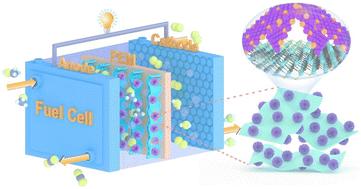
The development of direct methanol fuel cell technology is expected to ease the excessive consumption of non-renewable fossil fuels, which puts forward a new request for the exploration of advanced Pt-alternative electrocatalysts toward the methanol oxidation reaction (MOR). Here, we demonstrate a facile and robust bottom-up method for the spatial construction of three-dimensional (3D) porous rhodium–copper alloy nanoflowers stereoassembled on Ti3C2Tx MXene nanosheets (RhCu NF/Ti3C2Tx) through an in situ soft-chemistry process. With the synergistic contributions from the distinctive structural merits, such as the 3D nanoflower-shaped configuration, abundant porosity, bimetallic alloy and strain effects, and excellent metallic conductivity, the resultant RhCu NF/Ti3C2Tx nanoarchitectures manifest significantly boosted electrocatalytic MOR performance under alkaline conditions, which is more competitive than that of conventional particle-shaped Rh catalysts dispersed on Ti3C2Tx nanosheets, graphene, carbon nanotubes, carbon black and commercial Pt/carbon black and Pd/carbon black catalysts.





 京公网安备 11010802042870号
京ICP备2023020795号-1
京公网安备 11010802042870号
京ICP备2023020795号-1

 分享
分享
 求助内容:
求助内容: 应助结果提醒方式:
 扫码关注我们
