{"title":"社论:解码 ACLF-亚表型,推进急性慢性肝衰竭的精准医疗。作者回复。","authors":"Pratibha Garg, Nipun Verma, Ajay Duseja","doi":"10.1111/apt.18364","DOIUrl":null,"url":null,"abstract":"<p>We sincerely appreciate the insightful Editorial by Sangam et al. regarding our study [<span>1, 2</span>]. We echo the call for harmonising definitions and prognostication in acute-on-chronic liver failure (ACLF) [<span>3</span>]. While the debate over definitions continues, the core concept of ACLF—a rapid deterioration due to an acute insult on chronic liver disease, with organ dysfunction and high short-term mortality—remains consistent. The Asia Pacific (APASL) definition highlights liver-dominant injury without prior decompensation, whereas the European (EASL) definition includes patients with or without prior decompensation of cirrhosis and focuses on multi-organ failures. However, the core concept of acute worsening in the setting of chronic liver disease remains the common denominator (aka. Acute Decompensation-AD).</p><p>Our study aimed to objectively group such patients with AD; ‘ACLF by APASL or EASL definition’ through machine learning, identifying distinct phenotypes based on their clinical profiles without a priori hypotheses. This approach uncovered four clusters with unique survival trajectories, demonstrating that cluster membership independently predicted prognosis beyond established scores like the CLIF-C-ACLF. We integrated the supervised learning to predict these clusters with simple decision trees. This phenotype-based strategy was described to enhance clinical decision-making. We utilised a systematic approach to select variables for clustering, balancing both qualitative and quantitative aspects of patient data. Baseline variables were first considered to capture initial clinical states, followed by dynamic data to reflect disease progression. The use of composite severity scores was debated and ultimately included based on their proven contribution to the model's accuracy utilising a titration-based empiric approach of data science.</p><p>Although the clustering results reflect our single-centre experience, they provide a foundation for external validation in diverse populations to ensure robustness. Harmonising data across global cohorts will be crucial to establishing an internationally accepted framework for diagnosing and prognosticating patients with AD and ACLF. As recent meta-analyses suggest [<span>4</span>], our cohort shares similarities with global studies using various ACLF definitions (APASL, EASL, NACSELD), further supporting the generalisability of our findings. While external validation is essential, we believe our well-characterised cohort from a large public sector hospital in India represents similar settings across Asia.</p><p>We also agree with the Editorial's emphasis on distinguishing clinical and biological heterogeneity. Our study is the first to apply machine learning to ACLF phenotyping, akin to the work of Nakano et al. in heart failure patients [<span>5</span>]. However, integrating biological data, such as multi-omics, will be crucial in refining these clusters and aligning them with underlying biological pathways. For instance, Cockrell et al. [<span>6</span>] demonstrated how integrating cytokine profiles and genetic algorithms improved model robustness in systemic inflammation, a strategy that could be adapted to ACLF.</p><p>In conclusion, our study offers a proof of concept that machine learning can capture the clinical heterogeneity among patients with AD and ACLF, potentially guiding personalised management plans. We propose a framework (Figure 1) that integrates global definitions, geographical variations and disease progression to inform future management strategies. We hope that these efforts will lead to more precise, targeted interventions in patients with AD and ACLF.</p><p><b>Pratibha Garg:</b> writing – original draft. <b>Nipun Verma:</b> writing – review and editing, supervision. <b>Ajay Duseja:</b> writing – review and editing.</p><p>This article is linked to Verma et al papers. To view these articles, visit https://doi.org/10.1111/apt.18274 and https://doi.org/10.1111/apt.18322.</p>","PeriodicalId":121,"journal":{"name":"Alimentary Pharmacology & Therapeutics","volume":"60 11-12","pages":"1627-1628"},"PeriodicalIF":6.8000,"publicationDate":"2024-10-29","publicationTypes":"Journal Article","fieldsOfStudy":null,"isOpenAccess":false,"openAccessPdf":"https://onlinelibrary.wiley.com/doi/epdf/10.1111/apt.18364","citationCount":"0","resultStr":"{\"title\":\"Editorial: Decoding ACLF—Sub-Phenotyping to Advance Precision Medicine in Acute-on-Chronic Liver Failure. Authors' Reply\",\"authors\":\"Pratibha Garg, Nipun Verma, Ajay Duseja\",\"doi\":\"10.1111/apt.18364\",\"DOIUrl\":null,\"url\":null,\"abstract\":\"<p>We sincerely appreciate the insightful Editorial by Sangam et al. regarding our study [<span>1, 2</span>]. We echo the call for harmonising definitions and prognostication in acute-on-chronic liver failure (ACLF) [<span>3</span>]. While the debate over definitions continues, the core concept of ACLF—a rapid deterioration due to an acute insult on chronic liver disease, with organ dysfunction and high short-term mortality—remains consistent. The Asia Pacific (APASL) definition highlights liver-dominant injury without prior decompensation, whereas the European (EASL) definition includes patients with or without prior decompensation of cirrhosis and focuses on multi-organ failures. However, the core concept of acute worsening in the setting of chronic liver disease remains the common denominator (aka. Acute Decompensation-AD).</p><p>Our study aimed to objectively group such patients with AD; ‘ACLF by APASL or EASL definition’ through machine learning, identifying distinct phenotypes based on their clinical profiles without a priori hypotheses. This approach uncovered four clusters with unique survival trajectories, demonstrating that cluster membership independently predicted prognosis beyond established scores like the CLIF-C-ACLF. We integrated the supervised learning to predict these clusters with simple decision trees. This phenotype-based strategy was described to enhance clinical decision-making. We utilised a systematic approach to select variables for clustering, balancing both qualitative and quantitative aspects of patient data. Baseline variables were first considered to capture initial clinical states, followed by dynamic data to reflect disease progression. The use of composite severity scores was debated and ultimately included based on their proven contribution to the model's accuracy utilising a titration-based empiric approach of data science.</p><p>Although the clustering results reflect our single-centre experience, they provide a foundation for external validation in diverse populations to ensure robustness. Harmonising data across global cohorts will be crucial to establishing an internationally accepted framework for diagnosing and prognosticating patients with AD and ACLF. As recent meta-analyses suggest [<span>4</span>], our cohort shares similarities with global studies using various ACLF definitions (APASL, EASL, NACSELD), further supporting the generalisability of our findings. While external validation is essential, we believe our well-characterised cohort from a large public sector hospital in India represents similar settings across Asia.</p><p>We also agree with the Editorial's emphasis on distinguishing clinical and biological heterogeneity. Our study is the first to apply machine learning to ACLF phenotyping, akin to the work of Nakano et al. in heart failure patients [<span>5</span>]. However, integrating biological data, such as multi-omics, will be crucial in refining these clusters and aligning them with underlying biological pathways. For instance, Cockrell et al. [<span>6</span>] demonstrated how integrating cytokine profiles and genetic algorithms improved model robustness in systemic inflammation, a strategy that could be adapted to ACLF.</p><p>In conclusion, our study offers a proof of concept that machine learning can capture the clinical heterogeneity among patients with AD and ACLF, potentially guiding personalised management plans. We propose a framework (Figure 1) that integrates global definitions, geographical variations and disease progression to inform future management strategies. We hope that these efforts will lead to more precise, targeted interventions in patients with AD and ACLF.</p><p><b>Pratibha Garg:</b> writing – original draft. <b>Nipun Verma:</b> writing – review and editing, supervision. <b>Ajay Duseja:</b> writing – review and editing.</p><p>This article is linked to Verma et al papers. To view these articles, visit https://doi.org/10.1111/apt.18274 and https://doi.org/10.1111/apt.18322.</p>\",\"PeriodicalId\":121,\"journal\":{\"name\":\"Alimentary Pharmacology & Therapeutics\",\"volume\":\"60 11-12\",\"pages\":\"1627-1628\"},\"PeriodicalIF\":6.8000,\"publicationDate\":\"2024-10-29\",\"publicationTypes\":\"Journal Article\",\"fieldsOfStudy\":null,\"isOpenAccess\":false,\"openAccessPdf\":\"https://onlinelibrary.wiley.com/doi/epdf/10.1111/apt.18364\",\"citationCount\":\"0\",\"resultStr\":null,\"platform\":\"Semanticscholar\",\"paperid\":null,\"PeriodicalName\":\"Alimentary Pharmacology & Therapeutics\",\"FirstCategoryId\":\"3\",\"ListUrlMain\":\"https://onlinelibrary.wiley.com/doi/10.1111/apt.18364\",\"RegionNum\":1,\"RegionCategory\":\"医学\",\"ArticlePicture\":[],\"TitleCN\":null,\"AbstractTextCN\":null,\"PMCID\":null,\"EPubDate\":\"\",\"PubModel\":\"\",\"JCR\":\"Q1\",\"JCRName\":\"GASTROENTEROLOGY & HEPATOLOGY\",\"Score\":null,\"Total\":0}","platform":"Semanticscholar","paperid":null,"PeriodicalName":"Alimentary Pharmacology & Therapeutics","FirstCategoryId":"3","ListUrlMain":"https://onlinelibrary.wiley.com/doi/10.1111/apt.18364","RegionNum":1,"RegionCategory":"医学","ArticlePicture":[],"TitleCN":null,"AbstractTextCN":null,"PMCID":null,"EPubDate":"","PubModel":"","JCR":"Q1","JCRName":"GASTROENTEROLOGY & HEPATOLOGY","Score":null,"Total":0}
Editorial: Decoding ACLF—Sub-Phenotyping to Advance Precision Medicine in Acute-on-Chronic Liver Failure. Authors' Reply
We sincerely appreciate the insightful Editorial by Sangam et al. regarding our study [1, 2]. We echo the call for harmonising definitions and prognostication in acute-on-chronic liver failure (ACLF) [3]. While the debate over definitions continues, the core concept of ACLF—a rapid deterioration due to an acute insult on chronic liver disease, with organ dysfunction and high short-term mortality—remains consistent. The Asia Pacific (APASL) definition highlights liver-dominant injury without prior decompensation, whereas the European (EASL) definition includes patients with or without prior decompensation of cirrhosis and focuses on multi-organ failures. However, the core concept of acute worsening in the setting of chronic liver disease remains the common denominator (aka. Acute Decompensation-AD).
Our study aimed to objectively group such patients with AD; ‘ACLF by APASL or EASL definition’ through machine learning, identifying distinct phenotypes based on their clinical profiles without a priori hypotheses. This approach uncovered four clusters with unique survival trajectories, demonstrating that cluster membership independently predicted prognosis beyond established scores like the CLIF-C-ACLF. We integrated the supervised learning to predict these clusters with simple decision trees. This phenotype-based strategy was described to enhance clinical decision-making. We utilised a systematic approach to select variables for clustering, balancing both qualitative and quantitative aspects of patient data. Baseline variables were first considered to capture initial clinical states, followed by dynamic data to reflect disease progression. The use of composite severity scores was debated and ultimately included based on their proven contribution to the model's accuracy utilising a titration-based empiric approach of data science.
Although the clustering results reflect our single-centre experience, they provide a foundation for external validation in diverse populations to ensure robustness. Harmonising data across global cohorts will be crucial to establishing an internationally accepted framework for diagnosing and prognosticating patients with AD and ACLF. As recent meta-analyses suggest [4], our cohort shares similarities with global studies using various ACLF definitions (APASL, EASL, NACSELD), further supporting the generalisability of our findings. While external validation is essential, we believe our well-characterised cohort from a large public sector hospital in India represents similar settings across Asia.
We also agree with the Editorial's emphasis on distinguishing clinical and biological heterogeneity. Our study is the first to apply machine learning to ACLF phenotyping, akin to the work of Nakano et al. in heart failure patients [5]. However, integrating biological data, such as multi-omics, will be crucial in refining these clusters and aligning them with underlying biological pathways. For instance, Cockrell et al. [6] demonstrated how integrating cytokine profiles and genetic algorithms improved model robustness in systemic inflammation, a strategy that could be adapted to ACLF.
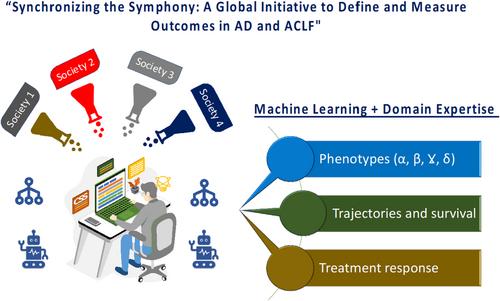
In conclusion, our study offers a proof of concept that machine learning can capture the clinical heterogeneity among patients with AD and ACLF, potentially guiding personalised management plans. We propose a framework (Figure 1) that integrates global definitions, geographical variations and disease progression to inform future management strategies. We hope that these efforts will lead to more precise, targeted interventions in patients with AD and ACLF.
Pratibha Garg: writing – original draft. Nipun Verma: writing – review and editing, supervision. Ajay Duseja: writing – review and editing.
This article is linked to Verma et al papers. To view these articles, visit https://doi.org/10.1111/apt.18274 and https://doi.org/10.1111/apt.18322.
期刊介绍:
Alimentary Pharmacology & Therapeutics is a global pharmacology journal focused on the impact of drugs on the human gastrointestinal and hepato-biliary systems. It covers a diverse range of topics, often with immediate clinical relevance to its readership.




 京公网安备 11010802042870号
京ICP备2023020795号-1
京公网安备 11010802042870号
京ICP备2023020795号-1

 分享
分享
 求助内容:
求助内容: 应助结果提醒方式:
 扫码关注我们
