Stephan Schneider, Pattraporn Satitsuksanoa, Huseyn Babayev, Willem van de Veen, Iris Chang, Minglin Yang, Cezmi A. Akdis, Kari Nadeau, Mübeccel Akdis
{"title":"过敏不协调的双胞胎在非转换 B 细胞和转换 B 细胞的基因表达上没有差异。","authors":"Stephan Schneider, Pattraporn Satitsuksanoa, Huseyn Babayev, Willem van de Veen, Iris Chang, Minglin Yang, Cezmi A. Akdis, Kari Nadeau, Mübeccel Akdis","doi":"10.1111/all.16376","DOIUrl":null,"url":null,"abstract":"<p>Allergy is a globally spread affliction that is based on dysregulation of immune responses towards ‘harmless’ antigens.<span><sup>1</sup></span> B cells and their regulation are also involved in mechanisms of allergic diseases.<span><sup>2, 3</sup></span> They produce the IgE essential for allergen-induced mast cell and basophil degranulation.<span><sup>4</sup></span> The common consensus is that the regulation of B cells is closely tied to tolerance and allergy.<span><sup>2, 5</sup></span> In allergy, this regulation is likely dysfunctional, resulting in different B-cell behaviours. Therefore, we suspected that B cells from allergic individuals may differ in their class-switching potential or process, making them more prone to IgE class-switching and allergies. We hypothesized that there would be significantly different expressions in pathways related to B-cell activation, B-cell regulation or B-cell isotype switching correlating to allergic symptoms. We had 16 twin pairs that were either healthy, allergy discordant or allergy concordant (Tables S1–S4). The donors were monozygotic and mainly allergic to timothy grass, birch tree pollen and/or house dust mites; none had taken or were on allergen-immunotherapy. We sorted switched and unswitched B cells (Figure S1) from bio-banked PBMCs, extracted RNA, depleted the ribosomal RNA, and performed 100 bp single-end RNA sequencing on the Illumina Novaseq 6000 platform.<span><sup>6</sup></span> Unbiased clustering of samples (Figure 1A), excluding long non-coding RNA, showed that the main influences for clustering in descending order are switched versus non-switched B cells, twin pairs and then their concordance status. The degree of clustering by concordance status varies, yet there is no clustering by allergy within the discordance clusters in both switched and non-switched B cells, suggesting that it is a confounding factor. An individuals' allergy status had little to no significant impact on the overall clustering. The same holds true for the PCA analysis of the top 300 significant genes of switched B cells, while non-switched B cells are separated by gender (Figure 1B). Comparing healthy concordant to allergy concordant twins could be greatly influenced by confounding factors like twin pair similarities and grouping by concordance instead of their actual health status. Therefore, we compared the healthy versus allergic within the discordant twin pairs to avoid these influences for gene expression analysis. In this comparison, neither switched nor non-switched B cells show pathways that would traditionally be associated with allergies or B-cell regulation (Table S5). A log fold change of greater than 0.5 and a <i>p</i>-value of .05 gave a FDR of 0.9999. Adjusting for an FDR below 0.05 (<i>p</i>-value <.00001) resulted in no differentially expressed genes for switched and five genes without a common pathway in non-switched B cells. Using these parameters, we did not find significant differences in pathway regulations on the wider scale of B cells between allergy-discordant twins.</p><p>PCA analysis for the top 300 genes by the <i>p</i>-value of the allergy-discordant twins confirmed that allergic versus healthy twins do not group by allergy status (Figure 2A). Pathway analysis of the top genes in allergy-discordant twins does not reveal any cohesive pathways (allergy vs. healthy) in the switched B cells (Figure 2B). One pathway in the non-switched B cells upregulated genes, is associated with the cell cycle but not directly with immune functions.</p><p>Our results show no indication that there is a general dysregulation of B cells as an underlying cause for allergies. Any differences that might exist are too subtle to be observed across B cells. We propose that distinctions between allergic and non-allergic individuals may only be noticeable in allergen-specific B cells. These effects are probably overshadowed by the variability among individuals due to the rarity of allergen-specific B cells in the overall B-cell population. Since the study focused on PBMCs, tissue-resident B cells may exhibit different properties.</p><p>M.A. conceived and designed the study. K.N. and I.C. provided the samples for the study S.S. M.A. and W.V. planned the experiments. S.S. performed the experiments. P.S., M.Y. helped with the experiments. H.B. helped with the bioinformatics and graphics. S.S. wrote the manuscript. K.N., W.V. and M.A. reviewed the manuscript.</p><p>This study was supported by funding from the Swiss National Science Funds (#31003–201053/320030–159870 to M.A.) and FreeNovation grant from the Novartis Research Foundation (to W.V.).</p><p>The authors declare no conflict of interest in relation to this work.</p>","PeriodicalId":122,"journal":{"name":"Allergy","volume":"80 1","pages":"342-345"},"PeriodicalIF":11.3000,"publicationDate":"2024-10-29","publicationTypes":"Journal Article","fieldsOfStudy":null,"isOpenAccess":false,"openAccessPdf":"https://www.ncbi.nlm.nih.gov/pmc/articles/PMC11724222/pdf/","citationCount":"0","resultStr":"{\"title\":\"Allergy discordant twins do not exhibit differences in gene expression in non-switched and switched B cells\",\"authors\":\"Stephan Schneider, Pattraporn Satitsuksanoa, Huseyn Babayev, Willem van de Veen, Iris Chang, Minglin Yang, Cezmi A. Akdis, Kari Nadeau, Mübeccel Akdis\",\"doi\":\"10.1111/all.16376\",\"DOIUrl\":null,\"url\":null,\"abstract\":\"<p>Allergy is a globally spread affliction that is based on dysregulation of immune responses towards ‘harmless’ antigens.<span><sup>1</sup></span> B cells and their regulation are also involved in mechanisms of allergic diseases.<span><sup>2, 3</sup></span> They produce the IgE essential for allergen-induced mast cell and basophil degranulation.<span><sup>4</sup></span> The common consensus is that the regulation of B cells is closely tied to tolerance and allergy.<span><sup>2, 5</sup></span> In allergy, this regulation is likely dysfunctional, resulting in different B-cell behaviours. Therefore, we suspected that B cells from allergic individuals may differ in their class-switching potential or process, making them more prone to IgE class-switching and allergies. We hypothesized that there would be significantly different expressions in pathways related to B-cell activation, B-cell regulation or B-cell isotype switching correlating to allergic symptoms. We had 16 twin pairs that were either healthy, allergy discordant or allergy concordant (Tables S1–S4). The donors were monozygotic and mainly allergic to timothy grass, birch tree pollen and/or house dust mites; none had taken or were on allergen-immunotherapy. We sorted switched and unswitched B cells (Figure S1) from bio-banked PBMCs, extracted RNA, depleted the ribosomal RNA, and performed 100 bp single-end RNA sequencing on the Illumina Novaseq 6000 platform.<span><sup>6</sup></span> Unbiased clustering of samples (Figure 1A), excluding long non-coding RNA, showed that the main influences for clustering in descending order are switched versus non-switched B cells, twin pairs and then their concordance status. The degree of clustering by concordance status varies, yet there is no clustering by allergy within the discordance clusters in both switched and non-switched B cells, suggesting that it is a confounding factor. An individuals' allergy status had little to no significant impact on the overall clustering. The same holds true for the PCA analysis of the top 300 significant genes of switched B cells, while non-switched B cells are separated by gender (Figure 1B). Comparing healthy concordant to allergy concordant twins could be greatly influenced by confounding factors like twin pair similarities and grouping by concordance instead of their actual health status. Therefore, we compared the healthy versus allergic within the discordant twin pairs to avoid these influences for gene expression analysis. In this comparison, neither switched nor non-switched B cells show pathways that would traditionally be associated with allergies or B-cell regulation (Table S5). A log fold change of greater than 0.5 and a <i>p</i>-value of .05 gave a FDR of 0.9999. Adjusting for an FDR below 0.05 (<i>p</i>-value <.00001) resulted in no differentially expressed genes for switched and five genes without a common pathway in non-switched B cells. Using these parameters, we did not find significant differences in pathway regulations on the wider scale of B cells between allergy-discordant twins.</p><p>PCA analysis for the top 300 genes by the <i>p</i>-value of the allergy-discordant twins confirmed that allergic versus healthy twins do not group by allergy status (Figure 2A). Pathway analysis of the top genes in allergy-discordant twins does not reveal any cohesive pathways (allergy vs. healthy) in the switched B cells (Figure 2B). One pathway in the non-switched B cells upregulated genes, is associated with the cell cycle but not directly with immune functions.</p><p>Our results show no indication that there is a general dysregulation of B cells as an underlying cause for allergies. Any differences that might exist are too subtle to be observed across B cells. We propose that distinctions between allergic and non-allergic individuals may only be noticeable in allergen-specific B cells. These effects are probably overshadowed by the variability among individuals due to the rarity of allergen-specific B cells in the overall B-cell population. Since the study focused on PBMCs, tissue-resident B cells may exhibit different properties.</p><p>M.A. conceived and designed the study. K.N. and I.C. provided the samples for the study S.S. M.A. and W.V. planned the experiments. S.S. performed the experiments. P.S., M.Y. helped with the experiments. H.B. helped with the bioinformatics and graphics. S.S. wrote the manuscript. K.N., W.V. and M.A. reviewed the manuscript.</p><p>This study was supported by funding from the Swiss National Science Funds (#31003–201053/320030–159870 to M.A.) and FreeNovation grant from the Novartis Research Foundation (to W.V.).</p><p>The authors declare no conflict of interest in relation to this work.</p>\",\"PeriodicalId\":122,\"journal\":{\"name\":\"Allergy\",\"volume\":\"80 1\",\"pages\":\"342-345\"},\"PeriodicalIF\":11.3000,\"publicationDate\":\"2024-10-29\",\"publicationTypes\":\"Journal Article\",\"fieldsOfStudy\":null,\"isOpenAccess\":false,\"openAccessPdf\":\"https://www.ncbi.nlm.nih.gov/pmc/articles/PMC11724222/pdf/\",\"citationCount\":\"0\",\"resultStr\":null,\"platform\":\"Semanticscholar\",\"paperid\":null,\"PeriodicalName\":\"Allergy\",\"FirstCategoryId\":\"3\",\"ListUrlMain\":\"https://onlinelibrary.wiley.com/doi/10.1111/all.16376\",\"RegionNum\":1,\"RegionCategory\":\"医学\",\"ArticlePicture\":[],\"TitleCN\":null,\"AbstractTextCN\":null,\"PMCID\":null,\"EPubDate\":\"\",\"PubModel\":\"\",\"JCR\":\"Q1\",\"JCRName\":\"ALLERGY\",\"Score\":null,\"Total\":0}","platform":"Semanticscholar","paperid":null,"PeriodicalName":"Allergy","FirstCategoryId":"3","ListUrlMain":"https://onlinelibrary.wiley.com/doi/10.1111/all.16376","RegionNum":1,"RegionCategory":"医学","ArticlePicture":[],"TitleCN":null,"AbstractTextCN":null,"PMCID":null,"EPubDate":"","PubModel":"","JCR":"Q1","JCRName":"ALLERGY","Score":null,"Total":0}
Allergy discordant twins do not exhibit differences in gene expression in non-switched and switched B cells
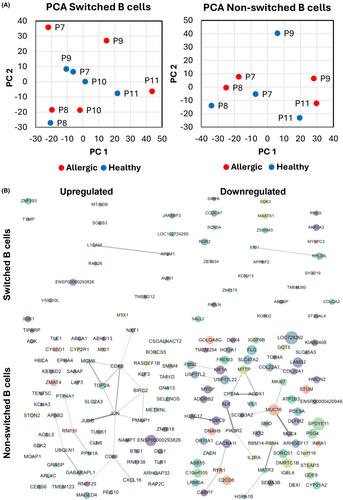
Allergy is a globally spread affliction that is based on dysregulation of immune responses towards ‘harmless’ antigens.1 B cells and their regulation are also involved in mechanisms of allergic diseases.2, 3 They produce the IgE essential for allergen-induced mast cell and basophil degranulation.4 The common consensus is that the regulation of B cells is closely tied to tolerance and allergy.2, 5 In allergy, this regulation is likely dysfunctional, resulting in different B-cell behaviours. Therefore, we suspected that B cells from allergic individuals may differ in their class-switching potential or process, making them more prone to IgE class-switching and allergies. We hypothesized that there would be significantly different expressions in pathways related to B-cell activation, B-cell regulation or B-cell isotype switching correlating to allergic symptoms. We had 16 twin pairs that were either healthy, allergy discordant or allergy concordant (Tables S1–S4). The donors were monozygotic and mainly allergic to timothy grass, birch tree pollen and/or house dust mites; none had taken or were on allergen-immunotherapy. We sorted switched and unswitched B cells (Figure S1) from bio-banked PBMCs, extracted RNA, depleted the ribosomal RNA, and performed 100 bp single-end RNA sequencing on the Illumina Novaseq 6000 platform.6 Unbiased clustering of samples (Figure 1A), excluding long non-coding RNA, showed that the main influences for clustering in descending order are switched versus non-switched B cells, twin pairs and then their concordance status. The degree of clustering by concordance status varies, yet there is no clustering by allergy within the discordance clusters in both switched and non-switched B cells, suggesting that it is a confounding factor. An individuals' allergy status had little to no significant impact on the overall clustering. The same holds true for the PCA analysis of the top 300 significant genes of switched B cells, while non-switched B cells are separated by gender (Figure 1B). Comparing healthy concordant to allergy concordant twins could be greatly influenced by confounding factors like twin pair similarities and grouping by concordance instead of their actual health status. Therefore, we compared the healthy versus allergic within the discordant twin pairs to avoid these influences for gene expression analysis. In this comparison, neither switched nor non-switched B cells show pathways that would traditionally be associated with allergies or B-cell regulation (Table S5). A log fold change of greater than 0.5 and a p-value of .05 gave a FDR of 0.9999. Adjusting for an FDR below 0.05 (p-value <.00001) resulted in no differentially expressed genes for switched and five genes without a common pathway in non-switched B cells. Using these parameters, we did not find significant differences in pathway regulations on the wider scale of B cells between allergy-discordant twins.
PCA analysis for the top 300 genes by the p-value of the allergy-discordant twins confirmed that allergic versus healthy twins do not group by allergy status (Figure 2A). Pathway analysis of the top genes in allergy-discordant twins does not reveal any cohesive pathways (allergy vs. healthy) in the switched B cells (Figure 2B). One pathway in the non-switched B cells upregulated genes, is associated with the cell cycle but not directly with immune functions.
Our results show no indication that there is a general dysregulation of B cells as an underlying cause for allergies. Any differences that might exist are too subtle to be observed across B cells. We propose that distinctions between allergic and non-allergic individuals may only be noticeable in allergen-specific B cells. These effects are probably overshadowed by the variability among individuals due to the rarity of allergen-specific B cells in the overall B-cell population. Since the study focused on PBMCs, tissue-resident B cells may exhibit different properties.
M.A. conceived and designed the study. K.N. and I.C. provided the samples for the study S.S. M.A. and W.V. planned the experiments. S.S. performed the experiments. P.S., M.Y. helped with the experiments. H.B. helped with the bioinformatics and graphics. S.S. wrote the manuscript. K.N., W.V. and M.A. reviewed the manuscript.
This study was supported by funding from the Swiss National Science Funds (#31003–201053/320030–159870 to M.A.) and FreeNovation grant from the Novartis Research Foundation (to W.V.).
The authors declare no conflict of interest in relation to this work.
期刊介绍:
Allergy is an international and multidisciplinary journal that aims to advance, impact, and communicate all aspects of the discipline of Allergy/Immunology. It publishes original articles, reviews, position papers, guidelines, editorials, news and commentaries, letters to the editors, and correspondences. The journal accepts articles based on their scientific merit and quality.
Allergy seeks to maintain contact between basic and clinical Allergy/Immunology and encourages contributions from contributors and readers from all countries. In addition to its publication, Allergy also provides abstracting and indexing information. Some of the databases that include Allergy abstracts are Abstracts on Hygiene & Communicable Disease, Academic Search Alumni Edition, AgBiotech News & Information, AGRICOLA Database, Biological Abstracts, PubMed Dietary Supplement Subset, and Global Health, among others.





 京公网安备 11010802042870号
京ICP备2023020795号-1
京公网安备 11010802042870号
京ICP备2023020795号-1

 分享
分享
 求助内容:
求助内容: 应助结果提醒方式:
 扫码关注我们
