{"title":"极端条件下微生物对复合材料导电性的影响","authors":"I. G. Kalinina, S. A. Semenov, V. B. Ivanov","doi":"10.1134/S1070363224090305","DOIUrl":null,"url":null,"abstract":"<p>It has been established that the variation in the conductance of insulation made with materials of various chemical nature and physical structure (polyvinyl chloride plastic compound and varnished cambric) with a short-term exposure to a mold fungus has an S-shaped character. The unambiguous correlation of the induction period, the stage of rapid increase and the time to reach the quasi-stationary level of conductance with the induction period, the stage of rapid growth, the time to reach the maximum amount of biomass on the surface of the material is due to the sorption by isolation of the metabolic products of the mold fungus. The variation in conductance at short times of exposure to microorganisms (~ 1 month) is reversible. Removal of microorganisms from the surface leads to a decrease in conductance to its original level. With their longer exposure (~ 1 year), the change in conductance may become irreversible as a result of the biochemical decomposition of insulation components, in particular, dialkyl phthalates - polyvinyl chloride plasticizers. Features of the processes of changes in conductance are due to the duration of the growth of microorganisms, the nature of materials and their components. The growth of microorganisms depends primarily on temperature and humidity conditions. For materials with high water absorption (varnished cambric), the most important external factor is temperature, and for materials with low water absorption (polyvinyl chloride) – relative humidity.</p>","PeriodicalId":761,"journal":{"name":"Russian Journal of General Chemistry","volume":"94 9","pages":"2534 - 2537"},"PeriodicalIF":0.8000,"publicationDate":"2024-10-29","publicationTypes":"Journal Article","fieldsOfStudy":null,"isOpenAccess":false,"openAccessPdf":"","citationCount":"0","resultStr":"{\"title\":\"Influence of Microorganisms on the Electrical Conductivity of Composite Materials Under Extreme Conditions\",\"authors\":\"I. G. Kalinina, S. A. Semenov, V. B. Ivanov\",\"doi\":\"10.1134/S1070363224090305\",\"DOIUrl\":null,\"url\":null,\"abstract\":\"<p>It has been established that the variation in the conductance of insulation made with materials of various chemical nature and physical structure (polyvinyl chloride plastic compound and varnished cambric) with a short-term exposure to a mold fungus has an S-shaped character. The unambiguous correlation of the induction period, the stage of rapid increase and the time to reach the quasi-stationary level of conductance with the induction period, the stage of rapid growth, the time to reach the maximum amount of biomass on the surface of the material is due to the sorption by isolation of the metabolic products of the mold fungus. The variation in conductance at short times of exposure to microorganisms (~ 1 month) is reversible. Removal of microorganisms from the surface leads to a decrease in conductance to its original level. With their longer exposure (~ 1 year), the change in conductance may become irreversible as a result of the biochemical decomposition of insulation components, in particular, dialkyl phthalates - polyvinyl chloride plasticizers. Features of the processes of changes in conductance are due to the duration of the growth of microorganisms, the nature of materials and their components. The growth of microorganisms depends primarily on temperature and humidity conditions. For materials with high water absorption (varnished cambric), the most important external factor is temperature, and for materials with low water absorption (polyvinyl chloride) – relative humidity.</p>\",\"PeriodicalId\":761,\"journal\":{\"name\":\"Russian Journal of General Chemistry\",\"volume\":\"94 9\",\"pages\":\"2534 - 2537\"},\"PeriodicalIF\":0.8000,\"publicationDate\":\"2024-10-29\",\"publicationTypes\":\"Journal Article\",\"fieldsOfStudy\":null,\"isOpenAccess\":false,\"openAccessPdf\":\"\",\"citationCount\":\"0\",\"resultStr\":null,\"platform\":\"Semanticscholar\",\"paperid\":null,\"PeriodicalName\":\"Russian Journal of General Chemistry\",\"FirstCategoryId\":\"92\",\"ListUrlMain\":\"https://link.springer.com/article/10.1134/S1070363224090305\",\"RegionNum\":4,\"RegionCategory\":\"化学\",\"ArticlePicture\":[],\"TitleCN\":null,\"AbstractTextCN\":null,\"PMCID\":null,\"EPubDate\":\"\",\"PubModel\":\"\",\"JCR\":\"Q4\",\"JCRName\":\"CHEMISTRY, MULTIDISCIPLINARY\",\"Score\":null,\"Total\":0}","platform":"Semanticscholar","paperid":null,"PeriodicalName":"Russian Journal of General Chemistry","FirstCategoryId":"92","ListUrlMain":"https://link.springer.com/article/10.1134/S1070363224090305","RegionNum":4,"RegionCategory":"化学","ArticlePicture":[],"TitleCN":null,"AbstractTextCN":null,"PMCID":null,"EPubDate":"","PubModel":"","JCR":"Q4","JCRName":"CHEMISTRY, MULTIDISCIPLINARY","Score":null,"Total":0}
引用次数: 0
摘要
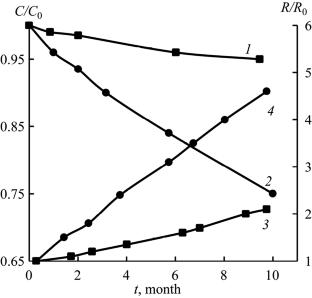
研究证实,用不同化学性质和物理结构的材料(聚氯乙烯塑料复合物和涂漆羊毛织物)制成的绝缘层在霉菌的短期暴露下,其电导率的变化呈 S 型。诱导期、快速增长阶段和电导率达到准稳定水平的时间与诱导期、快速增长阶段和材料表面生物量达到最大值的时间之间存在明确的相关性,这是由于霉菌的代谢产物被分离吸附所致。在短时间(约 1 个月)接触微生物后,电导率的变化是可逆的。从表面清除微生物后,电导率会下降到原来的水平。如果接触时间较长(约 1 年),由于绝缘成分(尤其是二烷基邻苯二甲酸酯--聚氯乙烯增塑剂)的生化分解,电导率的变化可能变得不可逆。电导率变化过程的特点取决于微生物生长的持续时间、材料及其成分的性质。微生物的生长主要取决于温度和湿度条件。对于吸水性强的材料(上光羊皮),最重要的外部因素是温度,而对于吸水性弱的材料 (聚氯乙烯),最重要的外部因素是相对湿度。
Influence of Microorganisms on the Electrical Conductivity of Composite Materials Under Extreme Conditions
It has been established that the variation in the conductance of insulation made with materials of various chemical nature and physical structure (polyvinyl chloride plastic compound and varnished cambric) with a short-term exposure to a mold fungus has an S-shaped character. The unambiguous correlation of the induction period, the stage of rapid increase and the time to reach the quasi-stationary level of conductance with the induction period, the stage of rapid growth, the time to reach the maximum amount of biomass on the surface of the material is due to the sorption by isolation of the metabolic products of the mold fungus. The variation in conductance at short times of exposure to microorganisms (~ 1 month) is reversible. Removal of microorganisms from the surface leads to a decrease in conductance to its original level. With their longer exposure (~ 1 year), the change in conductance may become irreversible as a result of the biochemical decomposition of insulation components, in particular, dialkyl phthalates - polyvinyl chloride plasticizers. Features of the processes of changes in conductance are due to the duration of the growth of microorganisms, the nature of materials and their components. The growth of microorganisms depends primarily on temperature and humidity conditions. For materials with high water absorption (varnished cambric), the most important external factor is temperature, and for materials with low water absorption (polyvinyl chloride) – relative humidity.
期刊介绍:
Russian Journal of General Chemistry is a journal that covers many problems that are of general interest to the whole community of chemists. The journal is the successor to Russia’s first chemical journal, Zhurnal Russkogo Khimicheskogo Obshchestva (Journal of the Russian Chemical Society ) founded in 1869 to cover all aspects of chemistry. Now the journal is focused on the interdisciplinary areas of chemistry (organometallics, organometalloids, organoinorganic complexes, mechanochemistry, nanochemistry, etc.), new achievements and long-term results in the field. The journal publishes reviews, current scientific papers, letters to the editor, and discussion papers.




 京公网安备 11010802042870号
京ICP备2023020795号-1
京公网安备 11010802042870号
京ICP备2023020795号-1

 分享
分享
 求助内容:
求助内容: 应助结果提醒方式:
 扫码关注我们
