Yanjun Lu , Mengqi Wang , Yiwen Yang , Qiukai Tang , Yanbo Zeng , Hailong Wang , Lijie Zhang , Chengrui Pan , Changkun Hu , Zhuowei Fu , Lei Li
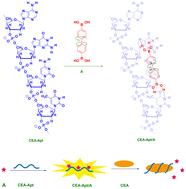
{"title":"基于聚集诱导的发射增强效应检测癌胚抗原","authors":"Yanjun Lu , Mengqi Wang , Yiwen Yang , Qiukai Tang , Yanbo Zeng , Hailong Wang , Lijie Zhang , Chengrui Pan , Changkun Hu , Zhuowei Fu , Lei Li","doi":"10.1039/d4cc04544k","DOIUrl":null,"url":null,"abstract":"<div><div>In this study, a novel label-free fluorescent aptasensor with an aggregation-induced emission enhancement effect was developed and applied for the detection of carcinoembryonic antigen (CEA). The sensor has a simple detection mechanism, easy operation, high sensitivity (with low limit of detection of 1 pg mL<sup>−1</sup>), good selectivity, and wide linear range (0.003–10 ng mL<sup>−1</sup>). In addition, it can be directly applied for the determination of CEA in human serum.</div></div>","PeriodicalId":67,"journal":{"name":"Chemical Communications","volume":"60 92","pages":"Pages 13570-13573"},"PeriodicalIF":4.2000,"publicationDate":"2024-10-25","publicationTypes":"Journal Article","fieldsOfStudy":null,"isOpenAccess":false,"openAccessPdf":"","citationCount":"0","resultStr":"{\"title\":\"Detecting carcinoembryonic antigen based on the aggregation-induced emission enhancement effect†\",\"authors\":\"Yanjun Lu , Mengqi Wang , Yiwen Yang , Qiukai Tang , Yanbo Zeng , Hailong Wang , Lijie Zhang , Chengrui Pan , Changkun Hu , Zhuowei Fu , Lei Li\",\"doi\":\"10.1039/d4cc04544k\",\"DOIUrl\":null,\"url\":null,\"abstract\":\"<div><div>In this study, a novel label-free fluorescent aptasensor with an aggregation-induced emission enhancement effect was developed and applied for the detection of carcinoembryonic antigen (CEA). The sensor has a simple detection mechanism, easy operation, high sensitivity (with low limit of detection of 1 pg mL<sup>−1</sup>), good selectivity, and wide linear range (0.003–10 ng mL<sup>−1</sup>). In addition, it can be directly applied for the determination of CEA in human serum.</div></div>\",\"PeriodicalId\":67,\"journal\":{\"name\":\"Chemical Communications\",\"volume\":\"60 92\",\"pages\":\"Pages 13570-13573\"},\"PeriodicalIF\":4.2000,\"publicationDate\":\"2024-10-25\",\"publicationTypes\":\"Journal Article\",\"fieldsOfStudy\":null,\"isOpenAccess\":false,\"openAccessPdf\":\"\",\"citationCount\":\"0\",\"resultStr\":null,\"platform\":\"Semanticscholar\",\"paperid\":null,\"PeriodicalName\":\"Chemical Communications\",\"FirstCategoryId\":\"92\",\"ListUrlMain\":\"https://www.sciencedirect.com/org/science/article/pii/S135973452402233X\",\"RegionNum\":2,\"RegionCategory\":\"化学\",\"ArticlePicture\":[],\"TitleCN\":null,\"AbstractTextCN\":null,\"PMCID\":null,\"EPubDate\":\"2024/10/24 0:00:00\",\"PubModel\":\"Epub\",\"JCR\":\"Q2\",\"JCRName\":\"CHEMISTRY, MULTIDISCIPLINARY\",\"Score\":null,\"Total\":0}","platform":"Semanticscholar","paperid":null,"PeriodicalName":"Chemical Communications","FirstCategoryId":"92","ListUrlMain":"https://www.sciencedirect.com/org/science/article/pii/S135973452402233X","RegionNum":2,"RegionCategory":"化学","ArticlePicture":[],"TitleCN":null,"AbstractTextCN":null,"PMCID":null,"EPubDate":"2024/10/24 0:00:00","PubModel":"Epub","JCR":"Q2","JCRName":"CHEMISTRY, MULTIDISCIPLINARY","Score":null,"Total":0}
引用次数: 0
摘要
本研究开发了一种具有聚集诱导发射增强效应的新型无标记荧光诱导传感器,并将其应用于检测癌胚抗原(CEA)。该传感器检测机制简单、操作方便、灵敏度高(检测限低至 1 pg mL-1)、选择性好、线性范围宽(0.003-10 ng mL-1)。此外,它还可直接用于人体血清中 CEA 的检测。
Detecting carcinoembryonic antigen based on the aggregation-induced emission enhancement effect†
In this study, a novel label-free fluorescent aptasensor with an aggregation-induced emission enhancement effect was developed and applied for the detection of carcinoembryonic antigen (CEA). The sensor has a simple detection mechanism, easy operation, high sensitivity (with low limit of detection of 1 pg mL−1), good selectivity, and wide linear range (0.003–10 ng mL−1). In addition, it can be directly applied for the determination of CEA in human serum.
期刊介绍:
ChemComm (Chemical Communications) is renowned as the fastest publisher of articles providing information on new avenues of research, drawn from all the world''s major areas of chemical research.




 京公网安备 11010802042870号
京ICP备2023020795号-1
京公网安备 11010802042870号
京ICP备2023020795号-1

 分享
分享
 求助内容:
求助内容: 应助结果提醒方式:
 扫码关注我们
