{"title":"凝聚蛋白复合物寡聚化可维持 DNA 双链断裂处的末端拴系","authors":"Jamie Phipps, Mathias Toulouze, Cécile Ducrot, Rafaël Costa, Clémentine Brocas, Karine Dubrana","doi":"10.1038/s41556-024-01552-2","DOIUrl":null,"url":null,"abstract":"DNA double-strand breaks (DSBs) must be repaired to ensure genome stability. Crucially, DSB-ends must be kept together for timely repair. In Saccharomyces cerevisiae, two pathways mediate DSB end-tethering. One employs the Mre11–Rad50–Xrs2 (MRX) complex to physically bridge DSB-ends. Another requires the conversion of DSB-ends into single-strand DNA (ssDNA) by Exo1, but the bridging proteins are unknown. We uncover that cohesin, its loader and Smc5/6 act with Exo1 to tether DSB-ends. Remarkably, cohesin specifically impaired in oligomerization fails to tether DSB-ends, revealing a function for cohesin oligomerization. In addition to the known importance of sister chromatid cohesion, microscopy-based microfluidic experiments unveil a role for cohesin in repair by ensuring DSB end-tethering. Altogether, our findings demonstrate that oligomerization of cohesin prevents DSB end-separation and promotes DSB repair, revealing a previously undescribed mode of action and role for cohesin in safeguarding genome integrity. Phipps et al. report a cohesin-dependent double-strand break (DSB) DNA end-tethering mechanism that requires Exo1 and SMC5/6 in budding yeast. They show that cohesin oligomerization promotes DSB end-tethering and repair, safeguarding genomic integrity.","PeriodicalId":18977,"journal":{"name":"Nature Cell Biology","volume":"27 1","pages":"118-129"},"PeriodicalIF":22.7000,"publicationDate":"2024-10-31","publicationTypes":"Journal Article","fieldsOfStudy":null,"isOpenAccess":false,"openAccessPdf":"https://www.nature.com/articles/s41556-024-01552-2.pdf","citationCount":"0","resultStr":"{\"title\":\"Cohesin complex oligomerization maintains end-tethering at DNA double-strand breaks\",\"authors\":\"Jamie Phipps, Mathias Toulouze, Cécile Ducrot, Rafaël Costa, Clémentine Brocas, Karine Dubrana\",\"doi\":\"10.1038/s41556-024-01552-2\",\"DOIUrl\":null,\"url\":null,\"abstract\":\"DNA double-strand breaks (DSBs) must be repaired to ensure genome stability. Crucially, DSB-ends must be kept together for timely repair. In Saccharomyces cerevisiae, two pathways mediate DSB end-tethering. One employs the Mre11–Rad50–Xrs2 (MRX) complex to physically bridge DSB-ends. Another requires the conversion of DSB-ends into single-strand DNA (ssDNA) by Exo1, but the bridging proteins are unknown. We uncover that cohesin, its loader and Smc5/6 act with Exo1 to tether DSB-ends. Remarkably, cohesin specifically impaired in oligomerization fails to tether DSB-ends, revealing a function for cohesin oligomerization. In addition to the known importance of sister chromatid cohesion, microscopy-based microfluidic experiments unveil a role for cohesin in repair by ensuring DSB end-tethering. Altogether, our findings demonstrate that oligomerization of cohesin prevents DSB end-separation and promotes DSB repair, revealing a previously undescribed mode of action and role for cohesin in safeguarding genome integrity. Phipps et al. report a cohesin-dependent double-strand break (DSB) DNA end-tethering mechanism that requires Exo1 and SMC5/6 in budding yeast. They show that cohesin oligomerization promotes DSB end-tethering and repair, safeguarding genomic integrity.\",\"PeriodicalId\":18977,\"journal\":{\"name\":\"Nature Cell Biology\",\"volume\":\"27 1\",\"pages\":\"118-129\"},\"PeriodicalIF\":22.7000,\"publicationDate\":\"2024-10-31\",\"publicationTypes\":\"Journal Article\",\"fieldsOfStudy\":null,\"isOpenAccess\":false,\"openAccessPdf\":\"https://www.nature.com/articles/s41556-024-01552-2.pdf\",\"citationCount\":\"0\",\"resultStr\":null,\"platform\":\"Semanticscholar\",\"paperid\":null,\"PeriodicalName\":\"Nature Cell Biology\",\"FirstCategoryId\":\"99\",\"ListUrlMain\":\"https://www.nature.com/articles/s41556-024-01552-2\",\"RegionNum\":1,\"RegionCategory\":\"生物学\",\"ArticlePicture\":[],\"TitleCN\":null,\"AbstractTextCN\":null,\"PMCID\":null,\"EPubDate\":\"\",\"PubModel\":\"\",\"JCR\":\"Q1\",\"JCRName\":\"CELL BIOLOGY\",\"Score\":null,\"Total\":0}","platform":"Semanticscholar","paperid":null,"PeriodicalName":"Nature Cell Biology","FirstCategoryId":"99","ListUrlMain":"https://www.nature.com/articles/s41556-024-01552-2","RegionNum":1,"RegionCategory":"生物学","ArticlePicture":[],"TitleCN":null,"AbstractTextCN":null,"PMCID":null,"EPubDate":"","PubModel":"","JCR":"Q1","JCRName":"CELL BIOLOGY","Score":null,"Total":0}
Cohesin complex oligomerization maintains end-tethering at DNA double-strand breaks
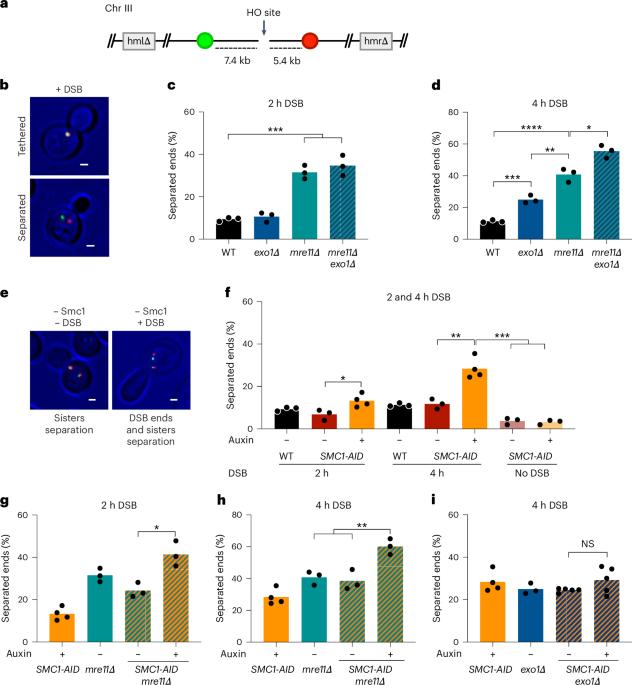
DNA double-strand breaks (DSBs) must be repaired to ensure genome stability. Crucially, DSB-ends must be kept together for timely repair. In Saccharomyces cerevisiae, two pathways mediate DSB end-tethering. One employs the Mre11–Rad50–Xrs2 (MRX) complex to physically bridge DSB-ends. Another requires the conversion of DSB-ends into single-strand DNA (ssDNA) by Exo1, but the bridging proteins are unknown. We uncover that cohesin, its loader and Smc5/6 act with Exo1 to tether DSB-ends. Remarkably, cohesin specifically impaired in oligomerization fails to tether DSB-ends, revealing a function for cohesin oligomerization. In addition to the known importance of sister chromatid cohesion, microscopy-based microfluidic experiments unveil a role for cohesin in repair by ensuring DSB end-tethering. Altogether, our findings demonstrate that oligomerization of cohesin prevents DSB end-separation and promotes DSB repair, revealing a previously undescribed mode of action and role for cohesin in safeguarding genome integrity. Phipps et al. report a cohesin-dependent double-strand break (DSB) DNA end-tethering mechanism that requires Exo1 and SMC5/6 in budding yeast. They show that cohesin oligomerization promotes DSB end-tethering and repair, safeguarding genomic integrity.
期刊介绍:
Nature Cell Biology, a prestigious journal, upholds a commitment to publishing papers of the highest quality across all areas of cell biology, with a particular focus on elucidating mechanisms underlying fundamental cell biological processes. The journal's broad scope encompasses various areas of interest, including but not limited to:
-Autophagy
-Cancer biology
-Cell adhesion and migration
-Cell cycle and growth
-Cell death
-Chromatin and epigenetics
-Cytoskeletal dynamics
-Developmental biology
-DNA replication and repair
-Mechanisms of human disease
-Mechanobiology
-Membrane traffic and dynamics
-Metabolism
-Nuclear organization and dynamics
-Organelle biology
-Proteolysis and quality control
-RNA biology
-Signal transduction
-Stem cell biology




 京公网安备 11010802042870号
京ICP备2023020795号-1
京公网安备 11010802042870号
京ICP备2023020795号-1

 分享
分享
 求助内容:
求助内容: 应助结果提醒方式:
 扫码关注我们
