{"title":"具有可调荧光和紫外线屏蔽功能的生物基聚氨酯复合材料,用于防伪和紫外线防护。","authors":"Mengyao Zhai, Tao Shou, Dexian Yin, Zhi Chen, Yaowen Wu, Yue Liu, Xiuying Zhao, Shikai Hu, Liqun Zhang","doi":"10.1021/acsami.4c12183","DOIUrl":null,"url":null,"abstract":"<p><p>Polyurethane and its composites play an important role in innovative packing materials including anticounterfeiting and ultraviolet protection, however, they are mainly derived from petroleum resources that are not sustainable. In this study, a 100% biobased thermoplastic polyurethane (Bio-TPU) was synthesized using biobased poly(trimethylene ether) glycol, pentamethylene disocyanate, and 1,4-butanediol. Subsequently, biobased tannic acid (TA) was employed to prepare biobased composites. The structures and properties of Bio-TPU and its composites were systematically evaluated. The results showed that the Bio-TPU/TA composite films had excellent and controllable fluorescence and UV-shielding properties. The fluorescence colors of the Bio-TPU/TA composite films could be adjusted to blue, green, and yellow by varying the TA content and adding coupling agents. Moreover, the UV transmittance of the Bio-TPU/TA composites decreased from 79.25 to 5.43% below 400 nm with an increasing TA content, indicating an excellent ultraviolet-barrier performance. Consequently, biobased TPU/TA composite films can be utilized as innovative anticounterfeiting materials and UV-shielding protection films. This study is expected to facilitate sustainable development in the polyurethane industry and broaden the high-end applications of polyurethane such as fashion, electronics, food manufacturing, pharmaceuticals, and finance.</p>","PeriodicalId":5,"journal":{"name":"ACS Applied Materials & Interfaces","volume":" ","pages":"62606-62616"},"PeriodicalIF":8.2000,"publicationDate":"2024-11-13","publicationTypes":"Journal Article","fieldsOfStudy":null,"isOpenAccess":false,"openAccessPdf":"","citationCount":"0","resultStr":"{\"title\":\"Bio-Based Polyurethane Composites with Adjustable Fluorescence and Ultraviolet Shielding for Anti-Counterfeiting and Ultraviolet Protection.\",\"authors\":\"Mengyao Zhai, Tao Shou, Dexian Yin, Zhi Chen, Yaowen Wu, Yue Liu, Xiuying Zhao, Shikai Hu, Liqun Zhang\",\"doi\":\"10.1021/acsami.4c12183\",\"DOIUrl\":null,\"url\":null,\"abstract\":\"<p><p>Polyurethane and its composites play an important role in innovative packing materials including anticounterfeiting and ultraviolet protection, however, they are mainly derived from petroleum resources that are not sustainable. In this study, a 100% biobased thermoplastic polyurethane (Bio-TPU) was synthesized using biobased poly(trimethylene ether) glycol, pentamethylene disocyanate, and 1,4-butanediol. Subsequently, biobased tannic acid (TA) was employed to prepare biobased composites. The structures and properties of Bio-TPU and its composites were systematically evaluated. The results showed that the Bio-TPU/TA composite films had excellent and controllable fluorescence and UV-shielding properties. The fluorescence colors of the Bio-TPU/TA composite films could be adjusted to blue, green, and yellow by varying the TA content and adding coupling agents. Moreover, the UV transmittance of the Bio-TPU/TA composites decreased from 79.25 to 5.43% below 400 nm with an increasing TA content, indicating an excellent ultraviolet-barrier performance. Consequently, biobased TPU/TA composite films can be utilized as innovative anticounterfeiting materials and UV-shielding protection films. This study is expected to facilitate sustainable development in the polyurethane industry and broaden the high-end applications of polyurethane such as fashion, electronics, food manufacturing, pharmaceuticals, and finance.</p>\",\"PeriodicalId\":5,\"journal\":{\"name\":\"ACS Applied Materials & Interfaces\",\"volume\":\" \",\"pages\":\"62606-62616\"},\"PeriodicalIF\":8.2000,\"publicationDate\":\"2024-11-13\",\"publicationTypes\":\"Journal Article\",\"fieldsOfStudy\":null,\"isOpenAccess\":false,\"openAccessPdf\":\"\",\"citationCount\":\"0\",\"resultStr\":null,\"platform\":\"Semanticscholar\",\"paperid\":null,\"PeriodicalName\":\"ACS Applied Materials & Interfaces\",\"FirstCategoryId\":\"88\",\"ListUrlMain\":\"https://doi.org/10.1021/acsami.4c12183\",\"RegionNum\":2,\"RegionCategory\":\"材料科学\",\"ArticlePicture\":[],\"TitleCN\":null,\"AbstractTextCN\":null,\"PMCID\":null,\"EPubDate\":\"2024/11/1 0:00:00\",\"PubModel\":\"Epub\",\"JCR\":\"Q1\",\"JCRName\":\"MATERIALS SCIENCE, MULTIDISCIPLINARY\",\"Score\":null,\"Total\":0}","platform":"Semanticscholar","paperid":null,"PeriodicalName":"ACS Applied Materials & Interfaces","FirstCategoryId":"88","ListUrlMain":"https://doi.org/10.1021/acsami.4c12183","RegionNum":2,"RegionCategory":"材料科学","ArticlePicture":[],"TitleCN":null,"AbstractTextCN":null,"PMCID":null,"EPubDate":"2024/11/1 0:00:00","PubModel":"Epub","JCR":"Q1","JCRName":"MATERIALS SCIENCE, MULTIDISCIPLINARY","Score":null,"Total":0}
引用次数: 0
摘要
聚氨酯及其复合材料在防伪和防紫外线等创新包装材料中发挥着重要作用,但它们主要来自石油资源,不具有可持续性。本研究使用生物基聚三亚甲基醚乙二醇、五亚甲基二氰酸酯和 1,4-丁二醇合成了 100% 生物基热塑性聚氨酯(Bio-TPU)。随后,采用生物基单宁酸(TA)制备生物基复合材料。对生物热塑性聚氨酯及其复合材料的结构和性能进行了系统评价。结果表明,Bio-TPU/TA 复合薄膜具有优异的可控荧光和紫外线屏蔽性能。通过改变 TA 的含量和添加偶联剂,可以将 Bio-TPU/TA 复合薄膜的荧光颜色调整为蓝色、绿色和黄色。此外,随着 TA 含量的增加,Bio-TPU/TA 复合材料在 400 纳米以下的紫外线透过率从 79.25% 降至 5.43%,表明其具有优异的紫外线阻隔性能。因此,生物基热塑性聚氨酯/TA 复合薄膜可用作创新型防伪材料和紫外线屏蔽保护膜。这项研究有望促进聚氨酯行业的可持续发展,并拓宽聚氨酯在时尚、电子、食品制造、制药和金融等领域的高端应用。
Bio-Based Polyurethane Composites with Adjustable Fluorescence and Ultraviolet Shielding for Anti-Counterfeiting and Ultraviolet Protection.
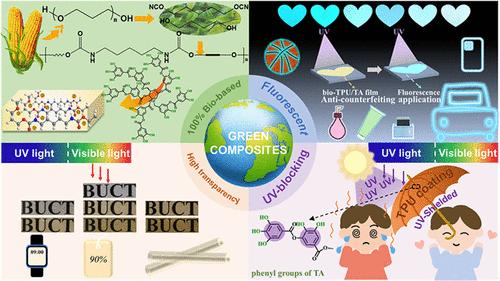
Polyurethane and its composites play an important role in innovative packing materials including anticounterfeiting and ultraviolet protection, however, they are mainly derived from petroleum resources that are not sustainable. In this study, a 100% biobased thermoplastic polyurethane (Bio-TPU) was synthesized using biobased poly(trimethylene ether) glycol, pentamethylene disocyanate, and 1,4-butanediol. Subsequently, biobased tannic acid (TA) was employed to prepare biobased composites. The structures and properties of Bio-TPU and its composites were systematically evaluated. The results showed that the Bio-TPU/TA composite films had excellent and controllable fluorescence and UV-shielding properties. The fluorescence colors of the Bio-TPU/TA composite films could be adjusted to blue, green, and yellow by varying the TA content and adding coupling agents. Moreover, the UV transmittance of the Bio-TPU/TA composites decreased from 79.25 to 5.43% below 400 nm with an increasing TA content, indicating an excellent ultraviolet-barrier performance. Consequently, biobased TPU/TA composite films can be utilized as innovative anticounterfeiting materials and UV-shielding protection films. This study is expected to facilitate sustainable development in the polyurethane industry and broaden the high-end applications of polyurethane such as fashion, electronics, food manufacturing, pharmaceuticals, and finance.
期刊介绍:
ACS Applied Materials & Interfaces is a leading interdisciplinary journal that brings together chemists, engineers, physicists, and biologists to explore the development and utilization of newly-discovered materials and interfacial processes for specific applications. Our journal has experienced remarkable growth since its establishment in 2009, both in terms of the number of articles published and the impact of the research showcased. We are proud to foster a truly global community, with the majority of published articles originating from outside the United States, reflecting the rapid growth of applied research worldwide.




 京公网安备 11010802042870号
京ICP备2023020795号-1
京公网安备 11010802042870号
京ICP备2023020795号-1

 分享
分享
 求助内容:
求助内容: 应助结果提醒方式:
 扫码关注我们
