Qianyi Chen, Zhenjie Lun, Dongdan Chen, Yongsheng Sun, Puxian Xiong, Siyun Li, Shanhui Xu and Zhongmin Yang
{"title":"用于高效单组分 pc-WLED 的新型超宽带可见光石榴石荧光粉","authors":"Qianyi Chen, Zhenjie Lun, Dongdan Chen, Yongsheng Sun, Puxian Xiong, Siyun Li, Shanhui Xu and Zhongmin Yang","doi":"10.1039/D4QI01824A","DOIUrl":null,"url":null,"abstract":"<p >The development of extra-broadband visible emission phosphors is crucial to achieve next-generation illumination with better color experience. Herein, a defect engineering strategy mediated by the structural cationic substitution is proposed and experimentally demonstrated for specific ultra-broadband emission in a garnet phosphor. The induced oxygen vacancies and interstitial cation through lattice distortion break the periodic potential field of the crystal and provide electronic levels in the band gap. As a result, excited by blue-light-emitting diodes, the novel Y<small><sub>3</sub></small>Sc<small><sub>2</sub></small>Al<small><sub>3</sub></small>O<small><sub>12</sub></small>:B<small><sup>3+</sup></small> shows an ultra-broad emission with a full width at half maximum (FWHM) of ∼170 nm. Compared to general defect-emitting phosphors, the unique Y<small><sub>3</sub></small>Sc<small><sub>2</sub></small>Al<small><sub>3</sub></small>O<small><sub>12</sub></small>:B<small><sup>3+</sup></small> exhibits excellent thermal quenching resistance and superior internal quantum efficiency of up to 95%. These findings not only show great promise of Y<small><sub>3</sub></small>Sc<small><sub>2</sub></small>Al<small><sub>3</sub></small>O<small><sub>12</sub></small>:B<small><sup>3+</sup></small> as an extra-broadband emitter but also provide a new design strategy to achieve a full-visible-spectrum phosphor in a single-component material for white-light applications.</p>","PeriodicalId":79,"journal":{"name":"Inorganic Chemistry Frontiers","volume":" 23","pages":" 8547-8554"},"PeriodicalIF":6.2000,"publicationDate":"2024-11-01","publicationTypes":"Journal Article","fieldsOfStudy":null,"isOpenAccess":false,"openAccessPdf":"","citationCount":"0","resultStr":"{\"title\":\"A novel extra-broadband visible-emitting garnet phosphor for efficient single-component pc-WLEDs†\",\"authors\":\"Qianyi Chen, Zhenjie Lun, Dongdan Chen, Yongsheng Sun, Puxian Xiong, Siyun Li, Shanhui Xu and Zhongmin Yang\",\"doi\":\"10.1039/D4QI01824A\",\"DOIUrl\":null,\"url\":null,\"abstract\":\"<p >The development of extra-broadband visible emission phosphors is crucial to achieve next-generation illumination with better color experience. Herein, a defect engineering strategy mediated by the structural cationic substitution is proposed and experimentally demonstrated for specific ultra-broadband emission in a garnet phosphor. The induced oxygen vacancies and interstitial cation through lattice distortion break the periodic potential field of the crystal and provide electronic levels in the band gap. As a result, excited by blue-light-emitting diodes, the novel Y<small><sub>3</sub></small>Sc<small><sub>2</sub></small>Al<small><sub>3</sub></small>O<small><sub>12</sub></small>:B<small><sup>3+</sup></small> shows an ultra-broad emission with a full width at half maximum (FWHM) of ∼170 nm. Compared to general defect-emitting phosphors, the unique Y<small><sub>3</sub></small>Sc<small><sub>2</sub></small>Al<small><sub>3</sub></small>O<small><sub>12</sub></small>:B<small><sup>3+</sup></small> exhibits excellent thermal quenching resistance and superior internal quantum efficiency of up to 95%. These findings not only show great promise of Y<small><sub>3</sub></small>Sc<small><sub>2</sub></small>Al<small><sub>3</sub></small>O<small><sub>12</sub></small>:B<small><sup>3+</sup></small> as an extra-broadband emitter but also provide a new design strategy to achieve a full-visible-spectrum phosphor in a single-component material for white-light applications.</p>\",\"PeriodicalId\":79,\"journal\":{\"name\":\"Inorganic Chemistry Frontiers\",\"volume\":\" 23\",\"pages\":\" 8547-8554\"},\"PeriodicalIF\":6.2000,\"publicationDate\":\"2024-11-01\",\"publicationTypes\":\"Journal Article\",\"fieldsOfStudy\":null,\"isOpenAccess\":false,\"openAccessPdf\":\"\",\"citationCount\":\"0\",\"resultStr\":null,\"platform\":\"Semanticscholar\",\"paperid\":null,\"PeriodicalName\":\"Inorganic Chemistry Frontiers\",\"FirstCategoryId\":\"92\",\"ListUrlMain\":\"https://pubs.rsc.org/en/content/articlelanding/2024/qi/d4qi01824a\",\"RegionNum\":1,\"RegionCategory\":\"化学\",\"ArticlePicture\":[],\"TitleCN\":null,\"AbstractTextCN\":null,\"PMCID\":null,\"EPubDate\":\"\",\"PubModel\":\"\",\"JCR\":\"Q1\",\"JCRName\":\"CHEMISTRY, INORGANIC & NUCLEAR\",\"Score\":null,\"Total\":0}","platform":"Semanticscholar","paperid":null,"PeriodicalName":"Inorganic Chemistry Frontiers","FirstCategoryId":"92","ListUrlMain":"https://pubs.rsc.org/en/content/articlelanding/2024/qi/d4qi01824a","RegionNum":1,"RegionCategory":"化学","ArticlePicture":[],"TitleCN":null,"AbstractTextCN":null,"PMCID":null,"EPubDate":"","PubModel":"","JCR":"Q1","JCRName":"CHEMISTRY, INORGANIC & NUCLEAR","Score":null,"Total":0}
A novel extra-broadband visible-emitting garnet phosphor for efficient single-component pc-WLEDs†
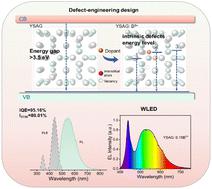
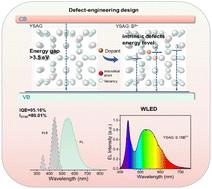
The development of extra-broadband visible emission phosphors is crucial to achieve next-generation illumination with better color experience. Herein, a defect engineering strategy mediated by the structural cationic substitution is proposed and experimentally demonstrated for specific ultra-broadband emission in a garnet phosphor. The induced oxygen vacancies and interstitial cation through lattice distortion break the periodic potential field of the crystal and provide electronic levels in the band gap. As a result, excited by blue-light-emitting diodes, the novel Y3Sc2Al3O12:B3+ shows an ultra-broad emission with a full width at half maximum (FWHM) of ∼170 nm. Compared to general defect-emitting phosphors, the unique Y3Sc2Al3O12:B3+ exhibits excellent thermal quenching resistance and superior internal quantum efficiency of up to 95%. These findings not only show great promise of Y3Sc2Al3O12:B3+ as an extra-broadband emitter but also provide a new design strategy to achieve a full-visible-spectrum phosphor in a single-component material for white-light applications.




 京公网安备 11010802042870号
京ICP备2023020795号-1
京公网安备 11010802042870号
京ICP备2023020795号-1

 分享
分享
 求助内容:
求助内容: 应助结果提醒方式:
 扫码关注我们
