{"title":"溴吡咯并[5]烯与磺化聚(芳基醚酮砜)交联可提高低离子交换容量膜的质子传导性","authors":"Xiaokang Dong, Hui Li*, Jingmei Xu, Xin Wang, Shuxin Wang, Yuting Yin, Chun-Li Song, Tian Lan, Zhe Wang* and Ying-Wei Yang*, ","doi":"10.1021/acsmaterialslett.4c01980","DOIUrl":null,"url":null,"abstract":"<p >Improving the overall performance of proton exchange membranes while maintaining high proton conductivity represents a persistent challenge. Bromo-functionalized pillar[5]arene (BrP5) is introduced as a multiarm cross-linker in sulfonated poly(aryl ether ketone sulfone) for the first time. Unlike traditional cross-linkers sacrificing proton conductivity, our pillararene-cross-linked membranes (SPAEKS-CL-QP5) retain cross-linking advantages without compromising conductivity, such as excellent oxidation stability (SPAEKS-CL-QP5-7% retained 84.2% after 24 h), low water absorption (9.7–18.4%), and low swelling (8.7–12.2%) at 80 °C, while exhibiting a high tensile strength of 50.4 MPa. SPAEKS-CL-QP5-7% exhibited a twice conductivity value per unit of ion exchange capacity (133.4 mS g cm<sup>–1</sup> mmol<sup>–1</sup>) compared to the control Am-SPAEKS (65.2 mS g cm<sup>–1</sup> mmol<sup>–1</sup>). The rigid pillar structure of pillararene macrocycles is critical to these performance improvements.</p>","PeriodicalId":19,"journal":{"name":"ACS Materials Letters","volume":"6 11","pages":"4962–4971 4962–4971"},"PeriodicalIF":8.6000,"publicationDate":"2024-10-03","publicationTypes":"Journal Article","fieldsOfStudy":null,"isOpenAccess":false,"openAccessPdf":"","citationCount":"0","resultStr":"{\"title\":\"Cross-Linking of Bromo-Pillar[5]arenes and Sulfonated Poly(Aryl Ether Ketone Sulfone) Enhances Proton Conductivity of Membranes at Low Ion Exchange Capacity\",\"authors\":\"Xiaokang Dong, Hui Li*, Jingmei Xu, Xin Wang, Shuxin Wang, Yuting Yin, Chun-Li Song, Tian Lan, Zhe Wang* and Ying-Wei Yang*, \",\"doi\":\"10.1021/acsmaterialslett.4c01980\",\"DOIUrl\":null,\"url\":null,\"abstract\":\"<p >Improving the overall performance of proton exchange membranes while maintaining high proton conductivity represents a persistent challenge. Bromo-functionalized pillar[5]arene (BrP5) is introduced as a multiarm cross-linker in sulfonated poly(aryl ether ketone sulfone) for the first time. Unlike traditional cross-linkers sacrificing proton conductivity, our pillararene-cross-linked membranes (SPAEKS-CL-QP5) retain cross-linking advantages without compromising conductivity, such as excellent oxidation stability (SPAEKS-CL-QP5-7% retained 84.2% after 24 h), low water absorption (9.7–18.4%), and low swelling (8.7–12.2%) at 80 °C, while exhibiting a high tensile strength of 50.4 MPa. SPAEKS-CL-QP5-7% exhibited a twice conductivity value per unit of ion exchange capacity (133.4 mS g cm<sup>–1</sup> mmol<sup>–1</sup>) compared to the control Am-SPAEKS (65.2 mS g cm<sup>–1</sup> mmol<sup>–1</sup>). The rigid pillar structure of pillararene macrocycles is critical to these performance improvements.</p>\",\"PeriodicalId\":19,\"journal\":{\"name\":\"ACS Materials Letters\",\"volume\":\"6 11\",\"pages\":\"4962–4971 4962–4971\"},\"PeriodicalIF\":8.6000,\"publicationDate\":\"2024-10-03\",\"publicationTypes\":\"Journal Article\",\"fieldsOfStudy\":null,\"isOpenAccess\":false,\"openAccessPdf\":\"\",\"citationCount\":\"0\",\"resultStr\":null,\"platform\":\"Semanticscholar\",\"paperid\":null,\"PeriodicalName\":\"ACS Materials Letters\",\"FirstCategoryId\":\"92\",\"ListUrlMain\":\"https://pubs.acs.org/doi/10.1021/acsmaterialslett.4c01980\",\"RegionNum\":1,\"RegionCategory\":\"化学\",\"ArticlePicture\":[],\"TitleCN\":null,\"AbstractTextCN\":null,\"PMCID\":null,\"EPubDate\":\"\",\"PubModel\":\"\",\"JCR\":\"Q1\",\"JCRName\":\"MATERIALS SCIENCE, MULTIDISCIPLINARY\",\"Score\":null,\"Total\":0}","platform":"Semanticscholar","paperid":null,"PeriodicalName":"ACS Materials Letters","FirstCategoryId":"92","ListUrlMain":"https://pubs.acs.org/doi/10.1021/acsmaterialslett.4c01980","RegionNum":1,"RegionCategory":"化学","ArticlePicture":[],"TitleCN":null,"AbstractTextCN":null,"PMCID":null,"EPubDate":"","PubModel":"","JCR":"Q1","JCRName":"MATERIALS SCIENCE, MULTIDISCIPLINARY","Score":null,"Total":0}
引用次数: 0
摘要
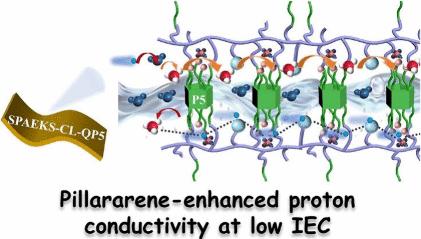
在保持高质子传导性的同时提高质子交换膜的整体性能是一项长期的挑战。溴功能化柱[5]炔(BrP5)首次作为多臂交联剂被引入磺化聚(芳基醚酮砜)中。与牺牲质子传导性的传统交联剂不同,我们的柱链烯交联膜(SPAEKS-CL-QP5)在不影响传导性的前提下保留了交联优势,例如出色的氧化稳定性(SPAEKS-CL-QP5-7% 在 24 小时后保留了 84.2%)、低吸水性(9.7-18.4%)和 80 °C 时低膨胀性(8.7-12.2%),同时还表现出 50.4 兆帕的高拉伸强度。SPAEKS-CL-QP5-7% 的单位离子交换容量电导率值(133.4 mS g cm-1 mmol-1)是对照组 Am-SPAEKS 的两倍(65.2 mS g cm-1 mmol-1)。柱状芳香族大环的刚性柱状结构是这些性能改进的关键。
Cross-Linking of Bromo-Pillar[5]arenes and Sulfonated Poly(Aryl Ether Ketone Sulfone) Enhances Proton Conductivity of Membranes at Low Ion Exchange Capacity
Improving the overall performance of proton exchange membranes while maintaining high proton conductivity represents a persistent challenge. Bromo-functionalized pillar[5]arene (BrP5) is introduced as a multiarm cross-linker in sulfonated poly(aryl ether ketone sulfone) for the first time. Unlike traditional cross-linkers sacrificing proton conductivity, our pillararene-cross-linked membranes (SPAEKS-CL-QP5) retain cross-linking advantages without compromising conductivity, such as excellent oxidation stability (SPAEKS-CL-QP5-7% retained 84.2% after 24 h), low water absorption (9.7–18.4%), and low swelling (8.7–12.2%) at 80 °C, while exhibiting a high tensile strength of 50.4 MPa. SPAEKS-CL-QP5-7% exhibited a twice conductivity value per unit of ion exchange capacity (133.4 mS g cm–1 mmol–1) compared to the control Am-SPAEKS (65.2 mS g cm–1 mmol–1). The rigid pillar structure of pillararene macrocycles is critical to these performance improvements.
期刊介绍:
ACS Materials Letters is a journal that publishes high-quality and urgent papers at the forefront of fundamental and applied research in the field of materials science. It aims to bridge the gap between materials and other disciplines such as chemistry, engineering, and biology. The journal encourages multidisciplinary and innovative research that addresses global challenges. Papers submitted to ACS Materials Letters should clearly demonstrate the need for rapid disclosure of key results. The journal is interested in various areas including the design, synthesis, characterization, and evaluation of emerging materials, understanding the relationships between structure, property, and performance, as well as developing materials for applications in energy, environment, biomedical, electronics, and catalysis. The journal has a 2-year impact factor of 11.4 and is dedicated to publishing transformative materials research with fast processing times. The editors and staff of ACS Materials Letters actively participate in major scientific conferences and engage closely with readers and authors. The journal also maintains an active presence on social media to provide authors with greater visibility.




 京公网安备 11010802042870号
京ICP备2023020795号-1
京公网安备 11010802042870号
京ICP备2023020795号-1

 分享
分享
 求助内容:
求助内容: 应助结果提醒方式:
 扫码关注我们
