Jianing Wang, Qilin Zhang, Lintao Zeng, Yuanhong Gao, Xiwei Zheng, Zhimin Meng, Shuhan Cao, Wei Huang* and Hong Meng*,
{"title":"基于 N 型宽带隙有机材料的高性能太阳盲紫外线探测器","authors":"Jianing Wang, Qilin Zhang, Lintao Zeng, Yuanhong Gao, Xiwei Zheng, Zhimin Meng, Shuhan Cao, Wei Huang* and Hong Meng*, ","doi":"10.1021/acsmaterialslett.4c01252","DOIUrl":null,"url":null,"abstract":"<p >A strategy based on N-type organic wide-bandgap materials to form heterojunctions enhances carrier separation and achieves high-performance UV detection. This approach addresses issues such as low UV detection performance and insufficient depth of detection wavelengths. In our study, we combined two N-type semiconductor materials with a p-type small molecule to form a heterojunction serving as the photosensitive layer. This configuration successfully achieved a high-performance solar-blind ultraviolet (SBUV) detector, exhibiting a maximum responsivity (<i>R</i>) of 227 A/W, an EQE of 1.1 × 10<sup>5</sup>%, and a peak detectivity of 3.3 × 10<sup>11</sup> Jones under 260 nm illumination with an intensity of 50 μW/cm<sup>2</sup>. Furthermore, by employing Al<sub>2</sub>O<sub>3</sub> with a high dielectric constant as the gate dielectric, we developed a detector operable with a low drive voltage of 1.8 V. This provides a valuable research paradigm for future organic ultraviolet detection endeavors.</p>","PeriodicalId":19,"journal":{"name":"ACS Materials Letters","volume":"6 11","pages":"5023–5030 5023–5030"},"PeriodicalIF":8.6000,"publicationDate":"2024-10-09","publicationTypes":"Journal Article","fieldsOfStudy":null,"isOpenAccess":false,"openAccessPdf":"","citationCount":"0","resultStr":"{\"title\":\"High Performance Solar-Blind UV Detectors Based on N-Type Wide Bandgap Organic Materials\",\"authors\":\"Jianing Wang, Qilin Zhang, Lintao Zeng, Yuanhong Gao, Xiwei Zheng, Zhimin Meng, Shuhan Cao, Wei Huang* and Hong Meng*, \",\"doi\":\"10.1021/acsmaterialslett.4c01252\",\"DOIUrl\":null,\"url\":null,\"abstract\":\"<p >A strategy based on N-type organic wide-bandgap materials to form heterojunctions enhances carrier separation and achieves high-performance UV detection. This approach addresses issues such as low UV detection performance and insufficient depth of detection wavelengths. In our study, we combined two N-type semiconductor materials with a p-type small molecule to form a heterojunction serving as the photosensitive layer. This configuration successfully achieved a high-performance solar-blind ultraviolet (SBUV) detector, exhibiting a maximum responsivity (<i>R</i>) of 227 A/W, an EQE of 1.1 × 10<sup>5</sup>%, and a peak detectivity of 3.3 × 10<sup>11</sup> Jones under 260 nm illumination with an intensity of 50 μW/cm<sup>2</sup>. Furthermore, by employing Al<sub>2</sub>O<sub>3</sub> with a high dielectric constant as the gate dielectric, we developed a detector operable with a low drive voltage of 1.8 V. This provides a valuable research paradigm for future organic ultraviolet detection endeavors.</p>\",\"PeriodicalId\":19,\"journal\":{\"name\":\"ACS Materials Letters\",\"volume\":\"6 11\",\"pages\":\"5023–5030 5023–5030\"},\"PeriodicalIF\":8.6000,\"publicationDate\":\"2024-10-09\",\"publicationTypes\":\"Journal Article\",\"fieldsOfStudy\":null,\"isOpenAccess\":false,\"openAccessPdf\":\"\",\"citationCount\":\"0\",\"resultStr\":null,\"platform\":\"Semanticscholar\",\"paperid\":null,\"PeriodicalName\":\"ACS Materials Letters\",\"FirstCategoryId\":\"92\",\"ListUrlMain\":\"https://pubs.acs.org/doi/10.1021/acsmaterialslett.4c01252\",\"RegionNum\":1,\"RegionCategory\":\"化学\",\"ArticlePicture\":[],\"TitleCN\":null,\"AbstractTextCN\":null,\"PMCID\":null,\"EPubDate\":\"\",\"PubModel\":\"\",\"JCR\":\"Q1\",\"JCRName\":\"MATERIALS SCIENCE, MULTIDISCIPLINARY\",\"Score\":null,\"Total\":0}","platform":"Semanticscholar","paperid":null,"PeriodicalName":"ACS Materials Letters","FirstCategoryId":"92","ListUrlMain":"https://pubs.acs.org/doi/10.1021/acsmaterialslett.4c01252","RegionNum":1,"RegionCategory":"化学","ArticlePicture":[],"TitleCN":null,"AbstractTextCN":null,"PMCID":null,"EPubDate":"","PubModel":"","JCR":"Q1","JCRName":"MATERIALS SCIENCE, MULTIDISCIPLINARY","Score":null,"Total":0}
引用次数: 0
摘要
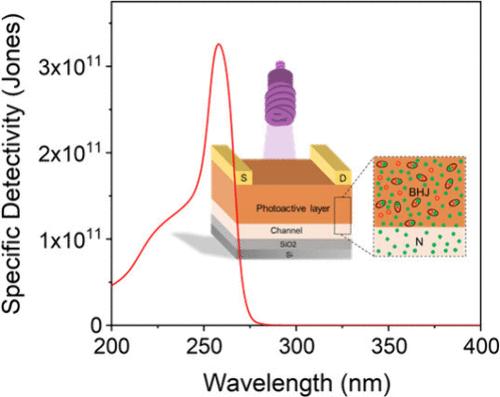
一种基于 N 型有机宽带隙材料形成异质结的策略可增强载流子分离,实现高性能紫外检测。这种方法解决了紫外检测性能低和检测波长深度不够等问题。在我们的研究中,我们将两种 N 型半导体材料与一种 p 型小分子结合起来,形成一个异质结,作为光敏层。在强度为 50 μW/cm2 的 260 纳米光照下,最大响应度 (R) 为 227 A/W,EQE 为 1.1 × 10⁵%,峰值检测率为 3.3 × 10¹¹ Jones。此外,通过采用高介电常数的 Al2O3 作为栅极电介质,我们开发出了一种可在 1.8 V 低驱动电压下工作的探测器。
High Performance Solar-Blind UV Detectors Based on N-Type Wide Bandgap Organic Materials
A strategy based on N-type organic wide-bandgap materials to form heterojunctions enhances carrier separation and achieves high-performance UV detection. This approach addresses issues such as low UV detection performance and insufficient depth of detection wavelengths. In our study, we combined two N-type semiconductor materials with a p-type small molecule to form a heterojunction serving as the photosensitive layer. This configuration successfully achieved a high-performance solar-blind ultraviolet (SBUV) detector, exhibiting a maximum responsivity (R) of 227 A/W, an EQE of 1.1 × 10⁵%, and a peak detectivity of 3.3 × 10¹¹ Jones under 260 nm illumination with an intensity of 50 μW/cm2. Furthermore, by employing Al2O3 with a high dielectric constant as the gate dielectric, we developed a detector operable with a low drive voltage of 1.8 V. This provides a valuable research paradigm for future organic ultraviolet detection endeavors.
期刊介绍:
ACS Materials Letters is a journal that publishes high-quality and urgent papers at the forefront of fundamental and applied research in the field of materials science. It aims to bridge the gap between materials and other disciplines such as chemistry, engineering, and biology. The journal encourages multidisciplinary and innovative research that addresses global challenges. Papers submitted to ACS Materials Letters should clearly demonstrate the need for rapid disclosure of key results. The journal is interested in various areas including the design, synthesis, characterization, and evaluation of emerging materials, understanding the relationships between structure, property, and performance, as well as developing materials for applications in energy, environment, biomedical, electronics, and catalysis. The journal has a 2-year impact factor of 11.4 and is dedicated to publishing transformative materials research with fast processing times. The editors and staff of ACS Materials Letters actively participate in major scientific conferences and engage closely with readers and authors. The journal also maintains an active presence on social media to provide authors with greater visibility.




 京公网安备 11010802042870号
京ICP备2023020795号-1
京公网安备 11010802042870号
京ICP备2023020795号-1

 分享
分享
 求助内容:
求助内容: 应助结果提醒方式:
 扫码关注我们
