Guo Peng, Guo-Xing Zhou, Xiang-Tao Dong, Yong-Bo Peng, Rong-Yan Zhang, Ying-Zhao Ma and Xiao-Ming Ren
{"title":"由具有三棱柱配位环境的镧系离子构建的多功能手性金属氢键有机框架","authors":"Guo Peng, Guo-Xing Zhou, Xiang-Tao Dong, Yong-Bo Peng, Rong-Yan Zhang, Ying-Zhao Ma and Xiao-Ming Ren","doi":"10.1039/D4DT02131B","DOIUrl":null,"url":null,"abstract":"<p >Two pairs of chiral enantiomers D/L-Dy(PMP)<small><sub>3</sub></small>·2H<small><sub>2</sub></small>O (<strong>D-1</strong>/<strong>L-1</strong>) and D/L-Yb(PMP)<small><sub>3</sub></small>·2H<small><sub>2</sub></small>O (<strong>D-2</strong>/<strong>L-2</strong>) were synthesized by the introduction of enantiomerically pure D/L-PMP (PMP = (phosphonomethyl)proline) ligands into lanthanide coordination chemistry. The chiral characteristics of these products were confirmed by single crystal X-ray diffraction, second harmonic generation (SHG) measurements and circular dichroism (CD) spectroscopy. These complexes are composed of 1D chains constructed from lanthanide ions with a trigonal prismatic coordination geometry and PMP ligands. The assembly of the 1D chains led to the formation of a lanthanide hydrogen-bonded organic framework with 1D water chains filled in the channels. Zero-field slow relaxation of magnetization was detected in <strong>L-1</strong>, whereas <strong>L-2</strong> showed field-induced single-molecule magnet (SMM) behavior. Complexes <strong>D-1</strong>, <strong>L-1</strong> and <strong>L-2</strong> show proton conductive ability and their conductivity values reach the order of 10<small><sup>−5</sup></small> S cm<small><sup>−1</sup></small> at 90 °C and 98% relative humidity.</p>","PeriodicalId":71,"journal":{"name":"Dalton Transactions","volume":" 1","pages":" 152-158"},"PeriodicalIF":3.3000,"publicationDate":"2024-11-05","publicationTypes":"Journal Article","fieldsOfStudy":null,"isOpenAccess":false,"openAccessPdf":"","citationCount":"0","resultStr":"{\"title\":\"Multifunctional chiral metal hydrogen-bonded organic frameworks constructed from lanthanide ions with a trigonal prismatic coordination environment†\",\"authors\":\"Guo Peng, Guo-Xing Zhou, Xiang-Tao Dong, Yong-Bo Peng, Rong-Yan Zhang, Ying-Zhao Ma and Xiao-Ming Ren\",\"doi\":\"10.1039/D4DT02131B\",\"DOIUrl\":null,\"url\":null,\"abstract\":\"<p >Two pairs of chiral enantiomers D/L-Dy(PMP)<small><sub>3</sub></small>·2H<small><sub>2</sub></small>O (<strong>D-1</strong>/<strong>L-1</strong>) and D/L-Yb(PMP)<small><sub>3</sub></small>·2H<small><sub>2</sub></small>O (<strong>D-2</strong>/<strong>L-2</strong>) were synthesized by the introduction of enantiomerically pure D/L-PMP (PMP = (phosphonomethyl)proline) ligands into lanthanide coordination chemistry. The chiral characteristics of these products were confirmed by single crystal X-ray diffraction, second harmonic generation (SHG) measurements and circular dichroism (CD) spectroscopy. These complexes are composed of 1D chains constructed from lanthanide ions with a trigonal prismatic coordination geometry and PMP ligands. The assembly of the 1D chains led to the formation of a lanthanide hydrogen-bonded organic framework with 1D water chains filled in the channels. Zero-field slow relaxation of magnetization was detected in <strong>L-1</strong>, whereas <strong>L-2</strong> showed field-induced single-molecule magnet (SMM) behavior. Complexes <strong>D-1</strong>, <strong>L-1</strong> and <strong>L-2</strong> show proton conductive ability and their conductivity values reach the order of 10<small><sup>−5</sup></small> S cm<small><sup>−1</sup></small> at 90 °C and 98% relative humidity.</p>\",\"PeriodicalId\":71,\"journal\":{\"name\":\"Dalton Transactions\",\"volume\":\" 1\",\"pages\":\" 152-158\"},\"PeriodicalIF\":3.3000,\"publicationDate\":\"2024-11-05\",\"publicationTypes\":\"Journal Article\",\"fieldsOfStudy\":null,\"isOpenAccess\":false,\"openAccessPdf\":\"\",\"citationCount\":\"0\",\"resultStr\":null,\"platform\":\"Semanticscholar\",\"paperid\":null,\"PeriodicalName\":\"Dalton Transactions\",\"FirstCategoryId\":\"92\",\"ListUrlMain\":\"https://pubs.rsc.org/en/content/articlelanding/2025/dt/d4dt02131b\",\"RegionNum\":3,\"RegionCategory\":\"化学\",\"ArticlePicture\":[],\"TitleCN\":null,\"AbstractTextCN\":null,\"PMCID\":null,\"EPubDate\":\"\",\"PubModel\":\"\",\"JCR\":\"Q2\",\"JCRName\":\"CHEMISTRY, INORGANIC & NUCLEAR\",\"Score\":null,\"Total\":0}","platform":"Semanticscholar","paperid":null,"PeriodicalName":"Dalton Transactions","FirstCategoryId":"92","ListUrlMain":"https://pubs.rsc.org/en/content/articlelanding/2025/dt/d4dt02131b","RegionNum":3,"RegionCategory":"化学","ArticlePicture":[],"TitleCN":null,"AbstractTextCN":null,"PMCID":null,"EPubDate":"","PubModel":"","JCR":"Q2","JCRName":"CHEMISTRY, INORGANIC & NUCLEAR","Score":null,"Total":0}
Multifunctional chiral metal hydrogen-bonded organic frameworks constructed from lanthanide ions with a trigonal prismatic coordination environment†
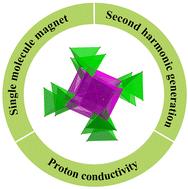
Two pairs of chiral enantiomers D/L-Dy(PMP)3·2H2O (D-1/L-1) and D/L-Yb(PMP)3·2H2O (D-2/L-2) were synthesized by the introduction of enantiomerically pure D/L-PMP (PMP = (phosphonomethyl)proline) ligands into lanthanide coordination chemistry. The chiral characteristics of these products were confirmed by single crystal X-ray diffraction, second harmonic generation (SHG) measurements and circular dichroism (CD) spectroscopy. These complexes are composed of 1D chains constructed from lanthanide ions with a trigonal prismatic coordination geometry and PMP ligands. The assembly of the 1D chains led to the formation of a lanthanide hydrogen-bonded organic framework with 1D water chains filled in the channels. Zero-field slow relaxation of magnetization was detected in L-1, whereas L-2 showed field-induced single-molecule magnet (SMM) behavior. Complexes D-1, L-1 and L-2 show proton conductive ability and their conductivity values reach the order of 10−5 S cm−1 at 90 °C and 98% relative humidity.
期刊介绍:
Dalton Transactions is a journal for all areas of inorganic chemistry, which encompasses the organometallic, bioinorganic and materials chemistry of the elements, with applications including synthesis, catalysis, energy conversion/storage, electrical devices and medicine. Dalton Transactions welcomes high-quality, original submissions in all of these areas and more, where the advancement of knowledge in inorganic chemistry is significant.




 京公网安备 11010802042870号
京ICP备2023020795号-1
京公网安备 11010802042870号
京ICP备2023020795号-1

 分享
分享
 求助内容:
求助内容: 应助结果提醒方式:
 扫码关注我们
