Jing-Kun Gao, Wandong Chen, Junjie Tai, Zhengwei Chen, Hang Liu, Yuxin Du, Yiting Jiang, Yuanbin She and Yun-Fang Yang
{"title":"手性锰卟啉催化的不对称 C-H 羟基化反应的机理研究","authors":"Jing-Kun Gao, Wandong Chen, Junjie Tai, Zhengwei Chen, Hang Liu, Yuxin Du, Yiting Jiang, Yuanbin She and Yun-Fang Yang","doi":"10.1039/D4DT02452D","DOIUrl":null,"url":null,"abstract":"<p >We employed density functional theory (DFT) calculations to elucidate the mechanism and origin of enantioselectivity in the C–H hydroxylation reaction catalyzed by a chiral manganese porphyrin complex. Our study reveals that the chiral manganese porphyrin forms a two-point hydrogen bonding interaction with the substrate. Specifically, the hydrogen atom abstraction of the methylene <em>pro</em>-(<em>S</em>) C–H bond at the heterocyclic C-3 position is 1.9 kcal mol<small><sup>−1</sup></small> favored over the hydrogen atom abstraction of the <em>pro</em>-(<em>R</em>) C–H bond. This preferential reactivity results in the predominant formation of (<em>S</em>)-hydroxylated products. Our DFT calculations are consistent with the experimental findings of high enantioselectivity in the chiral manganese porphyrin catalyzed C(sp<small><sup>3</sup></small>)–H hydroxylation of lactam derivatives. The observed enantioselectivity arises from the formation of two-point hydrogen bonding between lactam derivatives and manganese porphyrin catalysts. Moreover, our computations indicate varying degrees of substrate distortion upon attack by high-valent manganese oxygen complexes at different hydrogen atoms.</p>","PeriodicalId":71,"journal":{"name":"Dalton Transactions","volume":" 1","pages":" 215-221"},"PeriodicalIF":3.3000,"publicationDate":"2024-11-04","publicationTypes":"Journal Article","fieldsOfStudy":null,"isOpenAccess":false,"openAccessPdf":"","citationCount":"0","resultStr":"{\"title\":\"A mechanistic study of chiral manganese porphyrin-catalyzed enantioselective C–H hydroxylation reaction†\",\"authors\":\"Jing-Kun Gao, Wandong Chen, Junjie Tai, Zhengwei Chen, Hang Liu, Yuxin Du, Yiting Jiang, Yuanbin She and Yun-Fang Yang\",\"doi\":\"10.1039/D4DT02452D\",\"DOIUrl\":null,\"url\":null,\"abstract\":\"<p >We employed density functional theory (DFT) calculations to elucidate the mechanism and origin of enantioselectivity in the C–H hydroxylation reaction catalyzed by a chiral manganese porphyrin complex. Our study reveals that the chiral manganese porphyrin forms a two-point hydrogen bonding interaction with the substrate. Specifically, the hydrogen atom abstraction of the methylene <em>pro</em>-(<em>S</em>) C–H bond at the heterocyclic C-3 position is 1.9 kcal mol<small><sup>−1</sup></small> favored over the hydrogen atom abstraction of the <em>pro</em>-(<em>R</em>) C–H bond. This preferential reactivity results in the predominant formation of (<em>S</em>)-hydroxylated products. Our DFT calculations are consistent with the experimental findings of high enantioselectivity in the chiral manganese porphyrin catalyzed C(sp<small><sup>3</sup></small>)–H hydroxylation of lactam derivatives. The observed enantioselectivity arises from the formation of two-point hydrogen bonding between lactam derivatives and manganese porphyrin catalysts. Moreover, our computations indicate varying degrees of substrate distortion upon attack by high-valent manganese oxygen complexes at different hydrogen atoms.</p>\",\"PeriodicalId\":71,\"journal\":{\"name\":\"Dalton Transactions\",\"volume\":\" 1\",\"pages\":\" 215-221\"},\"PeriodicalIF\":3.3000,\"publicationDate\":\"2024-11-04\",\"publicationTypes\":\"Journal Article\",\"fieldsOfStudy\":null,\"isOpenAccess\":false,\"openAccessPdf\":\"\",\"citationCount\":\"0\",\"resultStr\":null,\"platform\":\"Semanticscholar\",\"paperid\":null,\"PeriodicalName\":\"Dalton Transactions\",\"FirstCategoryId\":\"92\",\"ListUrlMain\":\"https://pubs.rsc.org/en/content/articlelanding/2025/dt/d4dt02452d\",\"RegionNum\":3,\"RegionCategory\":\"化学\",\"ArticlePicture\":[],\"TitleCN\":null,\"AbstractTextCN\":null,\"PMCID\":null,\"EPubDate\":\"\",\"PubModel\":\"\",\"JCR\":\"Q2\",\"JCRName\":\"CHEMISTRY, INORGANIC & NUCLEAR\",\"Score\":null,\"Total\":0}","platform":"Semanticscholar","paperid":null,"PeriodicalName":"Dalton Transactions","FirstCategoryId":"92","ListUrlMain":"https://pubs.rsc.org/en/content/articlelanding/2025/dt/d4dt02452d","RegionNum":3,"RegionCategory":"化学","ArticlePicture":[],"TitleCN":null,"AbstractTextCN":null,"PMCID":null,"EPubDate":"","PubModel":"","JCR":"Q2","JCRName":"CHEMISTRY, INORGANIC & NUCLEAR","Score":null,"Total":0}
A mechanistic study of chiral manganese porphyrin-catalyzed enantioselective C–H hydroxylation reaction†
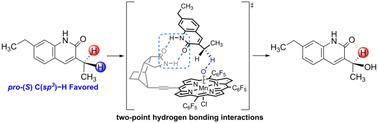
We employed density functional theory (DFT) calculations to elucidate the mechanism and origin of enantioselectivity in the C–H hydroxylation reaction catalyzed by a chiral manganese porphyrin complex. Our study reveals that the chiral manganese porphyrin forms a two-point hydrogen bonding interaction with the substrate. Specifically, the hydrogen atom abstraction of the methylene pro-(S) C–H bond at the heterocyclic C-3 position is 1.9 kcal mol−1 favored over the hydrogen atom abstraction of the pro-(R) C–H bond. This preferential reactivity results in the predominant formation of (S)-hydroxylated products. Our DFT calculations are consistent with the experimental findings of high enantioselectivity in the chiral manganese porphyrin catalyzed C(sp3)–H hydroxylation of lactam derivatives. The observed enantioselectivity arises from the formation of two-point hydrogen bonding between lactam derivatives and manganese porphyrin catalysts. Moreover, our computations indicate varying degrees of substrate distortion upon attack by high-valent manganese oxygen complexes at different hydrogen atoms.
期刊介绍:
Dalton Transactions is a journal for all areas of inorganic chemistry, which encompasses the organometallic, bioinorganic and materials chemistry of the elements, with applications including synthesis, catalysis, energy conversion/storage, electrical devices and medicine. Dalton Transactions welcomes high-quality, original submissions in all of these areas and more, where the advancement of knowledge in inorganic chemistry is significant.




 京公网安备 11010802042870号
京ICP备2023020795号-1
京公网安备 11010802042870号
京ICP备2023020795号-1

 分享
分享
 求助内容:
求助内容: 应助结果提醒方式:
 扫码关注我们
