Gao-Yu Zhao*, Mao-Jing Tian, Rui-Xi Wang, Yan Deng, Yan-Ling Zhao, Shu-Chang Luo and Ling Chen*,
{"title":"4-硝基苯丙氨酸溴化物:D-π-A 结构特征及其非线性和线性光学特性","authors":"Gao-Yu Zhao*, Mao-Jing Tian, Rui-Xi Wang, Yan Deng, Yan-Ling Zhao, Shu-Chang Luo and Ling Chen*, ","doi":"10.1021/acs.cgd.4c01223","DOIUrl":null,"url":null,"abstract":"<p >Nonlinear optical materials have important applications in optical communication, information processing, biomedicine, and other fields. Herein, two organic chiral 4-nitro-<span>d</span>(<span>l</span>)-phenylalanine bromides (4NDPAB and 4NLPAB) were successfully synthesized and fully characterized. Single-crystal X-ray diffraction data reveal the <i>P</i>2<sub>1</sub> non-centrosymmetric structure, in which the chiral cations and Br<sup>–</sup> anions are linked through four intermolecular hydrogen bonds. Chirality is identified by circular dichroism spectroscopy. One enantiomer, 4NDPAB, is described as an example. It exhibits an absorption edge at 435 nm (<i>E</i><sub>g</sub> = 2.85 eV) and demonstrates a high thermal stability up to 230 °C. Additionally, 4NDPAB shows strong second harmonic generation (SHG), 1.8 times higher than that of commercial KDP, and large birefringence (Δ<i>n</i><sub>exp</sub> = 0.178). Density functional theoretical calculations and analyses confirm that the strong SHG intensity and excellent anisotropy performance are due to the D−π–A structural nature of 4-nitro-phenylalanine and its parallel crystal packing arrangement.</p>","PeriodicalId":34,"journal":{"name":"Crystal Growth & Design","volume":"24 21","pages":"9235–9242 9235–9242"},"PeriodicalIF":3.6000,"publicationDate":"2024-10-15","publicationTypes":"Journal Article","fieldsOfStudy":null,"isOpenAccess":false,"openAccessPdf":"","citationCount":"0","resultStr":"{\"title\":\"4-Nitro-phenylalanine Bromides: D−π–A Structural Features and Their Nonlinear and Linear Optical Properties\",\"authors\":\"Gao-Yu Zhao*, Mao-Jing Tian, Rui-Xi Wang, Yan Deng, Yan-Ling Zhao, Shu-Chang Luo and Ling Chen*, \",\"doi\":\"10.1021/acs.cgd.4c01223\",\"DOIUrl\":null,\"url\":null,\"abstract\":\"<p >Nonlinear optical materials have important applications in optical communication, information processing, biomedicine, and other fields. Herein, two organic chiral 4-nitro-<span>d</span>(<span>l</span>)-phenylalanine bromides (4NDPAB and 4NLPAB) were successfully synthesized and fully characterized. Single-crystal X-ray diffraction data reveal the <i>P</i>2<sub>1</sub> non-centrosymmetric structure, in which the chiral cations and Br<sup>–</sup> anions are linked through four intermolecular hydrogen bonds. Chirality is identified by circular dichroism spectroscopy. One enantiomer, 4NDPAB, is described as an example. It exhibits an absorption edge at 435 nm (<i>E</i><sub>g</sub> = 2.85 eV) and demonstrates a high thermal stability up to 230 °C. Additionally, 4NDPAB shows strong second harmonic generation (SHG), 1.8 times higher than that of commercial KDP, and large birefringence (Δ<i>n</i><sub>exp</sub> = 0.178). Density functional theoretical calculations and analyses confirm that the strong SHG intensity and excellent anisotropy performance are due to the D−π–A structural nature of 4-nitro-phenylalanine and its parallel crystal packing arrangement.</p>\",\"PeriodicalId\":34,\"journal\":{\"name\":\"Crystal Growth & Design\",\"volume\":\"24 21\",\"pages\":\"9235–9242 9235–9242\"},\"PeriodicalIF\":3.6000,\"publicationDate\":\"2024-10-15\",\"publicationTypes\":\"Journal Article\",\"fieldsOfStudy\":null,\"isOpenAccess\":false,\"openAccessPdf\":\"\",\"citationCount\":\"0\",\"resultStr\":null,\"platform\":\"Semanticscholar\",\"paperid\":null,\"PeriodicalName\":\"Crystal Growth & Design\",\"FirstCategoryId\":\"92\",\"ListUrlMain\":\"https://pubs.acs.org/doi/10.1021/acs.cgd.4c01223\",\"RegionNum\":2,\"RegionCategory\":\"化学\",\"ArticlePicture\":[],\"TitleCN\":null,\"AbstractTextCN\":null,\"PMCID\":null,\"EPubDate\":\"\",\"PubModel\":\"\",\"JCR\":\"Q2\",\"JCRName\":\"CHEMISTRY, MULTIDISCIPLINARY\",\"Score\":null,\"Total\":0}","platform":"Semanticscholar","paperid":null,"PeriodicalName":"Crystal Growth & Design","FirstCategoryId":"92","ListUrlMain":"https://pubs.acs.org/doi/10.1021/acs.cgd.4c01223","RegionNum":2,"RegionCategory":"化学","ArticlePicture":[],"TitleCN":null,"AbstractTextCN":null,"PMCID":null,"EPubDate":"","PubModel":"","JCR":"Q2","JCRName":"CHEMISTRY, MULTIDISCIPLINARY","Score":null,"Total":0}
4-Nitro-phenylalanine Bromides: D−π–A Structural Features and Their Nonlinear and Linear Optical Properties
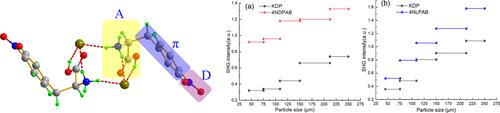
Nonlinear optical materials have important applications in optical communication, information processing, biomedicine, and other fields. Herein, two organic chiral 4-nitro-d(l)-phenylalanine bromides (4NDPAB and 4NLPAB) were successfully synthesized and fully characterized. Single-crystal X-ray diffraction data reveal the P21 non-centrosymmetric structure, in which the chiral cations and Br– anions are linked through four intermolecular hydrogen bonds. Chirality is identified by circular dichroism spectroscopy. One enantiomer, 4NDPAB, is described as an example. It exhibits an absorption edge at 435 nm (Eg = 2.85 eV) and demonstrates a high thermal stability up to 230 °C. Additionally, 4NDPAB shows strong second harmonic generation (SHG), 1.8 times higher than that of commercial KDP, and large birefringence (Δnexp = 0.178). Density functional theoretical calculations and analyses confirm that the strong SHG intensity and excellent anisotropy performance are due to the D−π–A structural nature of 4-nitro-phenylalanine and its parallel crystal packing arrangement.
期刊介绍:
The aim of Crystal Growth & Design is to stimulate crossfertilization of knowledge among scientists and engineers working in the fields of crystal growth, crystal engineering, and the industrial application of crystalline materials.
Crystal Growth & Design publishes theoretical and experimental studies of the physical, chemical, and biological phenomena and processes related to the design, growth, and application of crystalline materials. Synergistic approaches originating from different disciplines and technologies and integrating the fields of crystal growth, crystal engineering, intermolecular interactions, and industrial application are encouraged.




 京公网安备 11010802042870号
京ICP备2023020795号-1
京公网安备 11010802042870号
京ICP备2023020795号-1

 分享
分享
 求助内容:
求助内容: 应助结果提醒方式:
 扫码关注我们
