Ana C. R. Gonçalves, Silvia H. Libardi, Júlio C. Borges, Ronaldo J. Oliveira, Carla Gotzmann, Olivier Blacque, Sergio de Albuquerque, Carla D. Lopes, Roger Alberto and Pedro I. S. Maia
{"title":"铼(I)和锝(I)与巨唑衍生物的配合物:开发治疗南美锥虫病的治疗平台","authors":"Ana C. R. Gonçalves, Silvia H. Libardi, Júlio C. Borges, Ronaldo J. Oliveira, Carla Gotzmann, Olivier Blacque, Sergio de Albuquerque, Carla D. Lopes, Roger Alberto and Pedro I. S. Maia","doi":"10.1039/D4DT02714K","DOIUrl":null,"url":null,"abstract":"<p >The diagnosis and treatment of Chagas disease (CD) in the chronic phase remains a challenge. With that in mind, a potential theranostic device based on the trypanocidal agent known as megazol and the <em>fac</em>-M(CO)<small><sub>3</sub></small><small><sup>+</sup></small> (M = Re or <small><sup>99m</sup></small>Tc) fragment is proposed in the present work. The peripheral structure of megazol (L<small><sup>H,H</sup></small>) was modified to obtain the compounds L<small><sup>R1,R2</sup></small> (R1 = H, R2 = Me and R1 = R2 = Me), which were used in the syntheses of complexes of composition [ReBr(CO)<small><sub>3</sub></small>L<small><sup>R1,R2</sup></small>]. These compounds were studied by elemental analysis, FTIR, UV-vis, NMR (<small><sup>1</sup></small>H and <small><sup>13</sup></small>C), HR-ESI-MS, HPLC/UPLC and single-crystal XRD. The trypanocidal activity of the rhenium complexes was evaluated <em>in vitro</em> against the intracellular form of <em>Trypanosoma cruzi</em>. With exception of the [ReBr(CO)<small><sub>3</sub></small>L<small><sup>Me,Me</sup></small>] complex, all compounds are more active than the standard drug, benznidazole (Bzn), while [ReBr(CO)<small><sub>3</sub></small>L<small><sup>H,H</sup></small>] also exhibited a much higher selectivity index. In addition, the interaction of megazol and its Re<small><sup>I</sup></small> complex was evaluated with the <em>T. cruzi</em> Old Yellow Enzyme (TcOYE) by both experimental and computational methods. The data showed that megazol as well as its metal complex exhibited a higher affinity for TcOYE compared to Bzn. Finally, the labelling of megazol with <small><sup>99m</sup></small>Tc was successfully carried out. However, the results indicated that the Re complexes used as standards were not homologous with the <small><sup>99m</sup></small>Tc complexes. Despite this discrepancy, this research suggests that the investigation into Re and <small><sup>99m</sup></small>Tc complexes with megazol could lead to the development of a theranostic device for CD in a near future.</p>","PeriodicalId":71,"journal":{"name":"Dalton Transactions","volume":" 48","pages":" 19153-19165"},"PeriodicalIF":3.3000,"publicationDate":"2024-11-06","publicationTypes":"Journal Article","fieldsOfStudy":null,"isOpenAccess":false,"openAccessPdf":"","citationCount":"0","resultStr":"{\"title\":\"Rhenium(i) and technetium(i) complexes with megazol derivatives: towards the development of a theranostic platform for Chagas disease†\",\"authors\":\"Ana C. R. Gonçalves, Silvia H. Libardi, Júlio C. Borges, Ronaldo J. Oliveira, Carla Gotzmann, Olivier Blacque, Sergio de Albuquerque, Carla D. Lopes, Roger Alberto and Pedro I. S. Maia\",\"doi\":\"10.1039/D4DT02714K\",\"DOIUrl\":null,\"url\":null,\"abstract\":\"<p >The diagnosis and treatment of Chagas disease (CD) in the chronic phase remains a challenge. With that in mind, a potential theranostic device based on the trypanocidal agent known as megazol and the <em>fac</em>-M(CO)<small><sub>3</sub></small><small><sup>+</sup></small> (M = Re or <small><sup>99m</sup></small>Tc) fragment is proposed in the present work. The peripheral structure of megazol (L<small><sup>H,H</sup></small>) was modified to obtain the compounds L<small><sup>R1,R2</sup></small> (R1 = H, R2 = Me and R1 = R2 = Me), which were used in the syntheses of complexes of composition [ReBr(CO)<small><sub>3</sub></small>L<small><sup>R1,R2</sup></small>]. These compounds were studied by elemental analysis, FTIR, UV-vis, NMR (<small><sup>1</sup></small>H and <small><sup>13</sup></small>C), HR-ESI-MS, HPLC/UPLC and single-crystal XRD. The trypanocidal activity of the rhenium complexes was evaluated <em>in vitro</em> against the intracellular form of <em>Trypanosoma cruzi</em>. With exception of the [ReBr(CO)<small><sub>3</sub></small>L<small><sup>Me,Me</sup></small>] complex, all compounds are more active than the standard drug, benznidazole (Bzn), while [ReBr(CO)<small><sub>3</sub></small>L<small><sup>H,H</sup></small>] also exhibited a much higher selectivity index. In addition, the interaction of megazol and its Re<small><sup>I</sup></small> complex was evaluated with the <em>T. cruzi</em> Old Yellow Enzyme (TcOYE) by both experimental and computational methods. The data showed that megazol as well as its metal complex exhibited a higher affinity for TcOYE compared to Bzn. Finally, the labelling of megazol with <small><sup>99m</sup></small>Tc was successfully carried out. However, the results indicated that the Re complexes used as standards were not homologous with the <small><sup>99m</sup></small>Tc complexes. Despite this discrepancy, this research suggests that the investigation into Re and <small><sup>99m</sup></small>Tc complexes with megazol could lead to the development of a theranostic device for CD in a near future.</p>\",\"PeriodicalId\":71,\"journal\":{\"name\":\"Dalton Transactions\",\"volume\":\" 48\",\"pages\":\" 19153-19165\"},\"PeriodicalIF\":3.3000,\"publicationDate\":\"2024-11-06\",\"publicationTypes\":\"Journal Article\",\"fieldsOfStudy\":null,\"isOpenAccess\":false,\"openAccessPdf\":\"\",\"citationCount\":\"0\",\"resultStr\":null,\"platform\":\"Semanticscholar\",\"paperid\":null,\"PeriodicalName\":\"Dalton Transactions\",\"FirstCategoryId\":\"92\",\"ListUrlMain\":\"https://pubs.rsc.org/en/content/articlelanding/2024/dt/d4dt02714k\",\"RegionNum\":3,\"RegionCategory\":\"化学\",\"ArticlePicture\":[],\"TitleCN\":null,\"AbstractTextCN\":null,\"PMCID\":null,\"EPubDate\":\"\",\"PubModel\":\"\",\"JCR\":\"Q2\",\"JCRName\":\"CHEMISTRY, INORGANIC & NUCLEAR\",\"Score\":null,\"Total\":0}","platform":"Semanticscholar","paperid":null,"PeriodicalName":"Dalton Transactions","FirstCategoryId":"92","ListUrlMain":"https://pubs.rsc.org/en/content/articlelanding/2024/dt/d4dt02714k","RegionNum":3,"RegionCategory":"化学","ArticlePicture":[],"TitleCN":null,"AbstractTextCN":null,"PMCID":null,"EPubDate":"","PubModel":"","JCR":"Q2","JCRName":"CHEMISTRY, INORGANIC & NUCLEAR","Score":null,"Total":0}
引用次数: 0
摘要
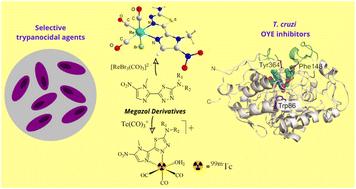
恰加斯病(CD)慢性期的诊断和治疗仍然是一项挑战。有鉴于此,本研究提出了一种潜在的治疗装置,该装置基于被称为megazol的杀锥虫剂和fac-M(CO)3+(M = Re或99mTc)片段。通过改变甲咔唑(LH,H)的外围结构,得到了化合物 LR1,R2(R1 = H,R2 = Me 和 R1 = R2 = Me),并将其用于合成[ReBr(CO)3LR1,R2]复合物。对这些化合物进行了元素分析、傅立叶变换红外光谱、紫外-可见光谱、核磁共振(1H 和 13C)、HR-ESI-MS、HPLC/UPLC 和单晶 XRD 研究。在体外评估了铼复合物对细胞内的克鲁氏锥虫的杀锥活性。除[ReBr(CO)3LMe,Me]复合物外,所有化合物的活性都高于标准药物苯并咪唑(Bzn),而[ReBr(CO)3LH,H]也表现出更高的选择性指数。此外,还通过实验和计算方法评估了甲萘唑及其 ReI 复合物与克柔子老黄酶(TcOYE)的相互作用。数据显示,与 Bzn 相比,megazol 及其金属复合物对 TcOYE 的亲和力更高。最后,成功地用 99mTc 标记了megazol。但结果表明,用作标准的 Re 复合物与 99mTc 复合物并非同源。尽管存在这种差异,但这项研究表明,研究 Re 和 99mTc 与麦加唑的复合物可能会在不久的将来开发出用于 CD 的治疗仪。
Rhenium(i) and technetium(i) complexes with megazol derivatives: towards the development of a theranostic platform for Chagas disease†
The diagnosis and treatment of Chagas disease (CD) in the chronic phase remains a challenge. With that in mind, a potential theranostic device based on the trypanocidal agent known as megazol and the fac-M(CO)3+ (M = Re or 99mTc) fragment is proposed in the present work. The peripheral structure of megazol (LH,H) was modified to obtain the compounds LR1,R2 (R1 = H, R2 = Me and R1 = R2 = Me), which were used in the syntheses of complexes of composition [ReBr(CO)3LR1,R2]. These compounds were studied by elemental analysis, FTIR, UV-vis, NMR (1H and 13C), HR-ESI-MS, HPLC/UPLC and single-crystal XRD. The trypanocidal activity of the rhenium complexes was evaluated in vitro against the intracellular form of Trypanosoma cruzi. With exception of the [ReBr(CO)3LMe,Me] complex, all compounds are more active than the standard drug, benznidazole (Bzn), while [ReBr(CO)3LH,H] also exhibited a much higher selectivity index. In addition, the interaction of megazol and its ReI complex was evaluated with the T. cruzi Old Yellow Enzyme (TcOYE) by both experimental and computational methods. The data showed that megazol as well as its metal complex exhibited a higher affinity for TcOYE compared to Bzn. Finally, the labelling of megazol with 99mTc was successfully carried out. However, the results indicated that the Re complexes used as standards were not homologous with the 99mTc complexes. Despite this discrepancy, this research suggests that the investigation into Re and 99mTc complexes with megazol could lead to the development of a theranostic device for CD in a near future.
期刊介绍:
Dalton Transactions is a journal for all areas of inorganic chemistry, which encompasses the organometallic, bioinorganic and materials chemistry of the elements, with applications including synthesis, catalysis, energy conversion/storage, electrical devices and medicine. Dalton Transactions welcomes high-quality, original submissions in all of these areas and more, where the advancement of knowledge in inorganic chemistry is significant.




 京公网安备 11010802042870号
京ICP备2023020795号-1
京公网安备 11010802042870号
京ICP备2023020795号-1

 分享
分享
 求助内容:
求助内容: 应助结果提醒方式:
 扫码关注我们
