Yuefeng Qiu , Peng Jiang , Wenkai Ye , Jiahao Hu , Bin Zhang , Tuo Ji , Liwen Mu , Xin Feng , Xiaohua Lu , Jiahua Zhu
{"title":"用于环氧丙烷连续温和合成的空间集成电化学-热串联反应","authors":"Yuefeng Qiu , Peng Jiang , Wenkai Ye , Jiahao Hu , Bin Zhang , Tuo Ji , Liwen Mu , Xin Feng , Xiaohua Lu , Jiahua Zhu","doi":"10.1039/d4gc03455d","DOIUrl":null,"url":null,"abstract":"<div><div>An electrochemical–thermal tandem reaction system was designed in this work and enabled the highly efficient synthesis of propylene oxide (PO) at 1 atm without the use of H<sub>2</sub>O<sub>2</sub>. The electrochemical part produced OOH<sup>−</sup> through a 2e<sup>−</sup> oxygen reduction reaction, which migrated and distributed in the full space of a chamber filled with a mixture of solid electrolyte particles and modified (m-) catalysts. Mediated by the relay of OOH<sup>−</sup> and protic solvent methanol, full space tandem reactions were achieved with a high PO selectivity of 95.2% and a productivity of 319.75 mmol g<sub>ecat</sub><sup>−1</sup> h<sup>−1</sup>. A mechanistic study revealed that the m- catalysts accepted the migrated OOH<sup>−</sup> and formed a intermediate, which played a key role in relaying the tandem reactions for an efficient propylene epoxidation reaction. Techno-economic analysis and life-cycle assessment revealed favorable figures for the proposed process compared to the conventional process.</div></div>","PeriodicalId":78,"journal":{"name":"Green Chemistry","volume":"26 22","pages":"Pages 11206-11215"},"PeriodicalIF":10.6000,"publicationDate":"2024-10-08","publicationTypes":"Journal Article","fieldsOfStudy":null,"isOpenAccess":false,"openAccessPdf":"","citationCount":"0","resultStr":"{\"title\":\"A spatially integrated electrochemical–thermal tandem reaction for continuous mild synthesis of propylene oxide†\",\"authors\":\"Yuefeng Qiu , Peng Jiang , Wenkai Ye , Jiahao Hu , Bin Zhang , Tuo Ji , Liwen Mu , Xin Feng , Xiaohua Lu , Jiahua Zhu\",\"doi\":\"10.1039/d4gc03455d\",\"DOIUrl\":null,\"url\":null,\"abstract\":\"<div><div>An electrochemical–thermal tandem reaction system was designed in this work and enabled the highly efficient synthesis of propylene oxide (PO) at 1 atm without the use of H<sub>2</sub>O<sub>2</sub>. The electrochemical part produced OOH<sup>−</sup> through a 2e<sup>−</sup> oxygen reduction reaction, which migrated and distributed in the full space of a chamber filled with a mixture of solid electrolyte particles and modified (m-) catalysts. Mediated by the relay of OOH<sup>−</sup> and protic solvent methanol, full space tandem reactions were achieved with a high PO selectivity of 95.2% and a productivity of 319.75 mmol g<sub>ecat</sub><sup>−1</sup> h<sup>−1</sup>. A mechanistic study revealed that the m- catalysts accepted the migrated OOH<sup>−</sup> and formed a intermediate, which played a key role in relaying the tandem reactions for an efficient propylene epoxidation reaction. Techno-economic analysis and life-cycle assessment revealed favorable figures for the proposed process compared to the conventional process.</div></div>\",\"PeriodicalId\":78,\"journal\":{\"name\":\"Green Chemistry\",\"volume\":\"26 22\",\"pages\":\"Pages 11206-11215\"},\"PeriodicalIF\":10.6000,\"publicationDate\":\"2024-10-08\",\"publicationTypes\":\"Journal Article\",\"fieldsOfStudy\":null,\"isOpenAccess\":false,\"openAccessPdf\":\"\",\"citationCount\":\"0\",\"resultStr\":null,\"platform\":\"Semanticscholar\",\"paperid\":null,\"PeriodicalName\":\"Green Chemistry\",\"FirstCategoryId\":\"92\",\"ListUrlMain\":\"https://www.sciencedirect.com/org/science/article/pii/S1463926224008598\",\"RegionNum\":1,\"RegionCategory\":\"化学\",\"ArticlePicture\":[],\"TitleCN\":null,\"AbstractTextCN\":null,\"PMCID\":null,\"EPubDate\":\"2024/10/2 0:00:00\",\"PubModel\":\"Epub\",\"JCR\":\"Q1\",\"JCRName\":\"CHEMISTRY, MULTIDISCIPLINARY\",\"Score\":null,\"Total\":0}","platform":"Semanticscholar","paperid":null,"PeriodicalName":"Green Chemistry","FirstCategoryId":"92","ListUrlMain":"https://www.sciencedirect.com/org/science/article/pii/S1463926224008598","RegionNum":1,"RegionCategory":"化学","ArticlePicture":[],"TitleCN":null,"AbstractTextCN":null,"PMCID":null,"EPubDate":"2024/10/2 0:00:00","PubModel":"Epub","JCR":"Q1","JCRName":"CHEMISTRY, MULTIDISCIPLINARY","Score":null,"Total":0}
A spatially integrated electrochemical–thermal tandem reaction for continuous mild synthesis of propylene oxide†
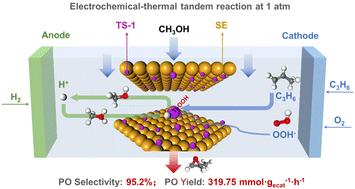
An electrochemical–thermal tandem reaction system was designed in this work and enabled the highly efficient synthesis of propylene oxide (PO) at 1 atm without the use of H2O2. The electrochemical part produced OOH− through a 2e− oxygen reduction reaction, which migrated and distributed in the full space of a chamber filled with a mixture of solid electrolyte particles and modified (m-) catalysts. Mediated by the relay of OOH− and protic solvent methanol, full space tandem reactions were achieved with a high PO selectivity of 95.2% and a productivity of 319.75 mmol gecat−1 h−1. A mechanistic study revealed that the m- catalysts accepted the migrated OOH− and formed a intermediate, which played a key role in relaying the tandem reactions for an efficient propylene epoxidation reaction. Techno-economic analysis and life-cycle assessment revealed favorable figures for the proposed process compared to the conventional process.
期刊介绍:
Green Chemistry is a journal that provides a unique forum for the publication of innovative research on the development of alternative green and sustainable technologies. The scope of Green Chemistry is based on the definition proposed by Anastas and Warner (Green Chemistry: Theory and Practice, P T Anastas and J C Warner, Oxford University Press, Oxford, 1998), which defines green chemistry as the utilisation of a set of principles that reduces or eliminates the use or generation of hazardous substances in the design, manufacture and application of chemical products. Green Chemistry aims to reduce the environmental impact of the chemical enterprise by developing a technology base that is inherently non-toxic to living things and the environment. The journal welcomes submissions on all aspects of research relating to this endeavor and publishes original and significant cutting-edge research that is likely to be of wide general appeal. For a work to be published, it must present a significant advance in green chemistry, including a comparison with existing methods and a demonstration of advantages over those methods.




 京公网安备 11010802042870号
京ICP备2023020795号-1
京公网安备 11010802042870号
京ICP备2023020795号-1

 分享
分享
 求助内容:
求助内容: 应助结果提醒方式:
 扫码关注我们
