Riccardo Vasapolli, Florent Ailloud, Beate Spießberger, Peter Malfertheiner, Sebastian Suerbaum, Christian Schulz
{"title":"实时评估幽门螺杆菌感染以指导分子抗生素耐药性测试:内窥镜检查与胃液分析相结合的方法","authors":"Riccardo Vasapolli, Florent Ailloud, Beate Spießberger, Peter Malfertheiner, Sebastian Suerbaum, Christian Schulz","doi":"10.1111/apt.18378","DOIUrl":null,"url":null,"abstract":"<div>\n \n \n <section>\n \n <h3> Background</h3>\n \n <p><i>Helicobacter pylori</i> antibiotic resistance is the most relevant cause of treatment failure. Antibiotic susceptibility testing (AST) allows for selecting the appropriate eradication regimen.</p>\n </section>\n \n <section>\n \n <h3> Aims</h3>\n \n <p>To assess the diagnostic accuracy of gastric aspirate-based genotypic AST (G-AST) for detecting clarithromycin and levofloxacin resistance compared with conventional phenotypic AST (P-AST).</p>\n </section>\n \n <section>\n \n <h3> Methods</h3>\n \n <p>We recruited 461 consecutive patients scheduled for endoscopy. <i>H. pylori</i> was detected intraprocedurally using Endofaster, a novel method combining endoscopy with gastric juice analysis. For <i>H. pylori</i>-positive patients, we collected gastric aspirates and biopsies. G-AST was performed using DNA extracted from aspirates, with Sanger sequencing to detect polymorphisms in the 23S rRNA and <i>gyrA</i> genes associated, respectively, with resistance to macrolides and fluoroquinolones. P-AST was performed on <i>H. pylori</i> isolated from biopsies using ETEST.</p>\n </section>\n \n <section>\n \n <h3> Results</h3>\n \n <p>One hundred and seventy-eight (40.4%) patients tested positive for <i>H. pylori</i> during endoscopy. Paired gastric biopsies and aspirates were available from 152 <i>H. pylori</i>-positive patients. By P-AST, resistance rates were 15.1% (23/152) for clarithromycin and 18.4% (28/152) for levofloxacin. G-AST showed a high level of agreement with P-AST for clarithromycin (kappa 0.86) and levofloxacin (kappa 0.81) resistance and diagnostic accuracy of 97% and 95%, respectively.</p>\n </section>\n \n <section>\n \n <h3> Conclusions</h3>\n \n <p>The novel method combining endoscopy with immediate intraprocedural gastric juice analysis for the detection of <i>H. pylori</i>, followed by AST in case of a positive finding, is valid and practical for tailoring eradication regimens for <i>H. pylori</i> infection. Genotypic AST from gastric aspirates is highly accurate for detecting clarithromycin and levofloxacin resistances.</p>\n </section>\n </div>","PeriodicalId":121,"journal":{"name":"Alimentary Pharmacology & Therapeutics","volume":"61 3","pages":"465-471"},"PeriodicalIF":6.8000,"publicationDate":"2024-11-12","publicationTypes":"Journal Article","fieldsOfStudy":null,"isOpenAccess":false,"openAccessPdf":"https://onlinelibrary.wiley.com/doi/epdf/10.1111/apt.18378","citationCount":"0","resultStr":"{\"title\":\"Real-Time Assessment of H. pylori Infection to Guide Molecular Antibiotic Resistance Testing: A Combined Endoscopy-Gastric Juice Analysis Approach\",\"authors\":\"Riccardo Vasapolli, Florent Ailloud, Beate Spießberger, Peter Malfertheiner, Sebastian Suerbaum, Christian Schulz\",\"doi\":\"10.1111/apt.18378\",\"DOIUrl\":null,\"url\":null,\"abstract\":\"<div>\\n \\n \\n <section>\\n \\n <h3> Background</h3>\\n \\n <p><i>Helicobacter pylori</i> antibiotic resistance is the most relevant cause of treatment failure. Antibiotic susceptibility testing (AST) allows for selecting the appropriate eradication regimen.</p>\\n </section>\\n \\n <section>\\n \\n <h3> Aims</h3>\\n \\n <p>To assess the diagnostic accuracy of gastric aspirate-based genotypic AST (G-AST) for detecting clarithromycin and levofloxacin resistance compared with conventional phenotypic AST (P-AST).</p>\\n </section>\\n \\n <section>\\n \\n <h3> Methods</h3>\\n \\n <p>We recruited 461 consecutive patients scheduled for endoscopy. <i>H. pylori</i> was detected intraprocedurally using Endofaster, a novel method combining endoscopy with gastric juice analysis. For <i>H. pylori</i>-positive patients, we collected gastric aspirates and biopsies. G-AST was performed using DNA extracted from aspirates, with Sanger sequencing to detect polymorphisms in the 23S rRNA and <i>gyrA</i> genes associated, respectively, with resistance to macrolides and fluoroquinolones. P-AST was performed on <i>H. pylori</i> isolated from biopsies using ETEST.</p>\\n </section>\\n \\n <section>\\n \\n <h3> Results</h3>\\n \\n <p>One hundred and seventy-eight (40.4%) patients tested positive for <i>H. pylori</i> during endoscopy. Paired gastric biopsies and aspirates were available from 152 <i>H. pylori</i>-positive patients. By P-AST, resistance rates were 15.1% (23/152) for clarithromycin and 18.4% (28/152) for levofloxacin. G-AST showed a high level of agreement with P-AST for clarithromycin (kappa 0.86) and levofloxacin (kappa 0.81) resistance and diagnostic accuracy of 97% and 95%, respectively.</p>\\n </section>\\n \\n <section>\\n \\n <h3> Conclusions</h3>\\n \\n <p>The novel method combining endoscopy with immediate intraprocedural gastric juice analysis for the detection of <i>H. pylori</i>, followed by AST in case of a positive finding, is valid and practical for tailoring eradication regimens for <i>H. pylori</i> infection. Genotypic AST from gastric aspirates is highly accurate for detecting clarithromycin and levofloxacin resistances.</p>\\n </section>\\n </div>\",\"PeriodicalId\":121,\"journal\":{\"name\":\"Alimentary Pharmacology & Therapeutics\",\"volume\":\"61 3\",\"pages\":\"465-471\"},\"PeriodicalIF\":6.8000,\"publicationDate\":\"2024-11-12\",\"publicationTypes\":\"Journal Article\",\"fieldsOfStudy\":null,\"isOpenAccess\":false,\"openAccessPdf\":\"https://onlinelibrary.wiley.com/doi/epdf/10.1111/apt.18378\",\"citationCount\":\"0\",\"resultStr\":null,\"platform\":\"Semanticscholar\",\"paperid\":null,\"PeriodicalName\":\"Alimentary Pharmacology & Therapeutics\",\"FirstCategoryId\":\"3\",\"ListUrlMain\":\"https://onlinelibrary.wiley.com/doi/10.1111/apt.18378\",\"RegionNum\":1,\"RegionCategory\":\"医学\",\"ArticlePicture\":[],\"TitleCN\":null,\"AbstractTextCN\":null,\"PMCID\":null,\"EPubDate\":\"\",\"PubModel\":\"\",\"JCR\":\"Q1\",\"JCRName\":\"GASTROENTEROLOGY & HEPATOLOGY\",\"Score\":null,\"Total\":0}","platform":"Semanticscholar","paperid":null,"PeriodicalName":"Alimentary Pharmacology & Therapeutics","FirstCategoryId":"3","ListUrlMain":"https://onlinelibrary.wiley.com/doi/10.1111/apt.18378","RegionNum":1,"RegionCategory":"医学","ArticlePicture":[],"TitleCN":null,"AbstractTextCN":null,"PMCID":null,"EPubDate":"","PubModel":"","JCR":"Q1","JCRName":"GASTROENTEROLOGY & HEPATOLOGY","Score":null,"Total":0}
Real-Time Assessment of H. pylori Infection to Guide Molecular Antibiotic Resistance Testing: A Combined Endoscopy-Gastric Juice Analysis Approach
Background
Helicobacter pylori antibiotic resistance is the most relevant cause of treatment failure. Antibiotic susceptibility testing (AST) allows for selecting the appropriate eradication regimen.
Aims
To assess the diagnostic accuracy of gastric aspirate-based genotypic AST (G-AST) for detecting clarithromycin and levofloxacin resistance compared with conventional phenotypic AST (P-AST).
Methods
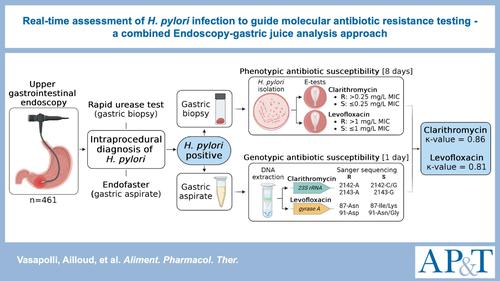
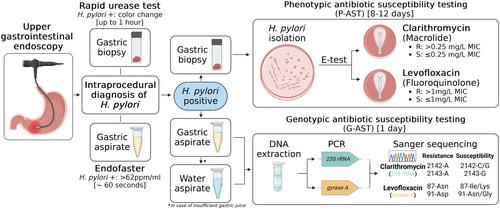
We recruited 461 consecutive patients scheduled for endoscopy. H. pylori was detected intraprocedurally using Endofaster, a novel method combining endoscopy with gastric juice analysis. For H. pylori-positive patients, we collected gastric aspirates and biopsies. G-AST was performed using DNA extracted from aspirates, with Sanger sequencing to detect polymorphisms in the 23S rRNA and gyrA genes associated, respectively, with resistance to macrolides and fluoroquinolones. P-AST was performed on H. pylori isolated from biopsies using ETEST.
Results
One hundred and seventy-eight (40.4%) patients tested positive for H. pylori during endoscopy. Paired gastric biopsies and aspirates were available from 152 H. pylori-positive patients. By P-AST, resistance rates were 15.1% (23/152) for clarithromycin and 18.4% (28/152) for levofloxacin. G-AST showed a high level of agreement with P-AST for clarithromycin (kappa 0.86) and levofloxacin (kappa 0.81) resistance and diagnostic accuracy of 97% and 95%, respectively.
Conclusions
The novel method combining endoscopy with immediate intraprocedural gastric juice analysis for the detection of H. pylori, followed by AST in case of a positive finding, is valid and practical for tailoring eradication regimens for H. pylori infection. Genotypic AST from gastric aspirates is highly accurate for detecting clarithromycin and levofloxacin resistances.
期刊介绍:
Alimentary Pharmacology & Therapeutics is a global pharmacology journal focused on the impact of drugs on the human gastrointestinal and hepato-biliary systems. It covers a diverse range of topics, often with immediate clinical relevance to its readership.




 京公网安备 11010802042870号
京ICP备2023020795号-1
京公网安备 11010802042870号
京ICP备2023020795号-1

 分享
分享
 求助内容:
求助内容: 应助结果提醒方式:
 扫码关注我们
