{"title":"通过柔电效应实现范德华发光二极管的直接线性偏振发射","authors":"Xiaoya Liu, Qiang Fu, Haijun Liao, Zhicong Wu, Xudong Sun, Weiqiao Xia, Xiao Tang, Shixuan Wang, Yuwei Zhang, Zhexing Duan, Takashi Taniguchi, Kenji Watanabe, Liang Ma, Zhenliang Hu, Zhenhua Ni, Junpeng Lu","doi":"10.1002/lpor.202401319","DOIUrl":null,"url":null,"abstract":"<p>Following the rapid development of information technology, modern polarized light, which is a critical component for display and data transmission, has been in demand for miniaturization and high efficiency, rendering two-dimensional (2D) semiconductors potential candidates. The traditional polarized light is usually generated by external optical structures or polarizers that influence the scaling and bring up losses. Previous works have reported polarized light emission from inversion-asymmetric 2D semiconductors such as black phosphorus (BP), black arsenide phosphorus (AsP), and rhenium disulfide (ReS<sub>2</sub>), however, their emission wavelengths are not in the visible range. Here, a direct emission of linearly polarized light is demonstrated from van der Waals light–emitting diodes (vdWLEDs) via the flexoelectric effects by inducing the non-uniform strain in monolayer (ML) transition metal dichalcogenides (TMDCs). In this work, the effects of strain including excitonic binding energy and exciton dipole moment distribution is analyzed by the density functional theory (DFT) then we show that linearly polarized photoluminescence (PL) with a degree of linear polarization (DOLP) of ≈17% can be realized at room temperature (RT), and the polarization angle is perpendicular to the direction of the strain-gradient. By incorporating the strained ML TMDCs into vdWLEDs, electroluminescence (EL) with DOLP of ≈19% can be observed at RT. This work puts forward a direct and universal strategy for fabricating polarized LEDs based on inversion-symmetric semiconductors.</p>","PeriodicalId":204,"journal":{"name":"Laser & Photonics Reviews","volume":"19 4","pages":""},"PeriodicalIF":10.0000,"publicationDate":"2024-11-12","publicationTypes":"Journal Article","fieldsOfStudy":null,"isOpenAccess":false,"openAccessPdf":"","citationCount":"0","resultStr":"{\"title\":\"Direct Linearly Polarized Emission in van der Waals LEDs via Flexoelectric Effect\",\"authors\":\"Xiaoya Liu, Qiang Fu, Haijun Liao, Zhicong Wu, Xudong Sun, Weiqiao Xia, Xiao Tang, Shixuan Wang, Yuwei Zhang, Zhexing Duan, Takashi Taniguchi, Kenji Watanabe, Liang Ma, Zhenliang Hu, Zhenhua Ni, Junpeng Lu\",\"doi\":\"10.1002/lpor.202401319\",\"DOIUrl\":null,\"url\":null,\"abstract\":\"<p>Following the rapid development of information technology, modern polarized light, which is a critical component for display and data transmission, has been in demand for miniaturization and high efficiency, rendering two-dimensional (2D) semiconductors potential candidates. The traditional polarized light is usually generated by external optical structures or polarizers that influence the scaling and bring up losses. Previous works have reported polarized light emission from inversion-asymmetric 2D semiconductors such as black phosphorus (BP), black arsenide phosphorus (AsP), and rhenium disulfide (ReS<sub>2</sub>), however, their emission wavelengths are not in the visible range. Here, a direct emission of linearly polarized light is demonstrated from van der Waals light–emitting diodes (vdWLEDs) via the flexoelectric effects by inducing the non-uniform strain in monolayer (ML) transition metal dichalcogenides (TMDCs). In this work, the effects of strain including excitonic binding energy and exciton dipole moment distribution is analyzed by the density functional theory (DFT) then we show that linearly polarized photoluminescence (PL) with a degree of linear polarization (DOLP) of ≈17% can be realized at room temperature (RT), and the polarization angle is perpendicular to the direction of the strain-gradient. By incorporating the strained ML TMDCs into vdWLEDs, electroluminescence (EL) with DOLP of ≈19% can be observed at RT. This work puts forward a direct and universal strategy for fabricating polarized LEDs based on inversion-symmetric semiconductors.</p>\",\"PeriodicalId\":204,\"journal\":{\"name\":\"Laser & Photonics Reviews\",\"volume\":\"19 4\",\"pages\":\"\"},\"PeriodicalIF\":10.0000,\"publicationDate\":\"2024-11-12\",\"publicationTypes\":\"Journal Article\",\"fieldsOfStudy\":null,\"isOpenAccess\":false,\"openAccessPdf\":\"\",\"citationCount\":\"0\",\"resultStr\":null,\"platform\":\"Semanticscholar\",\"paperid\":null,\"PeriodicalName\":\"Laser & Photonics Reviews\",\"FirstCategoryId\":\"101\",\"ListUrlMain\":\"https://onlinelibrary.wiley.com/doi/10.1002/lpor.202401319\",\"RegionNum\":1,\"RegionCategory\":\"物理与天体物理\",\"ArticlePicture\":[],\"TitleCN\":null,\"AbstractTextCN\":null,\"PMCID\":null,\"EPubDate\":\"\",\"PubModel\":\"\",\"JCR\":\"Q1\",\"JCRName\":\"OPTICS\",\"Score\":null,\"Total\":0}","platform":"Semanticscholar","paperid":null,"PeriodicalName":"Laser & Photonics Reviews","FirstCategoryId":"101","ListUrlMain":"https://onlinelibrary.wiley.com/doi/10.1002/lpor.202401319","RegionNum":1,"RegionCategory":"物理与天体物理","ArticlePicture":[],"TitleCN":null,"AbstractTextCN":null,"PMCID":null,"EPubDate":"","PubModel":"","JCR":"Q1","JCRName":"OPTICS","Score":null,"Total":0}
引用次数: 0
摘要
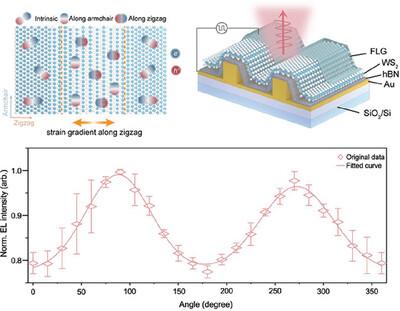
随着信息技术的飞速发展,现代偏振光作为显示和数据传输的重要组成部分,其微型化和高效率的需求使二维(2D)半导体成为潜在的候选材料。传统的偏振光通常由外部光学结构或偏振器产生,这些结构或偏振器会影响光的缩放并带来损耗。之前的研究已经报道了黑磷(BP)、黑砷磷(AsP)和二硫化铼(ReS2)等反转不对称二维半导体的偏振光发射,但它们的发射波长不在可见光范围内。在此,范德华发光二极管(vdWLED)通过在单层(ML)过渡金属二卤化物(TMDCs)中诱导非均匀应变,利用柔电效应直接发射线性偏振光。在这项工作中,我们通过密度泛函理论(DFT)分析了包括激子结合能和激子偶极矩分布在内的应变效应,然后证明在室温(RT)下可以实现线性极化度(DOLP)≈17%的线性极化光致发光(PL),且极化角垂直于应变梯度方向。通过将应变 ML TMDC 纳入 vdWLED,可在室温(RT)下观察到 DOLP ≈19% 的电致发光(EL)。这项工作为基于反转对称半导体制造极化 LED 提出了一种直接而通用的策略。
Direct Linearly Polarized Emission in van der Waals LEDs via Flexoelectric Effect
Following the rapid development of information technology, modern polarized light, which is a critical component for display and data transmission, has been in demand for miniaturization and high efficiency, rendering two-dimensional (2D) semiconductors potential candidates. The traditional polarized light is usually generated by external optical structures or polarizers that influence the scaling and bring up losses. Previous works have reported polarized light emission from inversion-asymmetric 2D semiconductors such as black phosphorus (BP), black arsenide phosphorus (AsP), and rhenium disulfide (ReS2), however, their emission wavelengths are not in the visible range. Here, a direct emission of linearly polarized light is demonstrated from van der Waals light–emitting diodes (vdWLEDs) via the flexoelectric effects by inducing the non-uniform strain in monolayer (ML) transition metal dichalcogenides (TMDCs). In this work, the effects of strain including excitonic binding energy and exciton dipole moment distribution is analyzed by the density functional theory (DFT) then we show that linearly polarized photoluminescence (PL) with a degree of linear polarization (DOLP) of ≈17% can be realized at room temperature (RT), and the polarization angle is perpendicular to the direction of the strain-gradient. By incorporating the strained ML TMDCs into vdWLEDs, electroluminescence (EL) with DOLP of ≈19% can be observed at RT. This work puts forward a direct and universal strategy for fabricating polarized LEDs based on inversion-symmetric semiconductors.
期刊介绍:
Laser & Photonics Reviews is a reputable journal that publishes high-quality Reviews, original Research Articles, and Perspectives in the field of photonics and optics. It covers both theoretical and experimental aspects, including recent groundbreaking research, specific advancements, and innovative applications.
As evidence of its impact and recognition, Laser & Photonics Reviews boasts a remarkable 2022 Impact Factor of 11.0, according to the Journal Citation Reports from Clarivate Analytics (2023). Moreover, it holds impressive rankings in the InCites Journal Citation Reports: in 2021, it was ranked 6th out of 101 in the field of Optics, 15th out of 161 in Applied Physics, and 12th out of 69 in Condensed Matter Physics.
The journal uses the ISSN numbers 1863-8880 for print and 1863-8899 for online publications.





 京公网安备 11010802042870号
京ICP备2023020795号-1
京公网安备 11010802042870号
京ICP备2023020795号-1

 分享
分享
 求助内容:
求助内容: 应助结果提醒方式:
 扫码关注我们
