Muhammad Ikram, Asif Minhas, Arwa A Al-Huqail, Adel M Ghoneim, Sammina Mahmood, Esawy Mahmoud, Maryam Tahira, Muhammad Mehran, Muhammad Faizan Khurram Maqsood, Abdul Rauf, Waqar Ali
{"title":"提高番茄的抗逆性:抗坏血酸和硫处理生物炭在盐碱和非盐碱栽培环境中的效果。","authors":"Muhammad Ikram, Asif Minhas, Arwa A Al-Huqail, Adel M Ghoneim, Sammina Mahmood, Esawy Mahmoud, Maryam Tahira, Muhammad Mehran, Muhammad Faizan Khurram Maqsood, Abdul Rauf, Waqar Ali","doi":"10.1186/s12870-024-05734-w","DOIUrl":null,"url":null,"abstract":"<p><p>The resilience of tomato plants under different cultivation environments, particularly saline and non-saline conditions, was investigated by applying various treatments, including 0.5% Ascorbic Acid (AsA) and 1% Sulphur-treated Biochar (BS). The study evaluated parameters such as fruit length, diameter, yield per plant and pot, Total Soluble Solids (TSS) content, chlorophyll content, electrolyte leakage, enzyme activities (Superoxide Dismutase - SOD, Peroxidase - POD, Catalase - CAT), and nutrient content (Nitrogen - N%, Phosphorus - P%, Potassium - K%). Under saline conditions, significant enhancements were observed in fruit characteristics and yield metrics with the application of AsA and BS individually, with the combined treatment yielding the most substantial improvements. Notably, AsA and BS treatments exhibited varying effects on TSS levels, chlorophyll content, electrolyte leakage, and enzyme activities, with the combination treatment consistently demonstrating superior outcomes. Additionally, nutrient content analysis revealed notable increases, particularly under non-saline conditions, with the combined treatment showcasing the most significant enhancements. Overall, the study underscores the potential of AsA and BS treatments in promoting tomato resilience, offering insights into their synergistic effects on multiple physiological and biochemical parameters crucial for plant growth and productivity.</p>","PeriodicalId":9198,"journal":{"name":"BMC Plant Biology","volume":"24 1","pages":"1053"},"PeriodicalIF":4.8000,"publicationDate":"2024-11-08","publicationTypes":"Journal Article","fieldsOfStudy":null,"isOpenAccess":false,"openAccessPdf":"https://www.ncbi.nlm.nih.gov/pmc/articles/PMC11545619/pdf/","citationCount":"0","resultStr":"{\"title\":\"Promoting tomato resilience: effects of ascorbic acid and sulfur-treated biochar in saline and non-saline cultivation environments.\",\"authors\":\"Muhammad Ikram, Asif Minhas, Arwa A Al-Huqail, Adel M Ghoneim, Sammina Mahmood, Esawy Mahmoud, Maryam Tahira, Muhammad Mehran, Muhammad Faizan Khurram Maqsood, Abdul Rauf, Waqar Ali\",\"doi\":\"10.1186/s12870-024-05734-w\",\"DOIUrl\":null,\"url\":null,\"abstract\":\"<p><p>The resilience of tomato plants under different cultivation environments, particularly saline and non-saline conditions, was investigated by applying various treatments, including 0.5% Ascorbic Acid (AsA) and 1% Sulphur-treated Biochar (BS). The study evaluated parameters such as fruit length, diameter, yield per plant and pot, Total Soluble Solids (TSS) content, chlorophyll content, electrolyte leakage, enzyme activities (Superoxide Dismutase - SOD, Peroxidase - POD, Catalase - CAT), and nutrient content (Nitrogen - N%, Phosphorus - P%, Potassium - K%). Under saline conditions, significant enhancements were observed in fruit characteristics and yield metrics with the application of AsA and BS individually, with the combined treatment yielding the most substantial improvements. Notably, AsA and BS treatments exhibited varying effects on TSS levels, chlorophyll content, electrolyte leakage, and enzyme activities, with the combination treatment consistently demonstrating superior outcomes. Additionally, nutrient content analysis revealed notable increases, particularly under non-saline conditions, with the combined treatment showcasing the most significant enhancements. Overall, the study underscores the potential of AsA and BS treatments in promoting tomato resilience, offering insights into their synergistic effects on multiple physiological and biochemical parameters crucial for plant growth and productivity.</p>\",\"PeriodicalId\":9198,\"journal\":{\"name\":\"BMC Plant Biology\",\"volume\":\"24 1\",\"pages\":\"1053\"},\"PeriodicalIF\":4.8000,\"publicationDate\":\"2024-11-08\",\"publicationTypes\":\"Journal Article\",\"fieldsOfStudy\":null,\"isOpenAccess\":false,\"openAccessPdf\":\"https://www.ncbi.nlm.nih.gov/pmc/articles/PMC11545619/pdf/\",\"citationCount\":\"0\",\"resultStr\":null,\"platform\":\"Semanticscholar\",\"paperid\":null,\"PeriodicalName\":\"BMC Plant Biology\",\"FirstCategoryId\":\"88\",\"ListUrlMain\":\"https://doi.org/10.1186/s12870-024-05734-w\",\"RegionNum\":2,\"RegionCategory\":\"生物学\",\"ArticlePicture\":[],\"TitleCN\":null,\"AbstractTextCN\":null,\"PMCID\":null,\"EPubDate\":\"\",\"PubModel\":\"\",\"JCR\":\"Q1\",\"JCRName\":\"PLANT SCIENCES\",\"Score\":null,\"Total\":0}","platform":"Semanticscholar","paperid":null,"PeriodicalName":"BMC Plant Biology","FirstCategoryId":"88","ListUrlMain":"https://doi.org/10.1186/s12870-024-05734-w","RegionNum":2,"RegionCategory":"生物学","ArticlePicture":[],"TitleCN":null,"AbstractTextCN":null,"PMCID":null,"EPubDate":"","PubModel":"","JCR":"Q1","JCRName":"PLANT SCIENCES","Score":null,"Total":0}
Promoting tomato resilience: effects of ascorbic acid and sulfur-treated biochar in saline and non-saline cultivation environments.
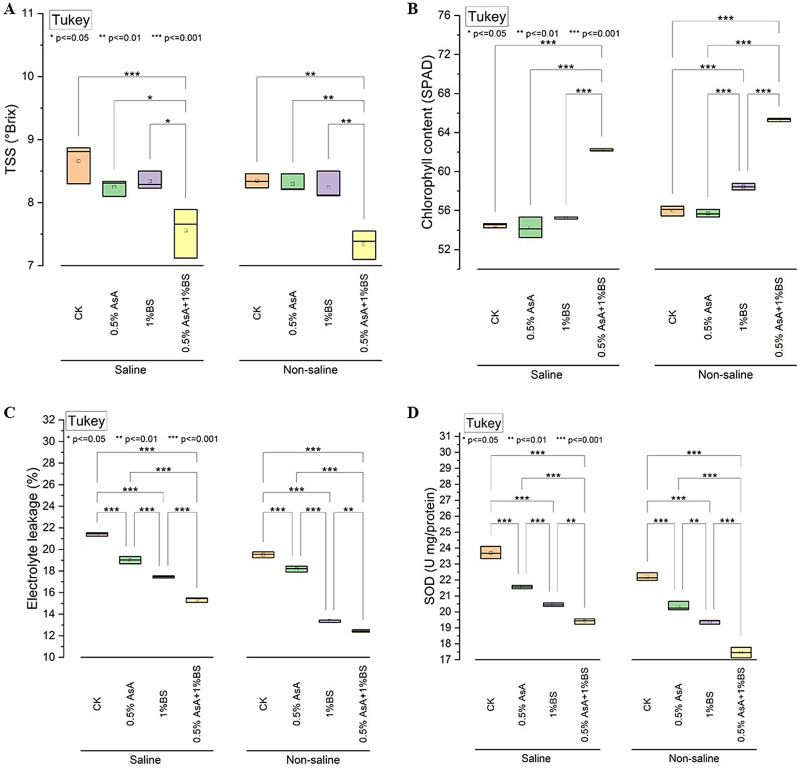
The resilience of tomato plants under different cultivation environments, particularly saline and non-saline conditions, was investigated by applying various treatments, including 0.5% Ascorbic Acid (AsA) and 1% Sulphur-treated Biochar (BS). The study evaluated parameters such as fruit length, diameter, yield per plant and pot, Total Soluble Solids (TSS) content, chlorophyll content, electrolyte leakage, enzyme activities (Superoxide Dismutase - SOD, Peroxidase - POD, Catalase - CAT), and nutrient content (Nitrogen - N%, Phosphorus - P%, Potassium - K%). Under saline conditions, significant enhancements were observed in fruit characteristics and yield metrics with the application of AsA and BS individually, with the combined treatment yielding the most substantial improvements. Notably, AsA and BS treatments exhibited varying effects on TSS levels, chlorophyll content, electrolyte leakage, and enzyme activities, with the combination treatment consistently demonstrating superior outcomes. Additionally, nutrient content analysis revealed notable increases, particularly under non-saline conditions, with the combined treatment showcasing the most significant enhancements. Overall, the study underscores the potential of AsA and BS treatments in promoting tomato resilience, offering insights into their synergistic effects on multiple physiological and biochemical parameters crucial for plant growth and productivity.
期刊介绍:
BMC Plant Biology is an open access, peer-reviewed journal that considers articles on all aspects of plant biology, including molecular, cellular, tissue, organ and whole organism research.






 京公网安备 11010802042870号
京ICP备2023020795号-1
京公网安备 11010802042870号
京ICP备2023020795号-1

 分享
分享
 求助内容:
求助内容: 应助结果提醒方式:
 扫码关注我们
