Bahar Ronnasi, Sophia P. McKillop, May Ourabi, Matthew Perry, Heather A. Sharp, Benoît H. Lessard
{"title":"壳聚糖电子器件:酸强度和塑化添加剂对器件性能的重要性","authors":"Bahar Ronnasi, Sophia P. McKillop, May Ourabi, Matthew Perry, Heather A. Sharp, Benoît H. Lessard","doi":"10.1021/acsami.4c10508","DOIUrl":null,"url":null,"abstract":"A rise in demand for disposable consumer electronics such as smart packaging, wearable electronics, and single-use point-of-source sensors requires the development of eco-friendly and compostable electronic materials. Chitosan is derived from crustacean waste and offers high dielectric constant values without requiring rigorous purification, making it sustainable for large-scale electronic device manufacturing. When processed in acidic media, the protonated backbone of chitosan pairs with counterions from the acid dissociation to form chitosan thin films with electrical double layers (EDLs) and tunable capacitive properties. We report the importance of the choice of acid when processing chitosan by surveying a series of halogenated and biosourced acids with varying p<i>K</i><sub>a</sub> values and solutions with different pH values. Oxalic acid outperforms other acids, with a maximum areal capacitance of 161 nF·mm<sup>–2</sup>. Tartaric acid and citric acid, despite lower capacitance values, showed promising results with a stable EDL capacitance and high reproducibility, making them optimal for large-area manufacturing. The incorporation of sorbitol as a plasticizer boosts the EDL formation onset of all chitosan–acid combinations to 1 × 10<sup>3</sup>–10<sup>5</sup> Hz and improves reproducibility. High-performing single-walled carbon nanotube thin film transistors were made using chitosan-based dielectrics treated with different acids with and without sorbitol, leading to transconductance as high as ≈5.2 μS and <i>I</i><sub>on</sub>/<i>I</i><sub>off</sub> of 10<sup>5</sup>. The capacitors and transistors remain functional after one year of storage in ambient conditions. Overall, this study demonstrates durable high-performance electronics based on chitosan and stresses the importance of processing acid and the use of plasticizing additives, such as sorbitol.","PeriodicalId":5,"journal":{"name":"ACS Applied Materials & Interfaces","volume":"6 1","pages":""},"PeriodicalIF":8.2000,"publicationDate":"2024-11-13","publicationTypes":"Journal Article","fieldsOfStudy":null,"isOpenAccess":false,"openAccessPdf":"","citationCount":"0","resultStr":"{\"title\":\"Chitosan-Based Electronics: The Importance of Acid Strength and Plasticizing Additives on Device Performance\",\"authors\":\"Bahar Ronnasi, Sophia P. McKillop, May Ourabi, Matthew Perry, Heather A. Sharp, Benoît H. Lessard\",\"doi\":\"10.1021/acsami.4c10508\",\"DOIUrl\":null,\"url\":null,\"abstract\":\"A rise in demand for disposable consumer electronics such as smart packaging, wearable electronics, and single-use point-of-source sensors requires the development of eco-friendly and compostable electronic materials. Chitosan is derived from crustacean waste and offers high dielectric constant values without requiring rigorous purification, making it sustainable for large-scale electronic device manufacturing. When processed in acidic media, the protonated backbone of chitosan pairs with counterions from the acid dissociation to form chitosan thin films with electrical double layers (EDLs) and tunable capacitive properties. We report the importance of the choice of acid when processing chitosan by surveying a series of halogenated and biosourced acids with varying p<i>K</i><sub>a</sub> values and solutions with different pH values. Oxalic acid outperforms other acids, with a maximum areal capacitance of 161 nF·mm<sup>–2</sup>. Tartaric acid and citric acid, despite lower capacitance values, showed promising results with a stable EDL capacitance and high reproducibility, making them optimal for large-area manufacturing. The incorporation of sorbitol as a plasticizer boosts the EDL formation onset of all chitosan–acid combinations to 1 × 10<sup>3</sup>–10<sup>5</sup> Hz and improves reproducibility. High-performing single-walled carbon nanotube thin film transistors were made using chitosan-based dielectrics treated with different acids with and without sorbitol, leading to transconductance as high as ≈5.2 μS and <i>I</i><sub>on</sub>/<i>I</i><sub>off</sub> of 10<sup>5</sup>. The capacitors and transistors remain functional after one year of storage in ambient conditions. Overall, this study demonstrates durable high-performance electronics based on chitosan and stresses the importance of processing acid and the use of plasticizing additives, such as sorbitol.\",\"PeriodicalId\":5,\"journal\":{\"name\":\"ACS Applied Materials & Interfaces\",\"volume\":\"6 1\",\"pages\":\"\"},\"PeriodicalIF\":8.2000,\"publicationDate\":\"2024-11-13\",\"publicationTypes\":\"Journal Article\",\"fieldsOfStudy\":null,\"isOpenAccess\":false,\"openAccessPdf\":\"\",\"citationCount\":\"0\",\"resultStr\":null,\"platform\":\"Semanticscholar\",\"paperid\":null,\"PeriodicalName\":\"ACS Applied Materials & Interfaces\",\"FirstCategoryId\":\"88\",\"ListUrlMain\":\"https://doi.org/10.1021/acsami.4c10508\",\"RegionNum\":2,\"RegionCategory\":\"材料科学\",\"ArticlePicture\":[],\"TitleCN\":null,\"AbstractTextCN\":null,\"PMCID\":null,\"EPubDate\":\"\",\"PubModel\":\"\",\"JCR\":\"Q1\",\"JCRName\":\"MATERIALS SCIENCE, MULTIDISCIPLINARY\",\"Score\":null,\"Total\":0}","platform":"Semanticscholar","paperid":null,"PeriodicalName":"ACS Applied Materials & Interfaces","FirstCategoryId":"88","ListUrlMain":"https://doi.org/10.1021/acsami.4c10508","RegionNum":2,"RegionCategory":"材料科学","ArticlePicture":[],"TitleCN":null,"AbstractTextCN":null,"PMCID":null,"EPubDate":"","PubModel":"","JCR":"Q1","JCRName":"MATERIALS SCIENCE, MULTIDISCIPLINARY","Score":null,"Total":0}
Chitosan-Based Electronics: The Importance of Acid Strength and Plasticizing Additives on Device Performance
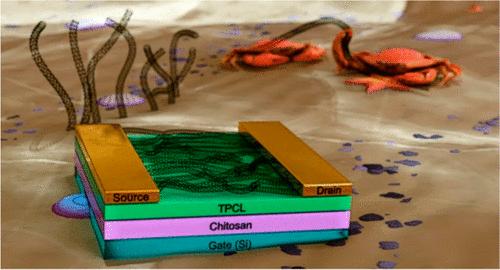
A rise in demand for disposable consumer electronics such as smart packaging, wearable electronics, and single-use point-of-source sensors requires the development of eco-friendly and compostable electronic materials. Chitosan is derived from crustacean waste and offers high dielectric constant values without requiring rigorous purification, making it sustainable for large-scale electronic device manufacturing. When processed in acidic media, the protonated backbone of chitosan pairs with counterions from the acid dissociation to form chitosan thin films with electrical double layers (EDLs) and tunable capacitive properties. We report the importance of the choice of acid when processing chitosan by surveying a series of halogenated and biosourced acids with varying pKa values and solutions with different pH values. Oxalic acid outperforms other acids, with a maximum areal capacitance of 161 nF·mm–2. Tartaric acid and citric acid, despite lower capacitance values, showed promising results with a stable EDL capacitance and high reproducibility, making them optimal for large-area manufacturing. The incorporation of sorbitol as a plasticizer boosts the EDL formation onset of all chitosan–acid combinations to 1 × 10³–105 Hz and improves reproducibility. High-performing single-walled carbon nanotube thin film transistors were made using chitosan-based dielectrics treated with different acids with and without sorbitol, leading to transconductance as high as ≈5.2 μS and Ion/Ioff of 105. The capacitors and transistors remain functional after one year of storage in ambient conditions. Overall, this study demonstrates durable high-performance electronics based on chitosan and stresses the importance of processing acid and the use of plasticizing additives, such as sorbitol.
期刊介绍:
ACS Applied Materials & Interfaces is a leading interdisciplinary journal that brings together chemists, engineers, physicists, and biologists to explore the development and utilization of newly-discovered materials and interfacial processes for specific applications. Our journal has experienced remarkable growth since its establishment in 2009, both in terms of the number of articles published and the impact of the research showcased. We are proud to foster a truly global community, with the majority of published articles originating from outside the United States, reflecting the rapid growth of applied research worldwide.




 京公网安备 11010802042870号
京ICP备2023020795号-1
京公网安备 11010802042870号
京ICP备2023020795号-1

 分享
分享
 求助内容:
求助内容: 应助结果提醒方式:
 扫码关注我们
