Huseyn Babayev, Ali Sahin, Sena Ardicli, Mubeccel Akdis, Cezmi A. Akdis
{"title":"追溯 IgG4 的进化途径:对免疫耐受和调节的影响。","authors":"Huseyn Babayev, Ali Sahin, Sena Ardicli, Mubeccel Akdis, Cezmi A. Akdis","doi":"10.1111/all.16383","DOIUrl":null,"url":null,"abstract":"<p>Immunoglobulin (Ig) G4 is functionally unique and the least abundant subclass of human IgG. It possesses distinctive structural and functional characteristics that modulate immune responses and confer tolerance, particularly in allergies, autoimmune diseases, and chronic infections. The evolutionary trajectory of IgG4 can provide insights into its role in immune regulation, interaction with pathogens, and implications for various pathologies. Although beneficial in reactions to allergens or parasites, IgG4 responses can also be harmful in autoimmune diseases and antitumor responses. The need for the immune system to adapt to various pathogens has influenced the evolutionary development of IgG subclasses, including IgG4. IgG4's evolutionary role is thought to be associated with its capacity to mediate immune tolerance to environmental antigens, decrease tissue injury and inflammation against parasites, and to regulate immune responses to other high-dose antigen exposure-related chronic conditions.<span><sup>1, 2</sup></span></p><p>IgG4 is upregulated in response to high dose allergen exposure in allergen immunotherapy-receiving patients and multiple beestings-receiving beekepers.<span><sup>2</sup></span> Given these properties, many humanized antibody-based biological therapies have been developed on IgG4 isotype antibodies. Three major features of IgG4 contribute to its association with immune tolerance and relatively less immune activation compared to other IgGs and IgE. They can be listed as (i) the Fab-arm exchange capacity that prevents cross-linking of the two arms upon antigen/allergen binding, (ii) the missing complement activation due to reduced C1q binding, and (iii) the decreased affinity of Fc receptors to IgG4 on effector cells, resulting in diminished antibody-dependent cellular cytotoxicity. Although cytokines involved in allergy pathogenesis such as IL-4, IL-13, and IL-21 are also known to be important for IgG4 induction, IL-10, known for its anti-inflammatory properties, has been identified and also shown to play a role in the induction of IgG4 and the reduction of IgE levels in human cell cultures and humanized mice.<span><sup>3, 4</sup></span> In addition, a distinct functional IgG4-expressing memory B cell subset with B regulatory cell and angiogenesis properties has been recently demonstrated.<span><sup>2, 4, 5</sup></span></p><p>Interestingly, the unique features of IgG4, such as Fab-arm exchange, are not universally present across all species, indicating a more recent evolutionary adaptation in primates.<span><sup>6</sup></span> Our comprehensive in silico analysis across the great apes (<i>Hominidae</i> family) provided deep insights into the evolutionary landscape of IgG4-like proteins. We focused on both amino acid level differences and their reflection on the evolution of great apes that underpin species-specific immunological adaptations. We started our study by characterizing the Ig heavy chain (<i>IGH</i>) locus in telomere-to-telomere sequences, defining IgG4-like proteins based on both sequence homology and their position in relation to other immunoglobulins within the locus (Figure 1A). The detailed methodology is provided in the supplementary file—Data S1. The presence of the second <i>IGHA</i> and <i>IGHE</i> paralog, <i>IGHG</i>, positioned next to the second farthest <i>IGHE</i> gene from <i>IGHM</i>, is defined as <i>IGHG4</i>. Initial sequence alignment of IgG4-like proteins revealed their ubiquitous presence in all examined great apes, including humans (<i>Homo sapiens</i>), bonobos (<i>Pan paniscus</i>), chimpanzees (<i>Pan troglodytes</i>), gorillas (<i>Gorilla gorilla</i>), and Sumatran and Bornean orangutans (<i>Pongo abelii</i>, <i>Pongo pygmeaus</i>, respectively). (Supplementary—Data S2.1) In both orangutans, the IgG4-like proteins are more similar to human IgG1 than other Ig subtypes, suggesting a recent duplication event of IgG1 that one of the duplicants had IgG4-specific mutations (Figure 1A–C). In the investigation of repeat sequences to find switch regions and enhancers, we found that the lengths of switch regions are comparable across the species. The mirror image of the switch region 2 (LS2), located next to exon 6 (M2), was shortened almost twice after <i>Homo-Pan</i> common ancestor (HPCA), and this finding was not reported previously (Figure 1D, Supplementary—Data S2.2).</p><p>The primary difference between the IgG4 protein sequences (Supplementary—Data S2.3) lies in the hinge region. The hinge region is three amino acids shorter in the <i>Homo-Gorilla</i> common ancestor (HGCA), decreasing the affinity of IgG4 proteins to both cellular Fc receptors and the C1q component. This difference is also present between human IgG1 and human IgG4; this three-amino acid length deletion region contains one cysteine residue, which makes the disulfide bond with the light chain (Figure 2). The shorter hinge region decreases Fab-arm flexibility and antigen-binding and cross-linking capacity.<span><sup>7</sup></span> The P228S substitution in the hinge region is present in the HPCA and is responsible for the disulfide bond rearrangement during Fab arm exchange.</p><p>The K409R substitution, present in HGCA and all its successors, facilitates Fab arm exchange by destabilizing the C<sub>H</sub>3-C<sub>H</sub>3 interface.<span><sup>7, 8</sup></span> The lower hinge region, BC-loop, and FG-loop are the primary interactors with C1q and Fcγ receptors. The L234F alteration in the lower hinge region, present in HGCA but absent in Pongo species, was associated with reduced binding to FcγRI.<span><sup>9</sup></span> H268Q substitution in the BC loop, A330S, and P331S substitutions in the FG-loop, also present in HGCA, are known to reduce C1q binding and Fcγ receptors.<span><sup>10</sup></span> Although there are no changes in hexamerization-related residues, Fab-arm exchange also affects the complement activation by blocking the hexameric immune complex formation.<span><sup>1</sup></span></p><p>In conclusion, IgG4 is apparently a recently evolved Ig isotype that has developed distinct functional properties, possibly as a part of the essential immune tolerance mechanisms. The evolution of IgG4 reflects the complex interplay between the immune system and environmental pressures. It is tempting to speculate that the evolutionary pressures could have been survival with certain parasite infections. IgG4s unique properties, such as the ability to undergo Fab-arm exchange and reduced affinity for Fc receptors, underline its role in immune regulation and tolerance. Our study reveals significant amino acid-level modifications in IgG4-like proteins across great apes, which may reflect evolutionary pressures tailored to each species' unique ecological niches and pathogen landscapes. Further research into the evolutionary biology of IgG4 and IgG4-expressing memory B cells and their immune regulatory mechanisms will provide deeper insights into understanding IgG4-related diseases and developing new therapeutic methods.</p><p>H.B., A.S., and C.A.A. conceptualized and designed the study. H.B., A.S., and S.A. were responsible for data collection, analysis, and interpretation of the results. C.A.A. and M.A. supervised the process. H.B. wrote the manuscript with input from A.S., S.A., M.A., and C.A.A. All authors critically reviewed the content, approved the final version for submission, and consented to publication.</p><p>None.</p><p>The authors declare that they have no relevant conflict of interest.</p>","PeriodicalId":122,"journal":{"name":"Allergy","volume":"80 1","pages":"346-348"},"PeriodicalIF":11.3000,"publicationDate":"2024-11-16","publicationTypes":"Journal Article","fieldsOfStudy":null,"isOpenAccess":false,"openAccessPdf":"https://www.ncbi.nlm.nih.gov/pmc/articles/PMC11724249/pdf/","citationCount":"0","resultStr":"{\"title\":\"Tracing the evolutionary pathway of IgG4: Implications for immune tolerance and regulation\",\"authors\":\"Huseyn Babayev, Ali Sahin, Sena Ardicli, Mubeccel Akdis, Cezmi A. Akdis\",\"doi\":\"10.1111/all.16383\",\"DOIUrl\":null,\"url\":null,\"abstract\":\"<p>Immunoglobulin (Ig) G4 is functionally unique and the least abundant subclass of human IgG. It possesses distinctive structural and functional characteristics that modulate immune responses and confer tolerance, particularly in allergies, autoimmune diseases, and chronic infections. The evolutionary trajectory of IgG4 can provide insights into its role in immune regulation, interaction with pathogens, and implications for various pathologies. Although beneficial in reactions to allergens or parasites, IgG4 responses can also be harmful in autoimmune diseases and antitumor responses. The need for the immune system to adapt to various pathogens has influenced the evolutionary development of IgG subclasses, including IgG4. IgG4's evolutionary role is thought to be associated with its capacity to mediate immune tolerance to environmental antigens, decrease tissue injury and inflammation against parasites, and to regulate immune responses to other high-dose antigen exposure-related chronic conditions.<span><sup>1, 2</sup></span></p><p>IgG4 is upregulated in response to high dose allergen exposure in allergen immunotherapy-receiving patients and multiple beestings-receiving beekepers.<span><sup>2</sup></span> Given these properties, many humanized antibody-based biological therapies have been developed on IgG4 isotype antibodies. Three major features of IgG4 contribute to its association with immune tolerance and relatively less immune activation compared to other IgGs and IgE. They can be listed as (i) the Fab-arm exchange capacity that prevents cross-linking of the two arms upon antigen/allergen binding, (ii) the missing complement activation due to reduced C1q binding, and (iii) the decreased affinity of Fc receptors to IgG4 on effector cells, resulting in diminished antibody-dependent cellular cytotoxicity. Although cytokines involved in allergy pathogenesis such as IL-4, IL-13, and IL-21 are also known to be important for IgG4 induction, IL-10, known for its anti-inflammatory properties, has been identified and also shown to play a role in the induction of IgG4 and the reduction of IgE levels in human cell cultures and humanized mice.<span><sup>3, 4</sup></span> In addition, a distinct functional IgG4-expressing memory B cell subset with B regulatory cell and angiogenesis properties has been recently demonstrated.<span><sup>2, 4, 5</sup></span></p><p>Interestingly, the unique features of IgG4, such as Fab-arm exchange, are not universally present across all species, indicating a more recent evolutionary adaptation in primates.<span><sup>6</sup></span> Our comprehensive in silico analysis across the great apes (<i>Hominidae</i> family) provided deep insights into the evolutionary landscape of IgG4-like proteins. We focused on both amino acid level differences and their reflection on the evolution of great apes that underpin species-specific immunological adaptations. We started our study by characterizing the Ig heavy chain (<i>IGH</i>) locus in telomere-to-telomere sequences, defining IgG4-like proteins based on both sequence homology and their position in relation to other immunoglobulins within the locus (Figure 1A). The detailed methodology is provided in the supplementary file—Data S1. The presence of the second <i>IGHA</i> and <i>IGHE</i> paralog, <i>IGHG</i>, positioned next to the second farthest <i>IGHE</i> gene from <i>IGHM</i>, is defined as <i>IGHG4</i>. Initial sequence alignment of IgG4-like proteins revealed their ubiquitous presence in all examined great apes, including humans (<i>Homo sapiens</i>), bonobos (<i>Pan paniscus</i>), chimpanzees (<i>Pan troglodytes</i>), gorillas (<i>Gorilla gorilla</i>), and Sumatran and Bornean orangutans (<i>Pongo abelii</i>, <i>Pongo pygmeaus</i>, respectively). (Supplementary—Data S2.1) In both orangutans, the IgG4-like proteins are more similar to human IgG1 than other Ig subtypes, suggesting a recent duplication event of IgG1 that one of the duplicants had IgG4-specific mutations (Figure 1A–C). In the investigation of repeat sequences to find switch regions and enhancers, we found that the lengths of switch regions are comparable across the species. The mirror image of the switch region 2 (LS2), located next to exon 6 (M2), was shortened almost twice after <i>Homo-Pan</i> common ancestor (HPCA), and this finding was not reported previously (Figure 1D, Supplementary—Data S2.2).</p><p>The primary difference between the IgG4 protein sequences (Supplementary—Data S2.3) lies in the hinge region. The hinge region is three amino acids shorter in the <i>Homo-Gorilla</i> common ancestor (HGCA), decreasing the affinity of IgG4 proteins to both cellular Fc receptors and the C1q component. This difference is also present between human IgG1 and human IgG4; this three-amino acid length deletion region contains one cysteine residue, which makes the disulfide bond with the light chain (Figure 2). The shorter hinge region decreases Fab-arm flexibility and antigen-binding and cross-linking capacity.<span><sup>7</sup></span> The P228S substitution in the hinge region is present in the HPCA and is responsible for the disulfide bond rearrangement during Fab arm exchange.</p><p>The K409R substitution, present in HGCA and all its successors, facilitates Fab arm exchange by destabilizing the C<sub>H</sub>3-C<sub>H</sub>3 interface.<span><sup>7, 8</sup></span> The lower hinge region, BC-loop, and FG-loop are the primary interactors with C1q and Fcγ receptors. The L234F alteration in the lower hinge region, present in HGCA but absent in Pongo species, was associated with reduced binding to FcγRI.<span><sup>9</sup></span> H268Q substitution in the BC loop, A330S, and P331S substitutions in the FG-loop, also present in HGCA, are known to reduce C1q binding and Fcγ receptors.<span><sup>10</sup></span> Although there are no changes in hexamerization-related residues, Fab-arm exchange also affects the complement activation by blocking the hexameric immune complex formation.<span><sup>1</sup></span></p><p>In conclusion, IgG4 is apparently a recently evolved Ig isotype that has developed distinct functional properties, possibly as a part of the essential immune tolerance mechanisms. The evolution of IgG4 reflects the complex interplay between the immune system and environmental pressures. It is tempting to speculate that the evolutionary pressures could have been survival with certain parasite infections. IgG4s unique properties, such as the ability to undergo Fab-arm exchange and reduced affinity for Fc receptors, underline its role in immune regulation and tolerance. Our study reveals significant amino acid-level modifications in IgG4-like proteins across great apes, which may reflect evolutionary pressures tailored to each species' unique ecological niches and pathogen landscapes. Further research into the evolutionary biology of IgG4 and IgG4-expressing memory B cells and their immune regulatory mechanisms will provide deeper insights into understanding IgG4-related diseases and developing new therapeutic methods.</p><p>H.B., A.S., and C.A.A. conceptualized and designed the study. H.B., A.S., and S.A. were responsible for data collection, analysis, and interpretation of the results. C.A.A. and M.A. supervised the process. H.B. wrote the manuscript with input from A.S., S.A., M.A., and C.A.A. All authors critically reviewed the content, approved the final version for submission, and consented to publication.</p><p>None.</p><p>The authors declare that they have no relevant conflict of interest.</p>\",\"PeriodicalId\":122,\"journal\":{\"name\":\"Allergy\",\"volume\":\"80 1\",\"pages\":\"346-348\"},\"PeriodicalIF\":11.3000,\"publicationDate\":\"2024-11-16\",\"publicationTypes\":\"Journal Article\",\"fieldsOfStudy\":null,\"isOpenAccess\":false,\"openAccessPdf\":\"https://www.ncbi.nlm.nih.gov/pmc/articles/PMC11724249/pdf/\",\"citationCount\":\"0\",\"resultStr\":null,\"platform\":\"Semanticscholar\",\"paperid\":null,\"PeriodicalName\":\"Allergy\",\"FirstCategoryId\":\"3\",\"ListUrlMain\":\"https://onlinelibrary.wiley.com/doi/10.1111/all.16383\",\"RegionNum\":1,\"RegionCategory\":\"医学\",\"ArticlePicture\":[],\"TitleCN\":null,\"AbstractTextCN\":null,\"PMCID\":null,\"EPubDate\":\"\",\"PubModel\":\"\",\"JCR\":\"Q1\",\"JCRName\":\"ALLERGY\",\"Score\":null,\"Total\":0}","platform":"Semanticscholar","paperid":null,"PeriodicalName":"Allergy","FirstCategoryId":"3","ListUrlMain":"https://onlinelibrary.wiley.com/doi/10.1111/all.16383","RegionNum":1,"RegionCategory":"医学","ArticlePicture":[],"TitleCN":null,"AbstractTextCN":null,"PMCID":null,"EPubDate":"","PubModel":"","JCR":"Q1","JCRName":"ALLERGY","Score":null,"Total":0}
Tracing the evolutionary pathway of IgG4: Implications for immune tolerance and regulation
Immunoglobulin (Ig) G4 is functionally unique and the least abundant subclass of human IgG. It possesses distinctive structural and functional characteristics that modulate immune responses and confer tolerance, particularly in allergies, autoimmune diseases, and chronic infections. The evolutionary trajectory of IgG4 can provide insights into its role in immune regulation, interaction with pathogens, and implications for various pathologies. Although beneficial in reactions to allergens or parasites, IgG4 responses can also be harmful in autoimmune diseases and antitumor responses. The need for the immune system to adapt to various pathogens has influenced the evolutionary development of IgG subclasses, including IgG4. IgG4's evolutionary role is thought to be associated with its capacity to mediate immune tolerance to environmental antigens, decrease tissue injury and inflammation against parasites, and to regulate immune responses to other high-dose antigen exposure-related chronic conditions.1, 2
IgG4 is upregulated in response to high dose allergen exposure in allergen immunotherapy-receiving patients and multiple beestings-receiving beekepers.2 Given these properties, many humanized antibody-based biological therapies have been developed on IgG4 isotype antibodies. Three major features of IgG4 contribute to its association with immune tolerance and relatively less immune activation compared to other IgGs and IgE. They can be listed as (i) the Fab-arm exchange capacity that prevents cross-linking of the two arms upon antigen/allergen binding, (ii) the missing complement activation due to reduced C1q binding, and (iii) the decreased affinity of Fc receptors to IgG4 on effector cells, resulting in diminished antibody-dependent cellular cytotoxicity. Although cytokines involved in allergy pathogenesis such as IL-4, IL-13, and IL-21 are also known to be important for IgG4 induction, IL-10, known for its anti-inflammatory properties, has been identified and also shown to play a role in the induction of IgG4 and the reduction of IgE levels in human cell cultures and humanized mice.3, 4 In addition, a distinct functional IgG4-expressing memory B cell subset with B regulatory cell and angiogenesis properties has been recently demonstrated.2, 4, 5
Interestingly, the unique features of IgG4, such as Fab-arm exchange, are not universally present across all species, indicating a more recent evolutionary adaptation in primates.6 Our comprehensive in silico analysis across the great apes (Hominidae family) provided deep insights into the evolutionary landscape of IgG4-like proteins. We focused on both amino acid level differences and their reflection on the evolution of great apes that underpin species-specific immunological adaptations. We started our study by characterizing the Ig heavy chain (IGH) locus in telomere-to-telomere sequences, defining IgG4-like proteins based on both sequence homology and their position in relation to other immunoglobulins within the locus (Figure 1A). The detailed methodology is provided in the supplementary file—Data S1. The presence of the second IGHA and IGHE paralog, IGHG, positioned next to the second farthest IGHE gene from IGHM, is defined as IGHG4. Initial sequence alignment of IgG4-like proteins revealed their ubiquitous presence in all examined great apes, including humans (Homo sapiens), bonobos (Pan paniscus), chimpanzees (Pan troglodytes), gorillas (Gorilla gorilla), and Sumatran and Bornean orangutans (Pongo abelii, Pongo pygmeaus, respectively). (Supplementary—Data S2.1) In both orangutans, the IgG4-like proteins are more similar to human IgG1 than other Ig subtypes, suggesting a recent duplication event of IgG1 that one of the duplicants had IgG4-specific mutations (Figure 1A–C). In the investigation of repeat sequences to find switch regions and enhancers, we found that the lengths of switch regions are comparable across the species. The mirror image of the switch region 2 (LS2), located next to exon 6 (M2), was shortened almost twice after Homo-Pan common ancestor (HPCA), and this finding was not reported previously (Figure 1D, Supplementary—Data S2.2).
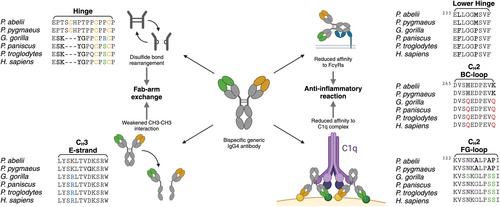
The primary difference between the IgG4 protein sequences (Supplementary—Data S2.3) lies in the hinge region. The hinge region is three amino acids shorter in the Homo-Gorilla common ancestor (HGCA), decreasing the affinity of IgG4 proteins to both cellular Fc receptors and the C1q component. This difference is also present between human IgG1 and human IgG4; this three-amino acid length deletion region contains one cysteine residue, which makes the disulfide bond with the light chain (Figure 2). The shorter hinge region decreases Fab-arm flexibility and antigen-binding and cross-linking capacity.7 The P228S substitution in the hinge region is present in the HPCA and is responsible for the disulfide bond rearrangement during Fab arm exchange.
The K409R substitution, present in HGCA and all its successors, facilitates Fab arm exchange by destabilizing the CH3-CH3 interface.7, 8 The lower hinge region, BC-loop, and FG-loop are the primary interactors with C1q and Fcγ receptors. The L234F alteration in the lower hinge region, present in HGCA but absent in Pongo species, was associated with reduced binding to FcγRI.9 H268Q substitution in the BC loop, A330S, and P331S substitutions in the FG-loop, also present in HGCA, are known to reduce C1q binding and Fcγ receptors.10 Although there are no changes in hexamerization-related residues, Fab-arm exchange also affects the complement activation by blocking the hexameric immune complex formation.1
In conclusion, IgG4 is apparently a recently evolved Ig isotype that has developed distinct functional properties, possibly as a part of the essential immune tolerance mechanisms. The evolution of IgG4 reflects the complex interplay between the immune system and environmental pressures. It is tempting to speculate that the evolutionary pressures could have been survival with certain parasite infections. IgG4s unique properties, such as the ability to undergo Fab-arm exchange and reduced affinity for Fc receptors, underline its role in immune regulation and tolerance. Our study reveals significant amino acid-level modifications in IgG4-like proteins across great apes, which may reflect evolutionary pressures tailored to each species' unique ecological niches and pathogen landscapes. Further research into the evolutionary biology of IgG4 and IgG4-expressing memory B cells and their immune regulatory mechanisms will provide deeper insights into understanding IgG4-related diseases and developing new therapeutic methods.
H.B., A.S., and C.A.A. conceptualized and designed the study. H.B., A.S., and S.A. were responsible for data collection, analysis, and interpretation of the results. C.A.A. and M.A. supervised the process. H.B. wrote the manuscript with input from A.S., S.A., M.A., and C.A.A. All authors critically reviewed the content, approved the final version for submission, and consented to publication.
None.
The authors declare that they have no relevant conflict of interest.
期刊介绍:
Allergy is an international and multidisciplinary journal that aims to advance, impact, and communicate all aspects of the discipline of Allergy/Immunology. It publishes original articles, reviews, position papers, guidelines, editorials, news and commentaries, letters to the editors, and correspondences. The journal accepts articles based on their scientific merit and quality.
Allergy seeks to maintain contact between basic and clinical Allergy/Immunology and encourages contributions from contributors and readers from all countries. In addition to its publication, Allergy also provides abstracting and indexing information. Some of the databases that include Allergy abstracts are Abstracts on Hygiene & Communicable Disease, Academic Search Alumni Edition, AgBiotech News & Information, AGRICOLA Database, Biological Abstracts, PubMed Dietary Supplement Subset, and Global Health, among others.




 京公网安备 11010802042870号
京ICP备2023020795号-1
京公网安备 11010802042870号
京ICP备2023020795号-1

 分享
分享
 求助内容:
求助内容: 应助结果提醒方式:
 扫码关注我们
