Olivier Fesneau, Kimberly A. Samson, Wesley Rosales, Bretton Jones, Tarsem Moudgil, Bernard A. Fox, Venkatesh Rajamanickam, Thomas Duhen
{"title":"IL-12 驱动人类肿瘤反应性 CD8 T 细胞上抑制性受体 NKG2A 的表达","authors":"Olivier Fesneau, Kimberly A. Samson, Wesley Rosales, Bretton Jones, Tarsem Moudgil, Bernard A. Fox, Venkatesh Rajamanickam, Thomas Duhen","doi":"10.1038/s41467-024-54420-w","DOIUrl":null,"url":null,"abstract":"<p>Blockade of NKG2A/HLA-E interaction is a promising strategy to unleash the anti-tumor response. Yet the role of NKG2A<sup>+</sup> CD8 T cells in the anti-tumor response and the regulation of NKG2A expression on human tumor-infiltrating T cells are still poorly understood. Here, by performing CITE-seq on T cells derived from head and neck squamous cell carcinoma and colorectal cancer, we show that NKG2A expression is induced on CD8 T cells differentiating into cytotoxic, CD39<sup>+</sup>CD103<sup>+</sup> double positive (DP) cells, a phenotype associated with tumor-reactive T cells. This developmental trajectory leads to TCR repertoire overlap between the NKG2A<sup>–</sup> and NKG2A<sup>+</sup> DP CD8 T cells, suggesting shared antigen specificities. Mechanistically, IL-12 is essential for the expression of NKG2A on CD8 T cells in a CD40/CD40L- dependent manner, in conjunction with TCR stimulation. Our study thus reveals that NKG2A is induced by IL-12 on human tumor-reactive CD8 T cells exposed to a TGF-β-rich environment, highlighting an underappreciated immuno-regulatory feedback loop dependent on IL-12 stimulation.</p>","PeriodicalId":19066,"journal":{"name":"Nature Communications","volume":"99 1","pages":""},"PeriodicalIF":18.1000,"publicationDate":"2024-11-18","publicationTypes":"Journal Article","fieldsOfStudy":null,"isOpenAccess":false,"openAccessPdf":"","citationCount":"0","resultStr":"{\"title\":\"IL-12 drives the expression of the inhibitory receptor NKG2A on human tumor-reactive CD8 T cells\",\"authors\":\"Olivier Fesneau, Kimberly A. Samson, Wesley Rosales, Bretton Jones, Tarsem Moudgil, Bernard A. Fox, Venkatesh Rajamanickam, Thomas Duhen\",\"doi\":\"10.1038/s41467-024-54420-w\",\"DOIUrl\":null,\"url\":null,\"abstract\":\"<p>Blockade of NKG2A/HLA-E interaction is a promising strategy to unleash the anti-tumor response. Yet the role of NKG2A<sup>+</sup> CD8 T cells in the anti-tumor response and the regulation of NKG2A expression on human tumor-infiltrating T cells are still poorly understood. Here, by performing CITE-seq on T cells derived from head and neck squamous cell carcinoma and colorectal cancer, we show that NKG2A expression is induced on CD8 T cells differentiating into cytotoxic, CD39<sup>+</sup>CD103<sup>+</sup> double positive (DP) cells, a phenotype associated with tumor-reactive T cells. This developmental trajectory leads to TCR repertoire overlap between the NKG2A<sup>–</sup> and NKG2A<sup>+</sup> DP CD8 T cells, suggesting shared antigen specificities. Mechanistically, IL-12 is essential for the expression of NKG2A on CD8 T cells in a CD40/CD40L- dependent manner, in conjunction with TCR stimulation. Our study thus reveals that NKG2A is induced by IL-12 on human tumor-reactive CD8 T cells exposed to a TGF-β-rich environment, highlighting an underappreciated immuno-regulatory feedback loop dependent on IL-12 stimulation.</p>\",\"PeriodicalId\":19066,\"journal\":{\"name\":\"Nature Communications\",\"volume\":\"99 1\",\"pages\":\"\"},\"PeriodicalIF\":18.1000,\"publicationDate\":\"2024-11-18\",\"publicationTypes\":\"Journal Article\",\"fieldsOfStudy\":null,\"isOpenAccess\":false,\"openAccessPdf\":\"\",\"citationCount\":\"0\",\"resultStr\":null,\"platform\":\"Semanticscholar\",\"paperid\":null,\"PeriodicalName\":\"Nature Communications\",\"FirstCategoryId\":\"103\",\"ListUrlMain\":\"https://doi.org/10.1038/s41467-024-54420-w\",\"RegionNum\":1,\"RegionCategory\":\"综合性期刊\",\"ArticlePicture\":[],\"TitleCN\":null,\"AbstractTextCN\":null,\"PMCID\":null,\"EPubDate\":\"\",\"PubModel\":\"\",\"JCR\":\"Q1\",\"JCRName\":\"MULTIDISCIPLINARY SCIENCES\",\"Score\":null,\"Total\":0}","platform":"Semanticscholar","paperid":null,"PeriodicalName":"Nature Communications","FirstCategoryId":"103","ListUrlMain":"https://doi.org/10.1038/s41467-024-54420-w","RegionNum":1,"RegionCategory":"综合性期刊","ArticlePicture":[],"TitleCN":null,"AbstractTextCN":null,"PMCID":null,"EPubDate":"","PubModel":"","JCR":"Q1","JCRName":"MULTIDISCIPLINARY SCIENCES","Score":null,"Total":0}
引用次数: 0
摘要
阻断 NKG2A/HLA-E 相互作用是一种很有希望的释放抗肿瘤反应的策略。然而,人们对 NKG2A+ CD8 T 细胞在抗肿瘤反应中的作用以及 NKG2A 在人类肿瘤浸润 T 细胞上的表达调控仍知之甚少。在这里,通过对来自头颈部鳞状细胞癌和结肠直肠癌的 T 细胞进行 CITE-seq 分析,我们发现 NKG2A 在分化成细胞毒性、CD39+CD103+ 双阳性(DP)细胞的 CD8 T 细胞上被诱导表达,这种表型与肿瘤反应性 T 细胞相关。这种发育轨迹导致 NKG2A- 和 NKG2A+ DP CD8 T 细胞的 TCR 反应谱重叠,表明它们具有共同的抗原特异性。从机理上讲,IL-12 是 CD8 T 细胞表达 NKG2A 的必要条件,它与 TCR 刺激一起以 CD40/CD40L 依赖性方式进行。因此,我们的研究揭示了在富含 TGF-β 的环境中,IL-12 可诱导人肿瘤反应性 CD8 T 细胞表达 NKG2A,这凸显了一种依赖于 IL-12 刺激的免疫调节反馈环路尚未得到充分重视。
IL-12 drives the expression of the inhibitory receptor NKG2A on human tumor-reactive CD8 T cells
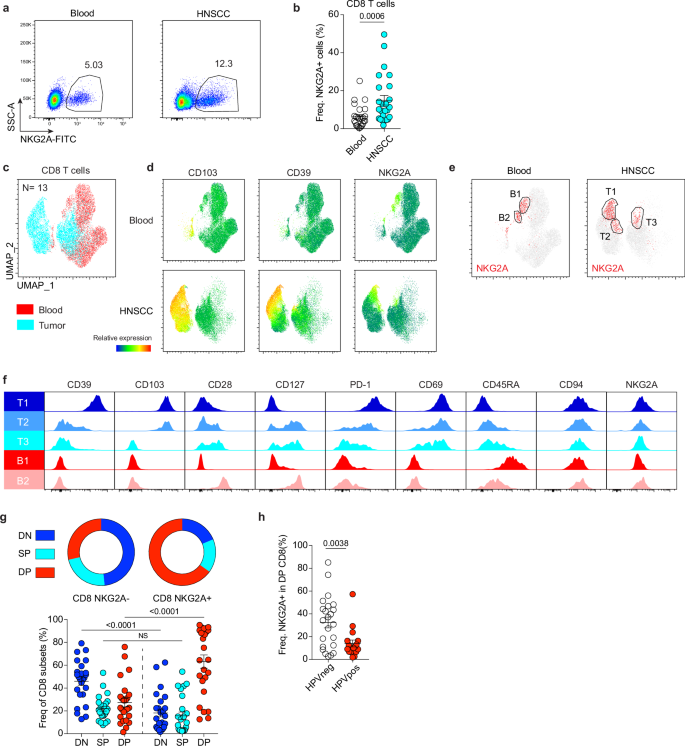
Blockade of NKG2A/HLA-E interaction is a promising strategy to unleash the anti-tumor response. Yet the role of NKG2A+ CD8 T cells in the anti-tumor response and the regulation of NKG2A expression on human tumor-infiltrating T cells are still poorly understood. Here, by performing CITE-seq on T cells derived from head and neck squamous cell carcinoma and colorectal cancer, we show that NKG2A expression is induced on CD8 T cells differentiating into cytotoxic, CD39+CD103+ double positive (DP) cells, a phenotype associated with tumor-reactive T cells. This developmental trajectory leads to TCR repertoire overlap between the NKG2A– and NKG2A+ DP CD8 T cells, suggesting shared antigen specificities. Mechanistically, IL-12 is essential for the expression of NKG2A on CD8 T cells in a CD40/CD40L- dependent manner, in conjunction with TCR stimulation. Our study thus reveals that NKG2A is induced by IL-12 on human tumor-reactive CD8 T cells exposed to a TGF-β-rich environment, highlighting an underappreciated immuno-regulatory feedback loop dependent on IL-12 stimulation.
期刊介绍:
Nature Communications, an open-access journal, publishes high-quality research spanning all areas of the natural sciences. Papers featured in the journal showcase significant advances relevant to specialists in each respective field. With a 2-year impact factor of 16.6 (2022) and a median time of 8 days from submission to the first editorial decision, Nature Communications is committed to rapid dissemination of research findings. As a multidisciplinary journal, it welcomes contributions from biological, health, physical, chemical, Earth, social, mathematical, applied, and engineering sciences, aiming to highlight important breakthroughs within each domain.




 京公网安备 11010802042870号
京ICP备2023020795号-1
京公网安备 11010802042870号
京ICP备2023020795号-1

 分享
分享
 求助内容:
求助内容: 应助结果提醒方式:
 扫码关注我们
