Guillaume Baudry, Nicolas Girerd, Maja Cikes, Maria Generosa Crespo-Leiro, Kevin Damman, Clément Delmas, Stamatis Adamopoulos, Sanem Nalbantgil, Hoong Sern Lim, Frank Ruschitzka, Marco Metra, Finn Gustafsson
{"title":"了解并应用 ESC/HFA 指南管理晚期心力衰竭","authors":"Guillaume Baudry, Nicolas Girerd, Maja Cikes, Maria Generosa Crespo-Leiro, Kevin Damman, Clément Delmas, Stamatis Adamopoulos, Sanem Nalbantgil, Hoong Sern Lim, Frank Ruschitzka, Marco Metra, Finn Gustafsson","doi":"10.1002/ejhf.3530","DOIUrl":null,"url":null,"abstract":"<div>\n \n <section>\n \n <h3> Aims</h3>\n \n <p>Management of advanced heart failure (HF) remains challenging despite specific sections in the 2021 European Society of Cardiology/Heart Failure Association (ESC/HFA) guidelines, with delays in referrals exacerbating the issue. This study aimed to evaluate the awareness and implementation of these guidelines among cardiologists and identify barriers to effective referral.</p>\n </section>\n \n <section>\n \n <h3> Methods and results</h3>\n \n <p>From June to October 2023, an online survey was disseminated through the ESC mailing list, targeting cardiologists across Europe. The survey investigated four areas: guideline awareness, healthcare network organization, clinical case management, and perceptions of mechanical circulatory support (MCS) outcomes. Respondents were categorized into heart failure cardiologists (HFCs), general cardiologists (GCs), and other participants (OPs). Among 497 respondents, 25% were heart HFCs, 40% were GCs, and 35% were OPs. A total of 84% of HFCs reported a high level of guideline knowledge, compared to 57% of GCs and 62% of OPs (<i>p</i> < 0.001). Additionally, 76% of HFCs ‘regularly or always’ used ESC/HFA criteria to identify advanced HF, compared to 44% of GCs and 48% of OPs (<i>p</i> < 0.001). Correct responses regarding the recommendation class for heart transplantation were 84%, 55%, and 60% (<i>p</i> < 0.0001), and for MCS as a bridge to transplantation, 69%, 65%, and 55% (<i>p</i> = 0.018) among HFCs, GCs, and OPs, respectively. Referring patients with severe HF to a tertiary centre team was found to be ‘very difficult’ or ‘difficult’ by 8.4% of HFCs, 19.6% of GCs, and 18.2% of OPs (<i>p</i> = 0.0005).</p>\n </section>\n \n <section>\n \n <h3> Conclusion</h3>\n \n <p>The study highlights significant disparities in knowledge and application of advanced HF guidelines among cardiologists, revealing an opportunity for educational initiatives. The difficulty in referring patients to tertiary centres underscores the need to improve the referral pathway for advanced HF patients.</p>\n </section>\n </div>","PeriodicalId":164,"journal":{"name":"European Journal of Heart Failure","volume":"27 6","pages":"1126-1135"},"PeriodicalIF":10.8000,"publicationDate":"2024-11-19","publicationTypes":"Journal Article","fieldsOfStudy":null,"isOpenAccess":false,"openAccessPdf":"https://onlinelibrary.wiley.com/doi/epdf/10.1002/ejhf.3530","citationCount":"0","resultStr":"{\"title\":\"Knowledge and application of ESC/HFA guidelines in the management of advanced heart failure\",\"authors\":\"Guillaume Baudry, Nicolas Girerd, Maja Cikes, Maria Generosa Crespo-Leiro, Kevin Damman, Clément Delmas, Stamatis Adamopoulos, Sanem Nalbantgil, Hoong Sern Lim, Frank Ruschitzka, Marco Metra, Finn Gustafsson\",\"doi\":\"10.1002/ejhf.3530\",\"DOIUrl\":null,\"url\":null,\"abstract\":\"<div>\\n \\n <section>\\n \\n <h3> Aims</h3>\\n \\n <p>Management of advanced heart failure (HF) remains challenging despite specific sections in the 2021 European Society of Cardiology/Heart Failure Association (ESC/HFA) guidelines, with delays in referrals exacerbating the issue. This study aimed to evaluate the awareness and implementation of these guidelines among cardiologists and identify barriers to effective referral.</p>\\n </section>\\n \\n <section>\\n \\n <h3> Methods and results</h3>\\n \\n <p>From June to October 2023, an online survey was disseminated through the ESC mailing list, targeting cardiologists across Europe. The survey investigated four areas: guideline awareness, healthcare network organization, clinical case management, and perceptions of mechanical circulatory support (MCS) outcomes. Respondents were categorized into heart failure cardiologists (HFCs), general cardiologists (GCs), and other participants (OPs). Among 497 respondents, 25% were heart HFCs, 40% were GCs, and 35% were OPs. A total of 84% of HFCs reported a high level of guideline knowledge, compared to 57% of GCs and 62% of OPs (<i>p</i> < 0.001). Additionally, 76% of HFCs ‘regularly or always’ used ESC/HFA criteria to identify advanced HF, compared to 44% of GCs and 48% of OPs (<i>p</i> < 0.001). Correct responses regarding the recommendation class for heart transplantation were 84%, 55%, and 60% (<i>p</i> < 0.0001), and for MCS as a bridge to transplantation, 69%, 65%, and 55% (<i>p</i> = 0.018) among HFCs, GCs, and OPs, respectively. Referring patients with severe HF to a tertiary centre team was found to be ‘very difficult’ or ‘difficult’ by 8.4% of HFCs, 19.6% of GCs, and 18.2% of OPs (<i>p</i> = 0.0005).</p>\\n </section>\\n \\n <section>\\n \\n <h3> Conclusion</h3>\\n \\n <p>The study highlights significant disparities in knowledge and application of advanced HF guidelines among cardiologists, revealing an opportunity for educational initiatives. The difficulty in referring patients to tertiary centres underscores the need to improve the referral pathway for advanced HF patients.</p>\\n </section>\\n </div>\",\"PeriodicalId\":164,\"journal\":{\"name\":\"European Journal of Heart Failure\",\"volume\":\"27 6\",\"pages\":\"1126-1135\"},\"PeriodicalIF\":10.8000,\"publicationDate\":\"2024-11-19\",\"publicationTypes\":\"Journal Article\",\"fieldsOfStudy\":null,\"isOpenAccess\":false,\"openAccessPdf\":\"https://onlinelibrary.wiley.com/doi/epdf/10.1002/ejhf.3530\",\"citationCount\":\"0\",\"resultStr\":null,\"platform\":\"Semanticscholar\",\"paperid\":null,\"PeriodicalName\":\"European Journal of Heart Failure\",\"FirstCategoryId\":\"3\",\"ListUrlMain\":\"https://onlinelibrary.wiley.com/doi/10.1002/ejhf.3530\",\"RegionNum\":1,\"RegionCategory\":\"医学\",\"ArticlePicture\":[],\"TitleCN\":null,\"AbstractTextCN\":null,\"PMCID\":null,\"EPubDate\":\"\",\"PubModel\":\"\",\"JCR\":\"Q1\",\"JCRName\":\"CARDIAC & CARDIOVASCULAR SYSTEMS\",\"Score\":null,\"Total\":0}","platform":"Semanticscholar","paperid":null,"PeriodicalName":"European Journal of Heart Failure","FirstCategoryId":"3","ListUrlMain":"https://onlinelibrary.wiley.com/doi/10.1002/ejhf.3530","RegionNum":1,"RegionCategory":"医学","ArticlePicture":[],"TitleCN":null,"AbstractTextCN":null,"PMCID":null,"EPubDate":"","PubModel":"","JCR":"Q1","JCRName":"CARDIAC & CARDIOVASCULAR SYSTEMS","Score":null,"Total":0}
Knowledge and application of ESC/HFA guidelines in the management of advanced heart failure
Aims
Management of advanced heart failure (HF) remains challenging despite specific sections in the 2021 European Society of Cardiology/Heart Failure Association (ESC/HFA) guidelines, with delays in referrals exacerbating the issue. This study aimed to evaluate the awareness and implementation of these guidelines among cardiologists and identify barriers to effective referral.
Methods and results
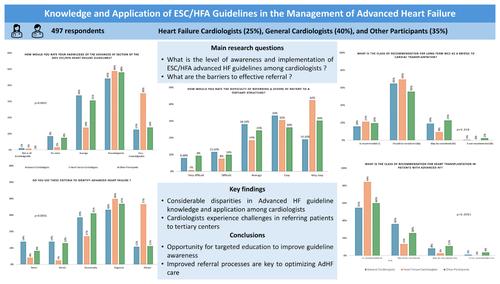
From June to October 2023, an online survey was disseminated through the ESC mailing list, targeting cardiologists across Europe. The survey investigated four areas: guideline awareness, healthcare network organization, clinical case management, and perceptions of mechanical circulatory support (MCS) outcomes. Respondents were categorized into heart failure cardiologists (HFCs), general cardiologists (GCs), and other participants (OPs). Among 497 respondents, 25% were heart HFCs, 40% were GCs, and 35% were OPs. A total of 84% of HFCs reported a high level of guideline knowledge, compared to 57% of GCs and 62% of OPs (p < 0.001). Additionally, 76% of HFCs ‘regularly or always’ used ESC/HFA criteria to identify advanced HF, compared to 44% of GCs and 48% of OPs (p < 0.001). Correct responses regarding the recommendation class for heart transplantation were 84%, 55%, and 60% (p < 0.0001), and for MCS as a bridge to transplantation, 69%, 65%, and 55% (p = 0.018) among HFCs, GCs, and OPs, respectively. Referring patients with severe HF to a tertiary centre team was found to be ‘very difficult’ or ‘difficult’ by 8.4% of HFCs, 19.6% of GCs, and 18.2% of OPs (p = 0.0005).
Conclusion
The study highlights significant disparities in knowledge and application of advanced HF guidelines among cardiologists, revealing an opportunity for educational initiatives. The difficulty in referring patients to tertiary centres underscores the need to improve the referral pathway for advanced HF patients.
期刊介绍:
European Journal of Heart Failure is an international journal dedicated to advancing knowledge in the field of heart failure management. The journal publishes reviews and editorials aimed at improving understanding, prevention, investigation, and treatment of heart failure. It covers various disciplines such as molecular and cellular biology, pathology, physiology, electrophysiology, pharmacology, clinical sciences, social sciences, and population sciences. The journal welcomes submissions of manuscripts on basic, clinical, and population sciences, as well as original contributions on nursing, care of the elderly, primary care, health economics, and other related specialist fields. It is published monthly and has a readership that includes cardiologists, emergency room physicians, intensivists, internists, general physicians, cardiac nurses, diabetologists, epidemiologists, basic scientists focusing on cardiovascular research, and those working in rehabilitation. The journal is abstracted and indexed in various databases such as Academic Search, Embase, MEDLINE/PubMed, and Science Citation Index.





 京公网安备 11010802042870号
京ICP备2023020795号-1
京公网安备 11010802042870号
京ICP备2023020795号-1

 分享
分享
 求助内容:
求助内容: 应助结果提醒方式:
 扫码关注我们
