{"title":"脂肪肝患者血清铁蛋白水平与肝脏相关事件:纵向队列研究","authors":"Byeong Geun Song, Myung Ji Goh, Wonseok Kang, Geum-Youn Gwak, Yong-Han Paik, Moon Seok Choi, Joon Hyeok Lee, Dong Hyun Sinn","doi":"10.1111/apt.18402","DOIUrl":null,"url":null,"abstract":"<div>\n \n \n <section>\n \n <h3> Background</h3>\n \n <p>Serum ferritin has been suggested as a potential biomarker associated with disease progression in metabolic dysfunction–associated steatotic liver disease (MASLD).</p>\n </section>\n \n <section>\n \n <h3> Aims</h3>\n \n <p>We investigated the association between serum ferritin levels and liver-related events (LREs) in individuals with steatotic liver disease (SLD).</p>\n </section>\n \n <section>\n \n <h3> Methods</h3>\n \n <p>This cohort study included 17,560 adults with SLD (MASLD [<i>n</i> = 15,744], MASLD with increased alcohol intake (MetALD) [<i>n</i> = 1103] and cryptogenic SLD [<i>n</i> = 713]) without LRE at baseline. A steatotic liver was diagnosed using ultrasound, and LRE was defined as the development of decompensation (ascites, variceal bleeding and hepatic encephalopathy) or hepatocellular carcinoma. Participants were categorised into high (≥ 300 μg/L for males, ≥ 200 μg/L for females) or normal to low (< 300 μg/L for males, < 200 μg/L for females) ferritin levels.</p>\n </section>\n \n <section>\n \n <h3> Results</h3>\n \n <p>During 211,425 person-years of follow-up (median: 12.3 years), 74 incident LRE cases were identified, with 63 cases in MASLD, 10 in MetALD and 1 in cryptogenic SLD. The multivariable-adjusted hazard ratio (aHR) for LRE comparing individuals with high and normal-to-low ferritin level was 3.13 (95% confidence interval [CI] 1.89–5.18). Increased risk of LRE in individuals with high serum ferritin level compared to those with normal to low serum ferritin level was consistent across SLD subtypes (aHR 2.69, 95% CI 1.55–4.67 for MASLD; aHR 5.73, 95% CI 1.31–25.0 for MetALD), and SLD severity assessed by Fibrosis-4 (FIB-4) index (aHR 2.38, 95% CI 1.34–4.21 for FIB-4 ≥ 1.3; aHR 3.13, 95% CI 1.18–8.29 for FIB-4 < 1.3).</p>\n </section>\n \n <section>\n \n <h3> Conclusions</h3>\n \n <p>Serum ferritin levels correlated with the risk of LRE in patients with SLD.</p>\n </section>\n </div>","PeriodicalId":121,"journal":{"name":"Alimentary Pharmacology & Therapeutics","volume":"61 3","pages":"491-500"},"PeriodicalIF":6.7000,"publicationDate":"2024-11-21","publicationTypes":"Journal Article","fieldsOfStudy":null,"isOpenAccess":false,"openAccessPdf":"","citationCount":"0","resultStr":"{\"title\":\"Serum Ferritin Levels and Liver-Related Events in Individuals With Steatotic Liver Disease: A Longitudinal Cohort Study\",\"authors\":\"Byeong Geun Song, Myung Ji Goh, Wonseok Kang, Geum-Youn Gwak, Yong-Han Paik, Moon Seok Choi, Joon Hyeok Lee, Dong Hyun Sinn\",\"doi\":\"10.1111/apt.18402\",\"DOIUrl\":null,\"url\":null,\"abstract\":\"<div>\\n \\n \\n <section>\\n \\n <h3> Background</h3>\\n \\n <p>Serum ferritin has been suggested as a potential biomarker associated with disease progression in metabolic dysfunction–associated steatotic liver disease (MASLD).</p>\\n </section>\\n \\n <section>\\n \\n <h3> Aims</h3>\\n \\n <p>We investigated the association between serum ferritin levels and liver-related events (LREs) in individuals with steatotic liver disease (SLD).</p>\\n </section>\\n \\n <section>\\n \\n <h3> Methods</h3>\\n \\n <p>This cohort study included 17,560 adults with SLD (MASLD [<i>n</i> = 15,744], MASLD with increased alcohol intake (MetALD) [<i>n</i> = 1103] and cryptogenic SLD [<i>n</i> = 713]) without LRE at baseline. A steatotic liver was diagnosed using ultrasound, and LRE was defined as the development of decompensation (ascites, variceal bleeding and hepatic encephalopathy) or hepatocellular carcinoma. Participants were categorised into high (≥ 300 μg/L for males, ≥ 200 μg/L for females) or normal to low (< 300 μg/L for males, < 200 μg/L for females) ferritin levels.</p>\\n </section>\\n \\n <section>\\n \\n <h3> Results</h3>\\n \\n <p>During 211,425 person-years of follow-up (median: 12.3 years), 74 incident LRE cases were identified, with 63 cases in MASLD, 10 in MetALD and 1 in cryptogenic SLD. The multivariable-adjusted hazard ratio (aHR) for LRE comparing individuals with high and normal-to-low ferritin level was 3.13 (95% confidence interval [CI] 1.89–5.18). Increased risk of LRE in individuals with high serum ferritin level compared to those with normal to low serum ferritin level was consistent across SLD subtypes (aHR 2.69, 95% CI 1.55–4.67 for MASLD; aHR 5.73, 95% CI 1.31–25.0 for MetALD), and SLD severity assessed by Fibrosis-4 (FIB-4) index (aHR 2.38, 95% CI 1.34–4.21 for FIB-4 ≥ 1.3; aHR 3.13, 95% CI 1.18–8.29 for FIB-4 < 1.3).</p>\\n </section>\\n \\n <section>\\n \\n <h3> Conclusions</h3>\\n \\n <p>Serum ferritin levels correlated with the risk of LRE in patients with SLD.</p>\\n </section>\\n </div>\",\"PeriodicalId\":121,\"journal\":{\"name\":\"Alimentary Pharmacology & Therapeutics\",\"volume\":\"61 3\",\"pages\":\"491-500\"},\"PeriodicalIF\":6.7000,\"publicationDate\":\"2024-11-21\",\"publicationTypes\":\"Journal Article\",\"fieldsOfStudy\":null,\"isOpenAccess\":false,\"openAccessPdf\":\"\",\"citationCount\":\"0\",\"resultStr\":null,\"platform\":\"Semanticscholar\",\"paperid\":null,\"PeriodicalName\":\"Alimentary Pharmacology & Therapeutics\",\"FirstCategoryId\":\"3\",\"ListUrlMain\":\"https://onlinelibrary.wiley.com/doi/10.1111/apt.18402\",\"RegionNum\":1,\"RegionCategory\":\"医学\",\"ArticlePicture\":[],\"TitleCN\":null,\"AbstractTextCN\":null,\"PMCID\":null,\"EPubDate\":\"\",\"PubModel\":\"\",\"JCR\":\"Q1\",\"JCRName\":\"GASTROENTEROLOGY & HEPATOLOGY\",\"Score\":null,\"Total\":0}","platform":"Semanticscholar","paperid":null,"PeriodicalName":"Alimentary Pharmacology & Therapeutics","FirstCategoryId":"3","ListUrlMain":"https://onlinelibrary.wiley.com/doi/10.1111/apt.18402","RegionNum":1,"RegionCategory":"医学","ArticlePicture":[],"TitleCN":null,"AbstractTextCN":null,"PMCID":null,"EPubDate":"","PubModel":"","JCR":"Q1","JCRName":"GASTROENTEROLOGY & HEPATOLOGY","Score":null,"Total":0}
Serum Ferritin Levels and Liver-Related Events in Individuals With Steatotic Liver Disease: A Longitudinal Cohort Study
Background
Serum ferritin has been suggested as a potential biomarker associated with disease progression in metabolic dysfunction–associated steatotic liver disease (MASLD).
Aims
We investigated the association between serum ferritin levels and liver-related events (LREs) in individuals with steatotic liver disease (SLD).
Methods
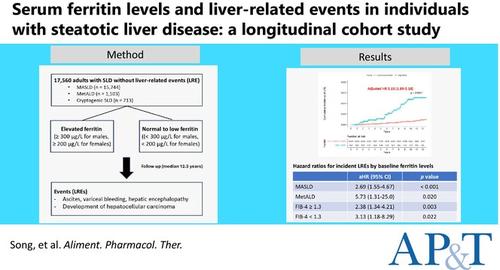
This cohort study included 17,560 adults with SLD (MASLD [n = 15,744], MASLD with increased alcohol intake (MetALD) [n = 1103] and cryptogenic SLD [n = 713]) without LRE at baseline. A steatotic liver was diagnosed using ultrasound, and LRE was defined as the development of decompensation (ascites, variceal bleeding and hepatic encephalopathy) or hepatocellular carcinoma. Participants were categorised into high (≥ 300 μg/L for males, ≥ 200 μg/L for females) or normal to low (< 300 μg/L for males, < 200 μg/L for females) ferritin levels.
Results
During 211,425 person-years of follow-up (median: 12.3 years), 74 incident LRE cases were identified, with 63 cases in MASLD, 10 in MetALD and 1 in cryptogenic SLD. The multivariable-adjusted hazard ratio (aHR) for LRE comparing individuals with high and normal-to-low ferritin level was 3.13 (95% confidence interval [CI] 1.89–5.18). Increased risk of LRE in individuals with high serum ferritin level compared to those with normal to low serum ferritin level was consistent across SLD subtypes (aHR 2.69, 95% CI 1.55–4.67 for MASLD; aHR 5.73, 95% CI 1.31–25.0 for MetALD), and SLD severity assessed by Fibrosis-4 (FIB-4) index (aHR 2.38, 95% CI 1.34–4.21 for FIB-4 ≥ 1.3; aHR 3.13, 95% CI 1.18–8.29 for FIB-4 < 1.3).
Conclusions
Serum ferritin levels correlated with the risk of LRE in patients with SLD.
期刊介绍:
Alimentary Pharmacology & Therapeutics is a global pharmacology journal focused on the impact of drugs on the human gastrointestinal and hepato-biliary systems. It covers a diverse range of topics, often with immediate clinical relevance to its readership.




 京公网安备 11010802042870号
京ICP备2023020795号-1
京公网安备 11010802042870号
京ICP备2023020795号-1

 分享
分享
 求助内容:
求助内容: 应助结果提醒方式:
 扫码关注我们
