Hong Wang, Jian Li, Ke Liu, Lei Lei, Xun Chen and Degao Wang
{"title":"利用分子层沉积将分子催化剂稳定在金属氧化物表面,以实现高效的水氧化。","authors":"Hong Wang, Jian Li, Ke Liu, Lei Lei, Xun Chen and Degao Wang","doi":"10.1039/D4MH01274G","DOIUrl":null,"url":null,"abstract":"<p >The stabilization of metal–oxide-bound molecular catalysts is essential for enhancing their lifetime and commercial viability in heterogeneous catalysis. This is particularly relevant in dye-sensitized photoelectrochemical cells (DSPECs), where the surface-bound chromophores and catalysts exhibit instability in aqueous environments, particularly at elevated pH levels. In this work, we have successfully employed molecular layer deposition (MLD) to stabilize ruthenium-based catalysts (RuCP(OH<small><sub>2</sub></small>)<small><sup>2+</sup></small>, denoted as RuCat). The application of polyimide (PI) <em>via</em> MLD onto the porous <em>nano</em>ITO surface significantly improved the stabilization of RuCat molecules for water oxidation. Additionally, time-resolved photoluminescence (TRPL) spectroscopy and femtosecond transient absorption spectroscopy (fs-TAS) results indicated that the MLD-deposited PI effectively preserved the robust redox capacity of the photogenerated electron–hole pairs associated with the catalyst molecules, thereby facilitating more efficient charge transfer. This research presents a novel approach for stabilizing surface-bound small molecules, which may contribute to advancements in heterogeneous catalysis and enhance its commercial viability.</p>","PeriodicalId":87,"journal":{"name":"Materials Horizons","volume":" 4","pages":" 1200-1206"},"PeriodicalIF":11.4000,"publicationDate":"2024-11-20","publicationTypes":"Journal Article","fieldsOfStudy":null,"isOpenAccess":false,"openAccessPdf":"","citationCount":"0","resultStr":"{\"title\":\"Stabilizing molecular catalysts on metal oxide surfaces using molecular layer deposition for efficient water oxidation†\",\"authors\":\"Hong Wang, Jian Li, Ke Liu, Lei Lei, Xun Chen and Degao Wang\",\"doi\":\"10.1039/D4MH01274G\",\"DOIUrl\":null,\"url\":null,\"abstract\":\"<p >The stabilization of metal–oxide-bound molecular catalysts is essential for enhancing their lifetime and commercial viability in heterogeneous catalysis. This is particularly relevant in dye-sensitized photoelectrochemical cells (DSPECs), where the surface-bound chromophores and catalysts exhibit instability in aqueous environments, particularly at elevated pH levels. In this work, we have successfully employed molecular layer deposition (MLD) to stabilize ruthenium-based catalysts (RuCP(OH<small><sub>2</sub></small>)<small><sup>2+</sup></small>, denoted as RuCat). The application of polyimide (PI) <em>via</em> MLD onto the porous <em>nano</em>ITO surface significantly improved the stabilization of RuCat molecules for water oxidation. Additionally, time-resolved photoluminescence (TRPL) spectroscopy and femtosecond transient absorption spectroscopy (fs-TAS) results indicated that the MLD-deposited PI effectively preserved the robust redox capacity of the photogenerated electron–hole pairs associated with the catalyst molecules, thereby facilitating more efficient charge transfer. This research presents a novel approach for stabilizing surface-bound small molecules, which may contribute to advancements in heterogeneous catalysis and enhance its commercial viability.</p>\",\"PeriodicalId\":87,\"journal\":{\"name\":\"Materials Horizons\",\"volume\":\" 4\",\"pages\":\" 1200-1206\"},\"PeriodicalIF\":11.4000,\"publicationDate\":\"2024-11-20\",\"publicationTypes\":\"Journal Article\",\"fieldsOfStudy\":null,\"isOpenAccess\":false,\"openAccessPdf\":\"\",\"citationCount\":\"0\",\"resultStr\":null,\"platform\":\"Semanticscholar\",\"paperid\":null,\"PeriodicalName\":\"Materials Horizons\",\"FirstCategoryId\":\"88\",\"ListUrlMain\":\"https://pubs.rsc.org/en/content/articlelanding/2025/mh/d4mh01274g\",\"RegionNum\":2,\"RegionCategory\":\"材料科学\",\"ArticlePicture\":[],\"TitleCN\":null,\"AbstractTextCN\":null,\"PMCID\":null,\"EPubDate\":\"\",\"PubModel\":\"\",\"JCR\":\"Q1\",\"JCRName\":\"CHEMISTRY, MULTIDISCIPLINARY\",\"Score\":null,\"Total\":0}","platform":"Semanticscholar","paperid":null,"PeriodicalName":"Materials Horizons","FirstCategoryId":"88","ListUrlMain":"https://pubs.rsc.org/en/content/articlelanding/2025/mh/d4mh01274g","RegionNum":2,"RegionCategory":"材料科学","ArticlePicture":[],"TitleCN":null,"AbstractTextCN":null,"PMCID":null,"EPubDate":"","PubModel":"","JCR":"Q1","JCRName":"CHEMISTRY, MULTIDISCIPLINARY","Score":null,"Total":0}
引用次数: 0
摘要
稳定与金属氧化物结合的分子催化剂对于提高其使用寿命和在异相催化中的商业可行性至关重要。这一点在染料敏化光电化学电池(DSPEC)中尤为重要,因为表面结合的发色团和催化剂在水环境中表现出不稳定性,尤其是在 pH 值升高的情况下。在这项工作中,我们成功地利用分子层沉积(MLD)技术稳定了钌基催化剂(RuCP(OH2)2+,简称 RuCat)。通过分子层沉积将聚酰亚胺(PI)应用于多孔纳米 ITO 表面,可显著提高 RuCat 分子在水氧化过程中的稳定性。此外,时间分辨光致发光(TRPL)光谱和飞秒瞬态吸收光谱(fs-TAS)结果表明,MLD 沉积的 PI 有效地保持了与催化剂分子相关的光生电子-空穴对的强大氧化还原能力,从而促进了更有效的电荷转移。这项研究提出了一种稳定表面结合小分子的新方法,有助于推动异相催化技术的发展并提高其商业可行性。
Stabilizing molecular catalysts on metal oxide surfaces using molecular layer deposition for efficient water oxidation†
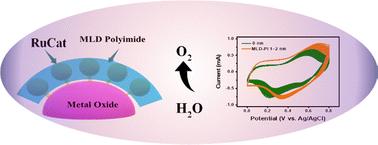
The stabilization of metal–oxide-bound molecular catalysts is essential for enhancing their lifetime and commercial viability in heterogeneous catalysis. This is particularly relevant in dye-sensitized photoelectrochemical cells (DSPECs), where the surface-bound chromophores and catalysts exhibit instability in aqueous environments, particularly at elevated pH levels. In this work, we have successfully employed molecular layer deposition (MLD) to stabilize ruthenium-based catalysts (RuCP(OH2)2+, denoted as RuCat). The application of polyimide (PI) via MLD onto the porous nanoITO surface significantly improved the stabilization of RuCat molecules for water oxidation. Additionally, time-resolved photoluminescence (TRPL) spectroscopy and femtosecond transient absorption spectroscopy (fs-TAS) results indicated that the MLD-deposited PI effectively preserved the robust redox capacity of the photogenerated electron–hole pairs associated with the catalyst molecules, thereby facilitating more efficient charge transfer. This research presents a novel approach for stabilizing surface-bound small molecules, which may contribute to advancements in heterogeneous catalysis and enhance its commercial viability.




 京公网安备 11010802042870号
京ICP备2023020795号-1
京公网安备 11010802042870号
京ICP备2023020795号-1

 分享
分享
 求助内容:
求助内容: 应助结果提醒方式:
 扫码关注我们
