Chenghao Duan, Kaicheng Zhang, Zijian Peng, Shiang Li, Feilin Zou, Feng Wang, Jiong Li, Zheng Zhang, Chang Chen, Qiliang Zhu, Jianhang Qiu, Xinhui Lu, Ning Li, Liming Ding, Christoph J. Brabec, Feng Gao, Keyou Yan
{"title":"耐用的全无机过氧化物串联光伏技术","authors":"Chenghao Duan, Kaicheng Zhang, Zijian Peng, Shiang Li, Feilin Zou, Feng Wang, Jiong Li, Zheng Zhang, Chang Chen, Qiliang Zhu, Jianhang Qiu, Xinhui Lu, Ning Li, Liming Ding, Christoph J. Brabec, Feng Gao, Keyou Yan","doi":"10.1038/s41586-024-08432-7","DOIUrl":null,"url":null,"abstract":"All-inorganic perovskites prepared by substituting the organic cations (for example, methylammonium and formamidinium) with inorganic cations (for example, Cs+) are effective concepts to enhance the long-term photostability and thermal stability of perovskite solar cells (PSCs)1,2. Hence, inorganic perovskite tandem solar cells (IPTSCs) are promising candidates for breaking the efficiency bottleneck and addressing the stability issue, too3,4. However, challenges remain in fabricating two-terminal (2T) IPTSCs due to the inferior film formation and deep trap states induced by tin cations5–7. Here a ligand evolution (LE) strategy with p-toluenesulfonyl hydrazide (PTSH) is used to regulate film formation and eliminate deep traps in inorganic narrow-bandgap (NBG) perovskites, enabling the successful development of 2T IPTSCs. Accordingly, the 1.31 eV CsPb0.4Sn0.6I3:LE device delivers a record efficiency of 17.41%. Combined with the 1.92 eV CsPbI2Br top cell, 2T IPTSCs exhibit a champion efficiency of 22.57% (certified, 21.92%). Moreover, IPTSCs are engineered to deliver remarkable durability under maximum power point (MPP) tracking, maintaining 80% of their initial efficiency at 65 °C for 1,510 h and at 85 °C for 800 h. We elucidate that LE deliberately leverages multiple roles for inorganic NBG perovskite growth and anticipate that our study provides an insightful guideline for developing high-efficiency and stable IPTSCs. Inorganic perovskite tandem solar cells using ligand evolution strategy achieve record efficiencies and durability, maintaining 80% of their initial efficiency under light/heat stresses, guiding the development of high-efficiency, stable inorganic perovskite tandem solar cells.","PeriodicalId":18787,"journal":{"name":"Nature","volume":"637 8048","pages":"1111-1117"},"PeriodicalIF":48.5000,"publicationDate":"2024-11-28","publicationTypes":"Journal Article","fieldsOfStudy":null,"isOpenAccess":false,"openAccessPdf":"","citationCount":"0","resultStr":"{\"title\":\"Durable all-inorganic perovskite tandem photovoltaics\",\"authors\":\"Chenghao Duan, Kaicheng Zhang, Zijian Peng, Shiang Li, Feilin Zou, Feng Wang, Jiong Li, Zheng Zhang, Chang Chen, Qiliang Zhu, Jianhang Qiu, Xinhui Lu, Ning Li, Liming Ding, Christoph J. Brabec, Feng Gao, Keyou Yan\",\"doi\":\"10.1038/s41586-024-08432-7\",\"DOIUrl\":null,\"url\":null,\"abstract\":\"All-inorganic perovskites prepared by substituting the organic cations (for example, methylammonium and formamidinium) with inorganic cations (for example, Cs+) are effective concepts to enhance the long-term photostability and thermal stability of perovskite solar cells (PSCs)1,2. Hence, inorganic perovskite tandem solar cells (IPTSCs) are promising candidates for breaking the efficiency bottleneck and addressing the stability issue, too3,4. However, challenges remain in fabricating two-terminal (2T) IPTSCs due to the inferior film formation and deep trap states induced by tin cations5–7. Here a ligand evolution (LE) strategy with p-toluenesulfonyl hydrazide (PTSH) is used to regulate film formation and eliminate deep traps in inorganic narrow-bandgap (NBG) perovskites, enabling the successful development of 2T IPTSCs. Accordingly, the 1.31 eV CsPb0.4Sn0.6I3:LE device delivers a record efficiency of 17.41%. Combined with the 1.92 eV CsPbI2Br top cell, 2T IPTSCs exhibit a champion efficiency of 22.57% (certified, 21.92%). Moreover, IPTSCs are engineered to deliver remarkable durability under maximum power point (MPP) tracking, maintaining 80% of their initial efficiency at 65 °C for 1,510 h and at 85 °C for 800 h. We elucidate that LE deliberately leverages multiple roles for inorganic NBG perovskite growth and anticipate that our study provides an insightful guideline for developing high-efficiency and stable IPTSCs. Inorganic perovskite tandem solar cells using ligand evolution strategy achieve record efficiencies and durability, maintaining 80% of their initial efficiency under light/heat stresses, guiding the development of high-efficiency, stable inorganic perovskite tandem solar cells.\",\"PeriodicalId\":18787,\"journal\":{\"name\":\"Nature\",\"volume\":\"637 8048\",\"pages\":\"1111-1117\"},\"PeriodicalIF\":48.5000,\"publicationDate\":\"2024-11-28\",\"publicationTypes\":\"Journal Article\",\"fieldsOfStudy\":null,\"isOpenAccess\":false,\"openAccessPdf\":\"\",\"citationCount\":\"0\",\"resultStr\":null,\"platform\":\"Semanticscholar\",\"paperid\":null,\"PeriodicalName\":\"Nature\",\"FirstCategoryId\":\"103\",\"ListUrlMain\":\"https://www.nature.com/articles/s41586-024-08432-7\",\"RegionNum\":1,\"RegionCategory\":\"综合性期刊\",\"ArticlePicture\":[],\"TitleCN\":null,\"AbstractTextCN\":null,\"PMCID\":null,\"EPubDate\":\"\",\"PubModel\":\"\",\"JCR\":\"Q1\",\"JCRName\":\"MULTIDISCIPLINARY SCIENCES\",\"Score\":null,\"Total\":0}","platform":"Semanticscholar","paperid":null,"PeriodicalName":"Nature","FirstCategoryId":"103","ListUrlMain":"https://www.nature.com/articles/s41586-024-08432-7","RegionNum":1,"RegionCategory":"综合性期刊","ArticlePicture":[],"TitleCN":null,"AbstractTextCN":null,"PMCID":null,"EPubDate":"","PubModel":"","JCR":"Q1","JCRName":"MULTIDISCIPLINARY SCIENCES","Score":null,"Total":0}
Durable all-inorganic perovskite tandem photovoltaics
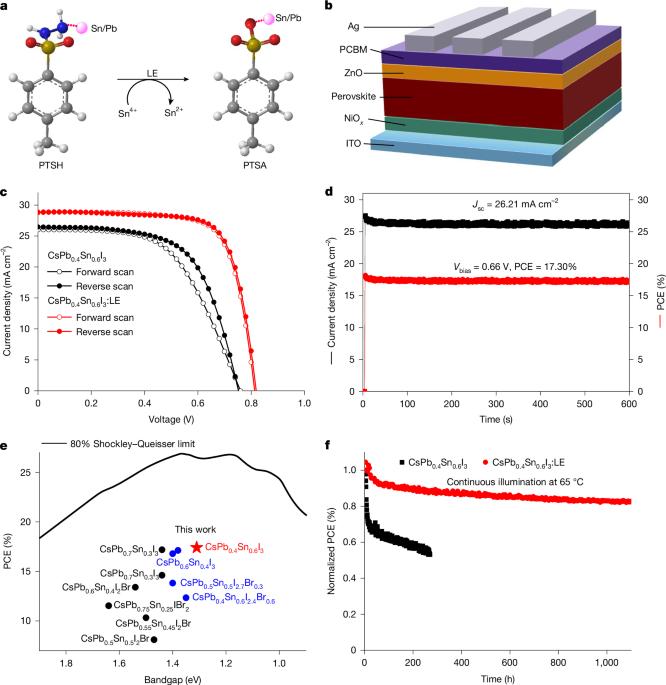
All-inorganic perovskites prepared by substituting the organic cations (for example, methylammonium and formamidinium) with inorganic cations (for example, Cs+) are effective concepts to enhance the long-term photostability and thermal stability of perovskite solar cells (PSCs)1,2. Hence, inorganic perovskite tandem solar cells (IPTSCs) are promising candidates for breaking the efficiency bottleneck and addressing the stability issue, too3,4. However, challenges remain in fabricating two-terminal (2T) IPTSCs due to the inferior film formation and deep trap states induced by tin cations5–7. Here a ligand evolution (LE) strategy with p-toluenesulfonyl hydrazide (PTSH) is used to regulate film formation and eliminate deep traps in inorganic narrow-bandgap (NBG) perovskites, enabling the successful development of 2T IPTSCs. Accordingly, the 1.31 eV CsPb0.4Sn0.6I3:LE device delivers a record efficiency of 17.41%. Combined with the 1.92 eV CsPbI2Br top cell, 2T IPTSCs exhibit a champion efficiency of 22.57% (certified, 21.92%). Moreover, IPTSCs are engineered to deliver remarkable durability under maximum power point (MPP) tracking, maintaining 80% of their initial efficiency at 65 °C for 1,510 h and at 85 °C for 800 h. We elucidate that LE deliberately leverages multiple roles for inorganic NBG perovskite growth and anticipate that our study provides an insightful guideline for developing high-efficiency and stable IPTSCs. Inorganic perovskite tandem solar cells using ligand evolution strategy achieve record efficiencies and durability, maintaining 80% of their initial efficiency under light/heat stresses, guiding the development of high-efficiency, stable inorganic perovskite tandem solar cells.
期刊介绍:
Nature is a prestigious international journal that publishes peer-reviewed research in various scientific and technological fields. The selection of articles is based on criteria such as originality, importance, interdisciplinary relevance, timeliness, accessibility, elegance, and surprising conclusions. In addition to showcasing significant scientific advances, Nature delivers rapid, authoritative, insightful news, and interpretation of current and upcoming trends impacting science, scientists, and the broader public. The journal serves a dual purpose: firstly, to promptly share noteworthy scientific advances and foster discussions among scientists, and secondly, to ensure the swift dissemination of scientific results globally, emphasizing their significance for knowledge, culture, and daily life.




 京公网安备 11010802042870号
京ICP备2023020795号-1
京公网安备 11010802042870号
京ICP备2023020795号-1

 分享
分享
 求助内容:
求助内容: 应助结果提醒方式:
 扫码关注我们
