Juanlong Li , Yezi Hu , Zewen Shen , Huihui Jin , Rong He , Wenkun Zhu , Guixia Zhao , Zhuoyu Ji , Bin Ma , Xiangke Wang
{"title":"脱酚配体络合从含氟废水中高效回收铀","authors":"Juanlong Li , Yezi Hu , Zewen Shen , Huihui Jin , Rong He , Wenkun Zhu , Guixia Zhao , Zhuoyu Ji , Bin Ma , Xiangke Wang","doi":"10.1016/j.watres.2024.122884","DOIUrl":null,"url":null,"abstract":"<div><div>Extracting uranium (U(VI)) from fluoride-rich radioactive wastewater is of great significance for the development of nuclear energy and environmental remediation. The presence of thermodynamically stable [UO<sub>2</sub>F<sub>n</sub>]<sup>2−</sup><em><sup>n</sup></em> (<em>n</em> = 0, 1, 2, 3, 4) aqueous complexes in fluoride-rich U(VI)-containing wastewater significantly hinders the efficiency of uranyl extraction and recovery using conventional methods. In this study, we report a direct precipitation method using deferiprone ligands for efficient uranyl extraction from fluoride-rich wastewater that offsets the preparation of solid materials. The deferiprone ligands exhibited exceptional chelating ability competing toward <em>F</em><sup>−</sup>. In simulated 2.1 × 10<sup>–4</sup> mol/L U(VI) wastewater with <em>F</em><sup>−</sup> concentrations ranging from 1 to 10 g/L, adjusting the amount of deferiprone ligands enabled a high U(Ⅵ) precipitation rate of 97.60 % to 86.90 %, correspondingly. A remarkable 99.71 % recovery of U(Ⅵ) from real fluoride-rich alkaline wastewater was achieved within 2 h. Detailed investigations revealed that the competitive chelating by deferiprone ligands results in the formation of insoluble U(VI)-deferiprone complexes ([(UO<sub>2</sub>)(H<sub>2</sub>O)(C<sub>7</sub>NO<sub>2</sub>H<sub>8</sub>)<sub>2</sub>]·4H<sub>2</sub>O), driven by π-π stacking interactions, electrostatic attractions, and intermolecular hydrogen bonds. Given the cost-efficiency and excellent radiation resistance of deferiprone ligands, this efficient and straightforward precipitation approach holds great promise for practical applications in U(VI) remediation and resource recovery from fluoride-rich wastewater.</div></div>","PeriodicalId":443,"journal":{"name":"Water Research","volume":"271 ","pages":"Article 122884"},"PeriodicalIF":12.8000,"publicationDate":"2025-03-01","publicationTypes":"Journal Article","fieldsOfStudy":null,"isOpenAccess":false,"openAccessPdf":"","citationCount":"0","resultStr":"{\"title\":\"Efficient uranium(VI) recovery from fluorinated wastewater via deferiprone ligand complexation\",\"authors\":\"Juanlong Li , Yezi Hu , Zewen Shen , Huihui Jin , Rong He , Wenkun Zhu , Guixia Zhao , Zhuoyu Ji , Bin Ma , Xiangke Wang\",\"doi\":\"10.1016/j.watres.2024.122884\",\"DOIUrl\":null,\"url\":null,\"abstract\":\"<div><div>Extracting uranium (U(VI)) from fluoride-rich radioactive wastewater is of great significance for the development of nuclear energy and environmental remediation. The presence of thermodynamically stable [UO<sub>2</sub>F<sub>n</sub>]<sup>2−</sup><em><sup>n</sup></em> (<em>n</em> = 0, 1, 2, 3, 4) aqueous complexes in fluoride-rich U(VI)-containing wastewater significantly hinders the efficiency of uranyl extraction and recovery using conventional methods. In this study, we report a direct precipitation method using deferiprone ligands for efficient uranyl extraction from fluoride-rich wastewater that offsets the preparation of solid materials. The deferiprone ligands exhibited exceptional chelating ability competing toward <em>F</em><sup>−</sup>. In simulated 2.1 × 10<sup>–4</sup> mol/L U(VI) wastewater with <em>F</em><sup>−</sup> concentrations ranging from 1 to 10 g/L, adjusting the amount of deferiprone ligands enabled a high U(Ⅵ) precipitation rate of 97.60 % to 86.90 %, correspondingly. A remarkable 99.71 % recovery of U(Ⅵ) from real fluoride-rich alkaline wastewater was achieved within 2 h. Detailed investigations revealed that the competitive chelating by deferiprone ligands results in the formation of insoluble U(VI)-deferiprone complexes ([(UO<sub>2</sub>)(H<sub>2</sub>O)(C<sub>7</sub>NO<sub>2</sub>H<sub>8</sub>)<sub>2</sub>]·4H<sub>2</sub>O), driven by π-π stacking interactions, electrostatic attractions, and intermolecular hydrogen bonds. Given the cost-efficiency and excellent radiation resistance of deferiprone ligands, this efficient and straightforward precipitation approach holds great promise for practical applications in U(VI) remediation and resource recovery from fluoride-rich wastewater.</div></div>\",\"PeriodicalId\":443,\"journal\":{\"name\":\"Water Research\",\"volume\":\"271 \",\"pages\":\"Article 122884\"},\"PeriodicalIF\":12.8000,\"publicationDate\":\"2025-03-01\",\"publicationTypes\":\"Journal Article\",\"fieldsOfStudy\":null,\"isOpenAccess\":false,\"openAccessPdf\":\"\",\"citationCount\":\"0\",\"resultStr\":null,\"platform\":\"Semanticscholar\",\"paperid\":null,\"PeriodicalName\":\"Water Research\",\"FirstCategoryId\":\"93\",\"ListUrlMain\":\"https://www.sciencedirect.com/science/article/pii/S0043135424017846\",\"RegionNum\":1,\"RegionCategory\":\"环境科学与生态学\",\"ArticlePicture\":[],\"TitleCN\":null,\"AbstractTextCN\":null,\"PMCID\":null,\"EPubDate\":\"2024/11/29 0:00:00\",\"PubModel\":\"Epub\",\"JCR\":\"Q1\",\"JCRName\":\"ENGINEERING, ENVIRONMENTAL\",\"Score\":null,\"Total\":0}","platform":"Semanticscholar","paperid":null,"PeriodicalName":"Water Research","FirstCategoryId":"93","ListUrlMain":"https://www.sciencedirect.com/science/article/pii/S0043135424017846","RegionNum":1,"RegionCategory":"环境科学与生态学","ArticlePicture":[],"TitleCN":null,"AbstractTextCN":null,"PMCID":null,"EPubDate":"2024/11/29 0:00:00","PubModel":"Epub","JCR":"Q1","JCRName":"ENGINEERING, ENVIRONMENTAL","Score":null,"Total":0}
Efficient uranium(VI) recovery from fluorinated wastewater via deferiprone ligand complexation
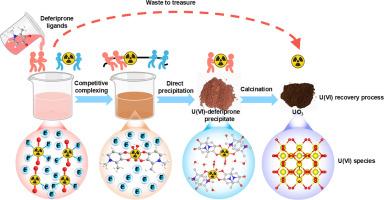
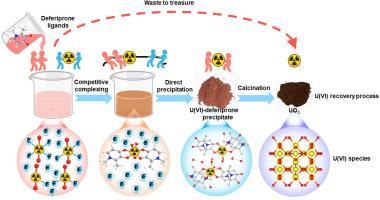
Extracting uranium (U(VI)) from fluoride-rich radioactive wastewater is of great significance for the development of nuclear energy and environmental remediation. The presence of thermodynamically stable [UO2Fn]2−n (n = 0, 1, 2, 3, 4) aqueous complexes in fluoride-rich U(VI)-containing wastewater significantly hinders the efficiency of uranyl extraction and recovery using conventional methods. In this study, we report a direct precipitation method using deferiprone ligands for efficient uranyl extraction from fluoride-rich wastewater that offsets the preparation of solid materials. The deferiprone ligands exhibited exceptional chelating ability competing toward F−. In simulated 2.1 × 10⁻⁴ mol/L U(VI) wastewater with F− concentrations ranging from 1 to 10 g/L, adjusting the amount of deferiprone ligands enabled a high U(Ⅵ) precipitation rate of 97.60 % to 86.90 %, correspondingly. A remarkable 99.71 % recovery of U(Ⅵ) from real fluoride-rich alkaline wastewater was achieved within 2 h. Detailed investigations revealed that the competitive chelating by deferiprone ligands results in the formation of insoluble U(VI)-deferiprone complexes ([(UO2)(H2O)(C7NO2H8)2]·4H2O), driven by π-π stacking interactions, electrostatic attractions, and intermolecular hydrogen bonds. Given the cost-efficiency and excellent radiation resistance of deferiprone ligands, this efficient and straightforward precipitation approach holds great promise for practical applications in U(VI) remediation and resource recovery from fluoride-rich wastewater.
期刊介绍:
Water Research, along with its open access companion journal Water Research X, serves as a platform for publishing original research papers covering various aspects of the science and technology related to the anthropogenic water cycle, water quality, and its management worldwide. The audience targeted by the journal comprises biologists, chemical engineers, chemists, civil engineers, environmental engineers, limnologists, and microbiologists. The scope of the journal include:
•Treatment processes for water and wastewaters (municipal, agricultural, industrial, and on-site treatment), including resource recovery and residuals management;
•Urban hydrology including sewer systems, stormwater management, and green infrastructure;
•Drinking water treatment and distribution;
•Potable and non-potable water reuse;
•Sanitation, public health, and risk assessment;
•Anaerobic digestion, solid and hazardous waste management, including source characterization and the effects and control of leachates and gaseous emissions;
•Contaminants (chemical, microbial, anthropogenic particles such as nanoparticles or microplastics) and related water quality sensing, monitoring, fate, and assessment;
•Anthropogenic impacts on inland, tidal, coastal and urban waters, focusing on surface and ground waters, and point and non-point sources of pollution;
•Environmental restoration, linked to surface water, groundwater and groundwater remediation;
•Analysis of the interfaces between sediments and water, and between water and atmosphere, focusing specifically on anthropogenic impacts;
•Mathematical modelling, systems analysis, machine learning, and beneficial use of big data related to the anthropogenic water cycle;
•Socio-economic, policy, and regulations studies.




 京公网安备 11010802042870号
京ICP备2023020795号-1
京公网安备 11010802042870号
京ICP备2023020795号-1

 分享
分享
 求助内容:
求助内容: 应助结果提醒方式:
 扫码关注我们
