Xiaohui Ma, Qiong Wang, Xi Zhang, Yu Lin, Fengyi Zhang, Jianhang Huang and Yonggang Wang
{"title":"高可逆锌阳极启用微量添加剂与pH缓冲能力","authors":"Xiaohui Ma, Qiong Wang, Xi Zhang, Yu Lin, Fengyi Zhang, Jianhang Huang and Yonggang Wang","doi":"10.1039/D4EE04870A","DOIUrl":null,"url":null,"abstract":"<p >Both high reversibility and cycle stability for zinc anode are desirable for practical applications. However, it is a challenge to obtain both due to severe hydrogen evolution, corrosion and pH fluctuation. Here, a trace-amount additive (0.1 wt%), ammonium succinate, is proposed to effectively suppress the above issues. The additive with high zinc absorbability not only participates in the Zn<small><sup>2+</sup></small> solvation shell, reducing H<small><sub>2</sub></small>O activity in the solvation shell but also forms an adsorption layer to inhibit corrosion and regulate ion flux for uniform deposition. More importantly, the strong pH buffering ability enabled by NH<small><sub>4</sub></small><small><sup>+</sup></small> endows batteries with high cycle stability. Therefore, an unprecedentedly high average coulombic efficiency of 99.91% at 1 mA cm<small><sup>−2</sup></small> was obtained, and the symmetrical cell could stably cycle with a high cumulative capacity of 6150 mA h cm<small><sup>−2</sup></small> at 10 mA cm<small><sup>−2</sup></small>, demonstrating the feasibility for both high reversibility and cycle stability for zinc anode.</p>","PeriodicalId":72,"journal":{"name":"Energy & Environmental Science","volume":" 2","pages":" 982-990"},"PeriodicalIF":30.8000,"publicationDate":"2024-11-29","publicationTypes":"Journal Article","fieldsOfStudy":null,"isOpenAccess":false,"openAccessPdf":"","citationCount":"0","resultStr":"{\"title\":\"Highly reversible zinc anode enabled by a trace-amount additive with pH buffering capability†\",\"authors\":\"Xiaohui Ma, Qiong Wang, Xi Zhang, Yu Lin, Fengyi Zhang, Jianhang Huang and Yonggang Wang\",\"doi\":\"10.1039/D4EE04870A\",\"DOIUrl\":null,\"url\":null,\"abstract\":\"<p >Both high reversibility and cycle stability for zinc anode are desirable for practical applications. However, it is a challenge to obtain both due to severe hydrogen evolution, corrosion and pH fluctuation. Here, a trace-amount additive (0.1 wt%), ammonium succinate, is proposed to effectively suppress the above issues. The additive with high zinc absorbability not only participates in the Zn<small><sup>2+</sup></small> solvation shell, reducing H<small><sub>2</sub></small>O activity in the solvation shell but also forms an adsorption layer to inhibit corrosion and regulate ion flux for uniform deposition. More importantly, the strong pH buffering ability enabled by NH<small><sub>4</sub></small><small><sup>+</sup></small> endows batteries with high cycle stability. Therefore, an unprecedentedly high average coulombic efficiency of 99.91% at 1 mA cm<small><sup>−2</sup></small> was obtained, and the symmetrical cell could stably cycle with a high cumulative capacity of 6150 mA h cm<small><sup>−2</sup></small> at 10 mA cm<small><sup>−2</sup></small>, demonstrating the feasibility for both high reversibility and cycle stability for zinc anode.</p>\",\"PeriodicalId\":72,\"journal\":{\"name\":\"Energy & Environmental Science\",\"volume\":\" 2\",\"pages\":\" 982-990\"},\"PeriodicalIF\":30.8000,\"publicationDate\":\"2024-11-29\",\"publicationTypes\":\"Journal Article\",\"fieldsOfStudy\":null,\"isOpenAccess\":false,\"openAccessPdf\":\"\",\"citationCount\":\"0\",\"resultStr\":null,\"platform\":\"Semanticscholar\",\"paperid\":null,\"PeriodicalName\":\"Energy & Environmental Science\",\"FirstCategoryId\":\"88\",\"ListUrlMain\":\"https://pubs.rsc.org/en/content/articlelanding/2025/ee/d4ee04870a\",\"RegionNum\":1,\"RegionCategory\":\"材料科学\",\"ArticlePicture\":[],\"TitleCN\":null,\"AbstractTextCN\":null,\"PMCID\":null,\"EPubDate\":\"\",\"PubModel\":\"\",\"JCR\":\"Q1\",\"JCRName\":\"CHEMISTRY, MULTIDISCIPLINARY\",\"Score\":null,\"Total\":0}","platform":"Semanticscholar","paperid":null,"PeriodicalName":"Energy & Environmental Science","FirstCategoryId":"88","ListUrlMain":"https://pubs.rsc.org/en/content/articlelanding/2025/ee/d4ee04870a","RegionNum":1,"RegionCategory":"材料科学","ArticlePicture":[],"TitleCN":null,"AbstractTextCN":null,"PMCID":null,"EPubDate":"","PubModel":"","JCR":"Q1","JCRName":"CHEMISTRY, MULTIDISCIPLINARY","Score":null,"Total":0}
引用次数: 0
摘要
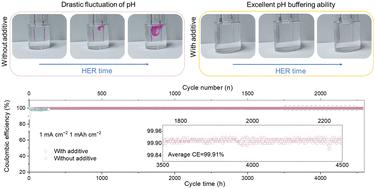
锌阳极的高可逆性和高循环稳定性在实际应用中是理想的。然而,由于严重的析氢、腐蚀和pH波动,获得这两种材料是一个挑战。本文提出了一种微量添加剂(0.1% wt.%)琥珀酸铵来有效地抑制上述问题。高锌吸收率的添加剂不仅参与Zn2+的溶剂化壳,降低溶剂化壳中H2O的活性,而且形成吸附层,抑制腐蚀,调节离子通量,使沉积均匀。更重要的是,NH4+具有较强的pH缓冲能力,使电池具有较高的循环稳定性。因此,在1mA cm−2下获得了99.91%的平均库仑效率,且对称电池在10ma cm−2下可以稳定循环,累积容量高达6150 mAh cm−2,证明了锌阳极高可逆性和循环稳定性的可行性。
Highly reversible zinc anode enabled by a trace-amount additive with pH buffering capability†
Both high reversibility and cycle stability for zinc anode are desirable for practical applications. However, it is a challenge to obtain both due to severe hydrogen evolution, corrosion and pH fluctuation. Here, a trace-amount additive (0.1 wt%), ammonium succinate, is proposed to effectively suppress the above issues. The additive with high zinc absorbability not only participates in the Zn2+ solvation shell, reducing H2O activity in the solvation shell but also forms an adsorption layer to inhibit corrosion and regulate ion flux for uniform deposition. More importantly, the strong pH buffering ability enabled by NH4+ endows batteries with high cycle stability. Therefore, an unprecedentedly high average coulombic efficiency of 99.91% at 1 mA cm−2 was obtained, and the symmetrical cell could stably cycle with a high cumulative capacity of 6150 mA h cm−2 at 10 mA cm−2, demonstrating the feasibility for both high reversibility and cycle stability for zinc anode.
期刊介绍:
Energy & Environmental Science, a peer-reviewed scientific journal, publishes original research and review articles covering interdisciplinary topics in the (bio)chemical and (bio)physical sciences, as well as chemical engineering disciplines. Published monthly by the Royal Society of Chemistry (RSC), a not-for-profit publisher, Energy & Environmental Science is recognized as a leading journal. It boasts an impressive impact factor of 8.500 as of 2009, ranking 8th among 140 journals in the category "Chemistry, Multidisciplinary," second among 71 journals in "Energy & Fuels," second among 128 journals in "Engineering, Chemical," and first among 181 scientific journals in "Environmental Sciences."
Energy & Environmental Science publishes various types of articles, including Research Papers (original scientific work), Review Articles, Perspectives, and Minireviews (feature review-type articles of broad interest), Communications (original scientific work of an urgent nature), Opinions (personal, often speculative viewpoints or hypotheses on current topics), and Analysis Articles (in-depth examination of energy-related issues).




 京公网安备 11010802042870号
京ICP备2023020795号-1
京公网安备 11010802042870号
京ICP备2023020795号-1

 分享
分享
 求助内容:
求助内容: 应助结果提醒方式:
 扫码关注我们
