{"title":"石油工业用橙皮、鱼皮废弃物生物吸附剂的研制","authors":"Rohit, Balbir Singh Kaith, Rakesh Kumar","doi":"10.1016/j.polymer.2024.127874","DOIUrl":null,"url":null,"abstract":"<div><div>In the present work biowaste orange peels and fish collagen-derived hydrophilic super-absorbent was synthesized using polyvinyl alcohol and methacrylic acid, and a hybrid natural pectin-collagen backbone. After optimization of different reaction parameters w.r.t. Percentage grafting, the equilibrium water removal capacity of the smart polymer in three different petroleum fraction-water emulsions: petrol-water, diesel-water, and petroleum ether-water was studied and optimized to get the maximum water absorption. The higher equilibrium water uptake capacity was found in the petrol-water emulsion (1.6740 g/g) followed by diesel-water (1.5126 g/g) and petroleum ether-water emulsions (1.3537 g/g). All petroleum fraction-water emulsions, including petrol-water (n = 0.3566), diesel-water (n = 0.3375), and petroleum ether-water (n = 0.3678), were able to allow water to penetrate the 3-D network of the smart polymer through a Fickian diffusion mechanism. The pseudo swelling kinetic model showed that the experimental results were consistent order with theoretical equilibrium water uptake values: 1.9548 g/g (petrol-water), 1.7393 g/g (diesel-water) and 1.6149 g/g (petroleum ether-water) along with swelling rate constant <strong>ks</strong> = 8.234 × 10<sup>−3</sup> g/g min (diesel-water), <strong>ks</strong> = 7.52 × 10<sup>−3</sup> g/g min (petrol-water) and <strong>ks</strong> = 6.64 × 10<sup>−3</sup> g/g min (petroleum ether-water). Further the candidate polymer exhibited the salt resistant water uptake behaviour w.r.t. 1.0, 5.0, 10.0 and 15.0 % NaCl concentration and thus, such materials are of great importance in membrane technology. The findings demonstrated that biowaste superabsorbent has a great potential as an environment friendly, cost-effective and “waste to wealth” for removing water from various petroleum fractions in petroleum industries.</div></div>","PeriodicalId":405,"journal":{"name":"Polymer","volume":"317 ","pages":"Article 127874"},"PeriodicalIF":5.1000,"publicationDate":"2025-01-15","publicationTypes":"Journal Article","fieldsOfStudy":null,"isOpenAccess":false,"openAccessPdf":"","citationCount":"0","resultStr":"{\"title\":\"Development of biosorbent from orange peel and fish skin waste for usage in petroleum industry\",\"authors\":\"Rohit, Balbir Singh Kaith, Rakesh Kumar\",\"doi\":\"10.1016/j.polymer.2024.127874\",\"DOIUrl\":null,\"url\":null,\"abstract\":\"<div><div>In the present work biowaste orange peels and fish collagen-derived hydrophilic super-absorbent was synthesized using polyvinyl alcohol and methacrylic acid, and a hybrid natural pectin-collagen backbone. After optimization of different reaction parameters w.r.t. Percentage grafting, the equilibrium water removal capacity of the smart polymer in three different petroleum fraction-water emulsions: petrol-water, diesel-water, and petroleum ether-water was studied and optimized to get the maximum water absorption. The higher equilibrium water uptake capacity was found in the petrol-water emulsion (1.6740 g/g) followed by diesel-water (1.5126 g/g) and petroleum ether-water emulsions (1.3537 g/g). All petroleum fraction-water emulsions, including petrol-water (n = 0.3566), diesel-water (n = 0.3375), and petroleum ether-water (n = 0.3678), were able to allow water to penetrate the 3-D network of the smart polymer through a Fickian diffusion mechanism. The pseudo swelling kinetic model showed that the experimental results were consistent order with theoretical equilibrium water uptake values: 1.9548 g/g (petrol-water), 1.7393 g/g (diesel-water) and 1.6149 g/g (petroleum ether-water) along with swelling rate constant <strong>ks</strong> = 8.234 × 10<sup>−3</sup> g/g min (diesel-water), <strong>ks</strong> = 7.52 × 10<sup>−3</sup> g/g min (petrol-water) and <strong>ks</strong> = 6.64 × 10<sup>−3</sup> g/g min (petroleum ether-water). Further the candidate polymer exhibited the salt resistant water uptake behaviour w.r.t. 1.0, 5.0, 10.0 and 15.0 % NaCl concentration and thus, such materials are of great importance in membrane technology. The findings demonstrated that biowaste superabsorbent has a great potential as an environment friendly, cost-effective and “waste to wealth” for removing water from various petroleum fractions in petroleum industries.</div></div>\",\"PeriodicalId\":405,\"journal\":{\"name\":\"Polymer\",\"volume\":\"317 \",\"pages\":\"Article 127874\"},\"PeriodicalIF\":5.1000,\"publicationDate\":\"2025-01-15\",\"publicationTypes\":\"Journal Article\",\"fieldsOfStudy\":null,\"isOpenAccess\":false,\"openAccessPdf\":\"\",\"citationCount\":\"0\",\"resultStr\":null,\"platform\":\"Semanticscholar\",\"paperid\":null,\"PeriodicalName\":\"Polymer\",\"FirstCategoryId\":\"92\",\"ListUrlMain\":\"https://www.sciencedirect.com/science/article/pii/S0032386124012102\",\"RegionNum\":2,\"RegionCategory\":\"化学\",\"ArticlePicture\":[],\"TitleCN\":null,\"AbstractTextCN\":null,\"PMCID\":null,\"EPubDate\":\"2024/11/29 0:00:00\",\"PubModel\":\"Epub\",\"JCR\":\"Q2\",\"JCRName\":\"POLYMER SCIENCE\",\"Score\":null,\"Total\":0}","platform":"Semanticscholar","paperid":null,"PeriodicalName":"Polymer","FirstCategoryId":"92","ListUrlMain":"https://www.sciencedirect.com/science/article/pii/S0032386124012102","RegionNum":2,"RegionCategory":"化学","ArticlePicture":[],"TitleCN":null,"AbstractTextCN":null,"PMCID":null,"EPubDate":"2024/11/29 0:00:00","PubModel":"Epub","JCR":"Q2","JCRName":"POLYMER SCIENCE","Score":null,"Total":0}
Development of biosorbent from orange peel and fish skin waste for usage in petroleum industry
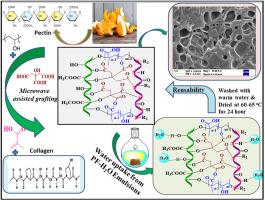
In the present work biowaste orange peels and fish collagen-derived hydrophilic super-absorbent was synthesized using polyvinyl alcohol and methacrylic acid, and a hybrid natural pectin-collagen backbone. After optimization of different reaction parameters w.r.t. Percentage grafting, the equilibrium water removal capacity of the smart polymer in three different petroleum fraction-water emulsions: petrol-water, diesel-water, and petroleum ether-water was studied and optimized to get the maximum water absorption. The higher equilibrium water uptake capacity was found in the petrol-water emulsion (1.6740 g/g) followed by diesel-water (1.5126 g/g) and petroleum ether-water emulsions (1.3537 g/g). All petroleum fraction-water emulsions, including petrol-water (n = 0.3566), diesel-water (n = 0.3375), and petroleum ether-water (n = 0.3678), were able to allow water to penetrate the 3-D network of the smart polymer through a Fickian diffusion mechanism. The pseudo swelling kinetic model showed that the experimental results were consistent order with theoretical equilibrium water uptake values: 1.9548 g/g (petrol-water), 1.7393 g/g (diesel-water) and 1.6149 g/g (petroleum ether-water) along with swelling rate constant ks = 8.234 × 10⁻³ g/g min (diesel-water), ks = 7.52 × 10⁻³ g/g min (petrol-water) and ks = 6.64 × 10⁻³ g/g min (petroleum ether-water). Further the candidate polymer exhibited the salt resistant water uptake behaviour w.r.t. 1.0, 5.0, 10.0 and 15.0 % NaCl concentration and thus, such materials are of great importance in membrane technology. The findings demonstrated that biowaste superabsorbent has a great potential as an environment friendly, cost-effective and “waste to wealth” for removing water from various petroleum fractions in petroleum industries.
期刊介绍:
Polymer is an interdisciplinary journal dedicated to publishing innovative and significant advances in Polymer Physics, Chemistry and Technology. We welcome submissions on polymer hybrids, nanocomposites, characterisation and self-assembly. Polymer also publishes work on the technological application of polymers in energy and optoelectronics.
The main scope is covered but not limited to the following core areas:
Polymer Materials
Nanocomposites and hybrid nanomaterials
Polymer blends, films, fibres, networks and porous materials
Physical Characterization
Characterisation, modelling and simulation* of molecular and materials properties in bulk, solution, and thin films
Polymer Engineering
Advanced multiscale processing methods
Polymer Synthesis, Modification and Self-assembly
Including designer polymer architectures, mechanisms and kinetics, and supramolecular polymerization
Technological Applications
Polymers for energy generation and storage
Polymer membranes for separation technology
Polymers for opto- and microelectronics.





 京公网安备 11010802042870号
京ICP备2023020795号-1
京公网安备 11010802042870号
京ICP备2023020795号-1

 分享
分享
 求助内容:
求助内容: 应助结果提醒方式:
 扫码关注我们
