Kuan Gao, Shudong He, John Shi, Sophia Jun Xue, Xingjiang Li, Hanju Sun
{"title":"ph转移和高压灭菌对红芸豆致敏性的影响凝集素","authors":"Kuan Gao, Shudong He, John Shi, Sophia Jun Xue, Xingjiang Li, Hanju Sun","doi":"10.1021/acs.jafc.4c07528","DOIUrl":null,"url":null,"abstract":"The ingestion of red kidney bean products is hindered by the persistent allergenicity of lectins, even after autoclaving. This study examined the modification of lectin allergenicity in red kidney beans by pH-shifting and autoclaving treatments, utilizing BALB/c mouse sensitization, <i>in situ</i> recirculating perfusion, and a bone marrow-derived dendritic cell (BMDC) model for allergenicity evaluation. Compared to autoclaving alone, combined pH-shifting and autoclaving reduced allergic symptoms in BALB/c mice, as evidenced by lower serum IgE, mMCPT-1, GM-CSF, HIS, IL-2, IL-4, IL-9, IL-13, and IL-17 levels and higher IgG1, IgG2a, IL-10, IFN-γ, and IFN-α cytokine release. Moreover, lectin continued to affect intestinal permeability and damaged the barrier despite undergoing pH-shifting and autoclaving treatments. Additionally, the uptake of lectin by BMDCs through mannose receptor-mediated endocytosis was diminished, with an increased susceptibility to endolysosomal degradation. The T-cell polarization was consistent with the mouse experiments, where the balance of Th1 and Th2 cells remained in lectin with pH-shifting and autoclaving treatments though the decreased abundance ratios of peptide YKYDSNAHT and increased abundance ratios of peptide ITKGNVETN in endolysosomal degradation. Therefore, the immunogenicity of lectins could be decreased by pH-shifting and autoclaving treatments, offering insights into the development of hypoallergenic legume products.","PeriodicalId":41,"journal":{"name":"Journal of Agricultural and Food Chemistry","volume":"53 1","pages":""},"PeriodicalIF":6.7000,"publicationDate":"2024-11-29","publicationTypes":"Journal Article","fieldsOfStudy":null,"isOpenAccess":false,"openAccessPdf":"","citationCount":"0","resultStr":"{\"title\":\"Impact of pH-Shifting and Autoclaving on the Allergenic Potential of Red Kidney Bean (Phaseolus vulgaris L.) Lectins\",\"authors\":\"Kuan Gao, Shudong He, John Shi, Sophia Jun Xue, Xingjiang Li, Hanju Sun\",\"doi\":\"10.1021/acs.jafc.4c07528\",\"DOIUrl\":null,\"url\":null,\"abstract\":\"The ingestion of red kidney bean products is hindered by the persistent allergenicity of lectins, even after autoclaving. This study examined the modification of lectin allergenicity in red kidney beans by pH-shifting and autoclaving treatments, utilizing BALB/c mouse sensitization, <i>in situ</i> recirculating perfusion, and a bone marrow-derived dendritic cell (BMDC) model for allergenicity evaluation. Compared to autoclaving alone, combined pH-shifting and autoclaving reduced allergic symptoms in BALB/c mice, as evidenced by lower serum IgE, mMCPT-1, GM-CSF, HIS, IL-2, IL-4, IL-9, IL-13, and IL-17 levels and higher IgG1, IgG2a, IL-10, IFN-γ, and IFN-α cytokine release. Moreover, lectin continued to affect intestinal permeability and damaged the barrier despite undergoing pH-shifting and autoclaving treatments. Additionally, the uptake of lectin by BMDCs through mannose receptor-mediated endocytosis was diminished, with an increased susceptibility to endolysosomal degradation. The T-cell polarization was consistent with the mouse experiments, where the balance of Th1 and Th2 cells remained in lectin with pH-shifting and autoclaving treatments though the decreased abundance ratios of peptide YKYDSNAHT and increased abundance ratios of peptide ITKGNVETN in endolysosomal degradation. Therefore, the immunogenicity of lectins could be decreased by pH-shifting and autoclaving treatments, offering insights into the development of hypoallergenic legume products.\",\"PeriodicalId\":41,\"journal\":{\"name\":\"Journal of Agricultural and Food Chemistry\",\"volume\":\"53 1\",\"pages\":\"\"},\"PeriodicalIF\":6.7000,\"publicationDate\":\"2024-11-29\",\"publicationTypes\":\"Journal Article\",\"fieldsOfStudy\":null,\"isOpenAccess\":false,\"openAccessPdf\":\"\",\"citationCount\":\"0\",\"resultStr\":null,\"platform\":\"Semanticscholar\",\"paperid\":null,\"PeriodicalName\":\"Journal of Agricultural and Food Chemistry\",\"FirstCategoryId\":\"97\",\"ListUrlMain\":\"https://doi.org/10.1021/acs.jafc.4c07528\",\"RegionNum\":1,\"RegionCategory\":\"农林科学\",\"ArticlePicture\":[],\"TitleCN\":null,\"AbstractTextCN\":null,\"PMCID\":null,\"EPubDate\":\"\",\"PubModel\":\"\",\"JCR\":\"Q1\",\"JCRName\":\"AGRICULTURE, MULTIDISCIPLINARY\",\"Score\":null,\"Total\":0}","platform":"Semanticscholar","paperid":null,"PeriodicalName":"Journal of Agricultural and Food Chemistry","FirstCategoryId":"97","ListUrlMain":"https://doi.org/10.1021/acs.jafc.4c07528","RegionNum":1,"RegionCategory":"农林科学","ArticlePicture":[],"TitleCN":null,"AbstractTextCN":null,"PMCID":null,"EPubDate":"","PubModel":"","JCR":"Q1","JCRName":"AGRICULTURE, MULTIDISCIPLINARY","Score":null,"Total":0}
Impact of pH-Shifting and Autoclaving on the Allergenic Potential of Red Kidney Bean (Phaseolus vulgaris L.) Lectins
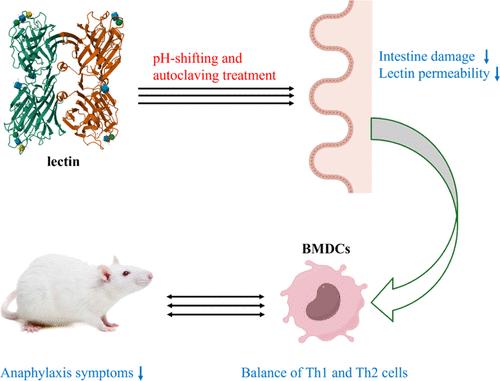
The ingestion of red kidney bean products is hindered by the persistent allergenicity of lectins, even after autoclaving. This study examined the modification of lectin allergenicity in red kidney beans by pH-shifting and autoclaving treatments, utilizing BALB/c mouse sensitization, in situ recirculating perfusion, and a bone marrow-derived dendritic cell (BMDC) model for allergenicity evaluation. Compared to autoclaving alone, combined pH-shifting and autoclaving reduced allergic symptoms in BALB/c mice, as evidenced by lower serum IgE, mMCPT-1, GM-CSF, HIS, IL-2, IL-4, IL-9, IL-13, and IL-17 levels and higher IgG1, IgG2a, IL-10, IFN-γ, and IFN-α cytokine release. Moreover, lectin continued to affect intestinal permeability and damaged the barrier despite undergoing pH-shifting and autoclaving treatments. Additionally, the uptake of lectin by BMDCs through mannose receptor-mediated endocytosis was diminished, with an increased susceptibility to endolysosomal degradation. The T-cell polarization was consistent with the mouse experiments, where the balance of Th1 and Th2 cells remained in lectin with pH-shifting and autoclaving treatments though the decreased abundance ratios of peptide YKYDSNAHT and increased abundance ratios of peptide ITKGNVETN in endolysosomal degradation. Therefore, the immunogenicity of lectins could be decreased by pH-shifting and autoclaving treatments, offering insights into the development of hypoallergenic legume products.
期刊介绍:
The Journal of Agricultural and Food Chemistry publishes high-quality, cutting edge original research representing complete studies and research advances dealing with the chemistry and biochemistry of agriculture and food. The Journal also encourages papers with chemistry and/or biochemistry as a major component combined with biological/sensory/nutritional/toxicological evaluation related to agriculture and/or food.




 京公网安备 11010802042870号
京ICP备2023020795号-1
京公网安备 11010802042870号
京ICP备2023020795号-1

 分享
分享
 求助内容:
求助内容: 应助结果提醒方式:
 扫码关注我们
