{"title":"新型恶二唑在气体、PCM和COSMO溶剂效应下作为高效光学、非线性光学和光伏材料的量子化学研究","authors":"Shamsa Bibi , Jannat Bibi , Shabbir Muhammad , Shafiq urRehman , Muhammad Adnan , Iqra Kaifi , Aijaz Rasool Chaudhry","doi":"10.1016/j.optlastec.2024.112099","DOIUrl":null,"url":null,"abstract":"<div><div>The science of organic optical and nonlinear optical (NLO) materials has been captivating the scientific community owing to their extensive applications in optoelectronics, OLEDs, and telecommunications. This study presents the design and investigation of novel organic compounds of pyrene and 1,3,4-oxadiazole derivatives (<strong>1-oxza</strong> to <strong>6-oxza</strong>), featuring various push–pull combinations. Quantum chemical calculations were employed to determine linear polarizabilities (α) and third-order NLO polarizabilities (γ). Notably, the largest average third-order NLO polarizability value was found to be 254.9 × 10<sup>−36</sup> esu for the finely tuned push–pull system <strong>6-oxza</strong>, which is ∼35 times greater than that of the prototype NLO molecule of <em>p</em>-nitroaniline (<em>p</em>-NA). Among the derivatives, <strong>1-oxza</strong> exhibits the highest linear isotropic polarizability (α<sub>iso</sub>) value of 61.59 × 10<sup>−24</sup> esu, while 5<strong>-oxza</strong> displays the highest linear anisotropic polarizability (α<sub>aniso</sub>) value of 60.09 × 10<sup>−24</sup> esu. A notable increase of approximately ∼1 to ∼2 times in < γ > is observed for selected compounds (<strong>1-oxza</strong>, <strong>4-oxza</strong>, <strong>6-oxza</strong>), indicating that the Conductor-like Screening Model (COSMO) overestimates the values compared to the polarizable continuum model (PCM) and gas phases. Solvent significantly enhances third-order NLO polarizability amplitudes depending upon solvent polarity and strength of substitution groups. We calculated the frequency-dependent third-order NLO polarizability of <strong>6-oxza</strong> at laser wavelengths ranging from 1400 to 1970 nm. The second hyperpolarizability EFISHG process (γ(−2ω; ω, ω, 0)) was calculated at a laser wavelength of 1400 nm, and the γ-amplitude was found to be 400.1 × 10<sup>−36</sup> esu. The remarkable hyperpolarizability response in the gas phase is corroborated by TD-DFT calculations, which reveal a larger transition dipole moment of 3.062 and a lower transition energy of 3.780 eV as origin of larger hyperpolarizability for <strong>6-oxza</strong>. A comprehensive analysis was performed based on FMOs for designed compounds to elucidate the intramolecular charge transfer (ICT) mechanisms and observed a notable reduction in energy band gap 4.89 eV for <strong>6-oxza,</strong> which is responsible for enhanced NLO response. Additionally, DOS maps revealed the quantitative contributions of HOMOs and LUMOs for crucial electronic states related to the efficient ICT process. Additionally, we analyzed the photovoltaic properties and found that <strong>6-oxza</strong> has the highest dye regeneration and the lowest open-circuit voltages of 1.89 eV and 2.22 eV, respectively. Our designed model compounds can put real-time such compounds under spotlight of scientific interests which seeks more efficient optical and NLO properties.</div></div>","PeriodicalId":19511,"journal":{"name":"Optics and Laser Technology","volume":"182 ","pages":"Article 112099"},"PeriodicalIF":5.2000,"publicationDate":"2025-04-01","publicationTypes":"Journal Article","fieldsOfStudy":null,"isOpenAccess":false,"openAccessPdf":"","citationCount":"0","resultStr":"{\"title\":\"Quantum chemical study of new oxadiazoles as efficient optical and nonlinear optical and photovoltaic materials under gas, PCM and COSMO solvent effects\",\"authors\":\"Shamsa Bibi , Jannat Bibi , Shabbir Muhammad , Shafiq urRehman , Muhammad Adnan , Iqra Kaifi , Aijaz Rasool Chaudhry\",\"doi\":\"10.1016/j.optlastec.2024.112099\",\"DOIUrl\":null,\"url\":null,\"abstract\":\"<div><div>The science of organic optical and nonlinear optical (NLO) materials has been captivating the scientific community owing to their extensive applications in optoelectronics, OLEDs, and telecommunications. This study presents the design and investigation of novel organic compounds of pyrene and 1,3,4-oxadiazole derivatives (<strong>1-oxza</strong> to <strong>6-oxza</strong>), featuring various push–pull combinations. Quantum chemical calculations were employed to determine linear polarizabilities (α) and third-order NLO polarizabilities (γ). Notably, the largest average third-order NLO polarizability value was found to be 254.9 × 10<sup>−36</sup> esu for the finely tuned push–pull system <strong>6-oxza</strong>, which is ∼35 times greater than that of the prototype NLO molecule of <em>p</em>-nitroaniline (<em>p</em>-NA). Among the derivatives, <strong>1-oxza</strong> exhibits the highest linear isotropic polarizability (α<sub>iso</sub>) value of 61.59 × 10<sup>−24</sup> esu, while 5<strong>-oxza</strong> displays the highest linear anisotropic polarizability (α<sub>aniso</sub>) value of 60.09 × 10<sup>−24</sup> esu. A notable increase of approximately ∼1 to ∼2 times in < γ > is observed for selected compounds (<strong>1-oxza</strong>, <strong>4-oxza</strong>, <strong>6-oxza</strong>), indicating that the Conductor-like Screening Model (COSMO) overestimates the values compared to the polarizable continuum model (PCM) and gas phases. Solvent significantly enhances third-order NLO polarizability amplitudes depending upon solvent polarity and strength of substitution groups. We calculated the frequency-dependent third-order NLO polarizability of <strong>6-oxza</strong> at laser wavelengths ranging from 1400 to 1970 nm. The second hyperpolarizability EFISHG process (γ(−2ω; ω, ω, 0)) was calculated at a laser wavelength of 1400 nm, and the γ-amplitude was found to be 400.1 × 10<sup>−36</sup> esu. The remarkable hyperpolarizability response in the gas phase is corroborated by TD-DFT calculations, which reveal a larger transition dipole moment of 3.062 and a lower transition energy of 3.780 eV as origin of larger hyperpolarizability for <strong>6-oxza</strong>. A comprehensive analysis was performed based on FMOs for designed compounds to elucidate the intramolecular charge transfer (ICT) mechanisms and observed a notable reduction in energy band gap 4.89 eV for <strong>6-oxza,</strong> which is responsible for enhanced NLO response. Additionally, DOS maps revealed the quantitative contributions of HOMOs and LUMOs for crucial electronic states related to the efficient ICT process. Additionally, we analyzed the photovoltaic properties and found that <strong>6-oxza</strong> has the highest dye regeneration and the lowest open-circuit voltages of 1.89 eV and 2.22 eV, respectively. Our designed model compounds can put real-time such compounds under spotlight of scientific interests which seeks more efficient optical and NLO properties.</div></div>\",\"PeriodicalId\":19511,\"journal\":{\"name\":\"Optics and Laser Technology\",\"volume\":\"182 \",\"pages\":\"Article 112099\"},\"PeriodicalIF\":5.2000,\"publicationDate\":\"2025-04-01\",\"publicationTypes\":\"Journal Article\",\"fieldsOfStudy\":null,\"isOpenAccess\":false,\"openAccessPdf\":\"\",\"citationCount\":\"0\",\"resultStr\":null,\"platform\":\"Semanticscholar\",\"paperid\":null,\"PeriodicalName\":\"Optics and Laser Technology\",\"FirstCategoryId\":\"101\",\"ListUrlMain\":\"https://www.sciencedirect.com/science/article/pii/S0030399224015573\",\"RegionNum\":2,\"RegionCategory\":\"物理与天体物理\",\"ArticlePicture\":[],\"TitleCN\":null,\"AbstractTextCN\":null,\"PMCID\":null,\"EPubDate\":\"2024/11/29 0:00:00\",\"PubModel\":\"Epub\",\"JCR\":\"Q1\",\"JCRName\":\"OPTICS\",\"Score\":null,\"Total\":0}","platform":"Semanticscholar","paperid":null,"PeriodicalName":"Optics and Laser Technology","FirstCategoryId":"101","ListUrlMain":"https://www.sciencedirect.com/science/article/pii/S0030399224015573","RegionNum":2,"RegionCategory":"物理与天体物理","ArticlePicture":[],"TitleCN":null,"AbstractTextCN":null,"PMCID":null,"EPubDate":"2024/11/29 0:00:00","PubModel":"Epub","JCR":"Q1","JCRName":"OPTICS","Score":null,"Total":0}
Quantum chemical study of new oxadiazoles as efficient optical and nonlinear optical and photovoltaic materials under gas, PCM and COSMO solvent effects
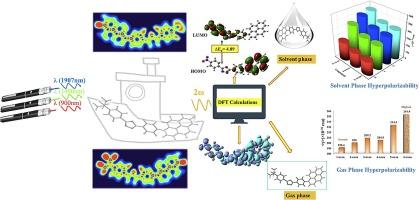
The science of organic optical and nonlinear optical (NLO) materials has been captivating the scientific community owing to their extensive applications in optoelectronics, OLEDs, and telecommunications. This study presents the design and investigation of novel organic compounds of pyrene and 1,3,4-oxadiazole derivatives (1-oxza to 6-oxza), featuring various push–pull combinations. Quantum chemical calculations were employed to determine linear polarizabilities (α) and third-order NLO polarizabilities (γ). Notably, the largest average third-order NLO polarizability value was found to be 254.9 × 10−36 esu for the finely tuned push–pull system 6-oxza, which is ∼35 times greater than that of the prototype NLO molecule of p-nitroaniline (p-NA). Among the derivatives, 1-oxza exhibits the highest linear isotropic polarizability (αiso) value of 61.59 × 10⁻²⁴ esu, while 5-oxza displays the highest linear anisotropic polarizability (αaniso) value of 60.09 × 10⁻²⁴ esu. A notable increase of approximately ∼1 to ∼2 times in < γ > is observed for selected compounds (1-oxza, 4-oxza, 6-oxza), indicating that the Conductor-like Screening Model (COSMO) overestimates the values compared to the polarizable continuum model (PCM) and gas phases. Solvent significantly enhances third-order NLO polarizability amplitudes depending upon solvent polarity and strength of substitution groups. We calculated the frequency-dependent third-order NLO polarizability of 6-oxza at laser wavelengths ranging from 1400 to 1970 nm. The second hyperpolarizability EFISHG process (γ(−2ω; ω, ω, 0)) was calculated at a laser wavelength of 1400 nm, and the γ-amplitude was found to be 400.1 × 10−36 esu. The remarkable hyperpolarizability response in the gas phase is corroborated by TD-DFT calculations, which reveal a larger transition dipole moment of 3.062 and a lower transition energy of 3.780 eV as origin of larger hyperpolarizability for 6-oxza. A comprehensive analysis was performed based on FMOs for designed compounds to elucidate the intramolecular charge transfer (ICT) mechanisms and observed a notable reduction in energy band gap 4.89 eV for 6-oxza, which is responsible for enhanced NLO response. Additionally, DOS maps revealed the quantitative contributions of HOMOs and LUMOs for crucial electronic states related to the efficient ICT process. Additionally, we analyzed the photovoltaic properties and found that 6-oxza has the highest dye regeneration and the lowest open-circuit voltages of 1.89 eV and 2.22 eV, respectively. Our designed model compounds can put real-time such compounds under spotlight of scientific interests which seeks more efficient optical and NLO properties.
期刊介绍:
Optics & Laser Technology aims to provide a vehicle for the publication of a broad range of high quality research and review papers in those fields of scientific and engineering research appertaining to the development and application of the technology of optics and lasers. Papers describing original work in these areas are submitted to rigorous refereeing prior to acceptance for publication.
The scope of Optics & Laser Technology encompasses, but is not restricted to, the following areas:
•development in all types of lasers
•developments in optoelectronic devices and photonics
•developments in new photonics and optical concepts
•developments in conventional optics, optical instruments and components
•techniques of optical metrology, including interferometry and optical fibre sensors
•LIDAR and other non-contact optical measurement techniques, including optical methods in heat and fluid flow
•applications of lasers to materials processing, optical NDT display (including holography) and optical communication
•research and development in the field of laser safety including studies of hazards resulting from the applications of lasers (laser safety, hazards of laser fume)
•developments in optical computing and optical information processing
•developments in new optical materials
•developments in new optical characterization methods and techniques
•developments in quantum optics
•developments in light assisted micro and nanofabrication methods and techniques
•developments in nanophotonics and biophotonics
•developments in imaging processing and systems




 京公网安备 11010802042870号
京ICP备2023020795号-1
京公网安备 11010802042870号
京ICP备2023020795号-1

 分享
分享
 求助内容:
求助内容: 应助结果提醒方式:
 扫码关注我们
