Sumaiya Saleem , Muhammad Salman , Abdallah M. Elgorban , Hind A. Al-Shwaiman , Yihan Ling , Majid Khan
{"title":"基于FeS2/Fe2O3/MoS2三元复合纳米结构的双功能高效析氢反应电催化剂及超级电容器电极材料","authors":"Sumaiya Saleem , Muhammad Salman , Abdallah M. Elgorban , Hind A. Al-Shwaiman , Yihan Ling , Majid Khan","doi":"10.1016/j.mssp.2024.109124","DOIUrl":null,"url":null,"abstract":"<div><div>Hydrogen is a promising and environment-friendly energy source that can be produced in a highly efficient manner through water electrolysis. This process requires the use of effective electrocatalysts to facilitate the hydrogen evolution reaction (HER). In this study, the synthesis, characterization, and electrochemical performance of FeS<sub>2</sub>, Fe<sub>2</sub>O<sub>3</sub>, a binary composite of FeS<sub>2</sub> and Fe<sub>2</sub>O<sub>3</sub> (FeS<sub>2</sub>/Fe<sub>2</sub>O<sub>3</sub>), and a ternary composite of FeS<sub>2</sub>, Fe<sub>2</sub>O<sub>3</sub>, and MoS<sub>2</sub> (FeS<sub>2</sub>/Fe<sub>2</sub>O<sub>3</sub>/MoS<sub>2</sub>) are investigated. The materials were prepared using a hydrothermal technique and analyzed using X-ray diffraction (XRD), Fourier-transform infrared spectroscopy (FTIR), ultraviolet–visible (UV–Vis) spectroscopy, scanning electron microscopy (SEM), energy-dispersive X-ray spectroscopy (EDX), X-ray photoelectron spectroscopy (XPS), and electrochemical assessments. The ternary composite demonstrated improved HER performance, with the FeS<sub>2</sub>/Fe<sub>2</sub>O<sub>3</sub>/MoS<sub>2</sub> hybrid exhibiting the highest electrochemically active surface area ECSA (27.79 μF/cm<sup>2</sup>), and lowest charge transfer resistance R<sub>ct</sub> (288 Ω), overpotential (96 mV vs. SHE at 10 mA/cm<sup>2</sup>) and Tafel slope (72 mV/decade), indicating the superior performance of the ternary composite in facilitating the HER. These results indicate that the combination of MoS<sub>2</sub> with FeS<sub>2</sub> and Fe<sub>2</sub>O<sub>3</sub> greatly enhances the catalytic activity, making the ternary composite a highly attractive option for effective water-splitting applications. In addition, the hybrid composite exhibited outstanding supercapacitor performance, with a specific capacitance of 171.42 F/g at a current density of 1 A/g. These results indicate that FeS<sub>2</sub>/Fe<sub>2</sub>O<sub>3</sub>/MoS<sub>2</sub> can function as a highly effective electrocatalyst for the HER and is a superior material for supercapacitors.</div></div>","PeriodicalId":18240,"journal":{"name":"Materials Science in Semiconductor Processing","volume":"187 ","pages":"Article 109124"},"PeriodicalIF":5.2000,"publicationDate":"2025-03-01","publicationTypes":"Journal Article","fieldsOfStudy":null,"isOpenAccess":false,"openAccessPdf":"","citationCount":"0","resultStr":"{\"title\":\"Dual-function efficient hydrogen evolution reaction electrocatalyst and electrode material for supercapacitors based on ternary composite FeS2/Fe2O3/MoS2 nanostructures\",\"authors\":\"Sumaiya Saleem , Muhammad Salman , Abdallah M. Elgorban , Hind A. Al-Shwaiman , Yihan Ling , Majid Khan\",\"doi\":\"10.1016/j.mssp.2024.109124\",\"DOIUrl\":null,\"url\":null,\"abstract\":\"<div><div>Hydrogen is a promising and environment-friendly energy source that can be produced in a highly efficient manner through water electrolysis. This process requires the use of effective electrocatalysts to facilitate the hydrogen evolution reaction (HER). In this study, the synthesis, characterization, and electrochemical performance of FeS<sub>2</sub>, Fe<sub>2</sub>O<sub>3</sub>, a binary composite of FeS<sub>2</sub> and Fe<sub>2</sub>O<sub>3</sub> (FeS<sub>2</sub>/Fe<sub>2</sub>O<sub>3</sub>), and a ternary composite of FeS<sub>2</sub>, Fe<sub>2</sub>O<sub>3</sub>, and MoS<sub>2</sub> (FeS<sub>2</sub>/Fe<sub>2</sub>O<sub>3</sub>/MoS<sub>2</sub>) are investigated. The materials were prepared using a hydrothermal technique and analyzed using X-ray diffraction (XRD), Fourier-transform infrared spectroscopy (FTIR), ultraviolet–visible (UV–Vis) spectroscopy, scanning electron microscopy (SEM), energy-dispersive X-ray spectroscopy (EDX), X-ray photoelectron spectroscopy (XPS), and electrochemical assessments. The ternary composite demonstrated improved HER performance, with the FeS<sub>2</sub>/Fe<sub>2</sub>O<sub>3</sub>/MoS<sub>2</sub> hybrid exhibiting the highest electrochemically active surface area ECSA (27.79 μF/cm<sup>2</sup>), and lowest charge transfer resistance R<sub>ct</sub> (288 Ω), overpotential (96 mV vs. SHE at 10 mA/cm<sup>2</sup>) and Tafel slope (72 mV/decade), indicating the superior performance of the ternary composite in facilitating the HER. These results indicate that the combination of MoS<sub>2</sub> with FeS<sub>2</sub> and Fe<sub>2</sub>O<sub>3</sub> greatly enhances the catalytic activity, making the ternary composite a highly attractive option for effective water-splitting applications. In addition, the hybrid composite exhibited outstanding supercapacitor performance, with a specific capacitance of 171.42 F/g at a current density of 1 A/g. These results indicate that FeS<sub>2</sub>/Fe<sub>2</sub>O<sub>3</sub>/MoS<sub>2</sub> can function as a highly effective electrocatalyst for the HER and is a superior material for supercapacitors.</div></div>\",\"PeriodicalId\":18240,\"journal\":{\"name\":\"Materials Science in Semiconductor Processing\",\"volume\":\"187 \",\"pages\":\"Article 109124\"},\"PeriodicalIF\":5.2000,\"publicationDate\":\"2025-03-01\",\"publicationTypes\":\"Journal Article\",\"fieldsOfStudy\":null,\"isOpenAccess\":false,\"openAccessPdf\":\"\",\"citationCount\":\"0\",\"resultStr\":null,\"platform\":\"Semanticscholar\",\"paperid\":null,\"PeriodicalName\":\"Materials Science in Semiconductor Processing\",\"FirstCategoryId\":\"5\",\"ListUrlMain\":\"https://www.sciencedirect.com/science/article/pii/S1369800124010205\",\"RegionNum\":3,\"RegionCategory\":\"工程技术\",\"ArticlePicture\":[],\"TitleCN\":null,\"AbstractTextCN\":null,\"PMCID\":null,\"EPubDate\":\"2024/11/29 0:00:00\",\"PubModel\":\"Epub\",\"JCR\":\"Q2\",\"JCRName\":\"ENGINEERING, ELECTRICAL & ELECTRONIC\",\"Score\":null,\"Total\":0}","platform":"Semanticscholar","paperid":null,"PeriodicalName":"Materials Science in Semiconductor Processing","FirstCategoryId":"5","ListUrlMain":"https://www.sciencedirect.com/science/article/pii/S1369800124010205","RegionNum":3,"RegionCategory":"工程技术","ArticlePicture":[],"TitleCN":null,"AbstractTextCN":null,"PMCID":null,"EPubDate":"2024/11/29 0:00:00","PubModel":"Epub","JCR":"Q2","JCRName":"ENGINEERING, ELECTRICAL & ELECTRONIC","Score":null,"Total":0}
引用次数: 0
摘要
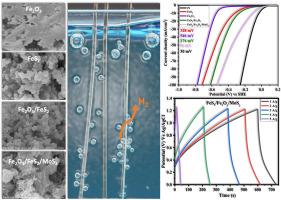
氢是一种很有前途的环保能源,可以通过水电解高效生产。该过程需要使用有效的电催化剂来促进析氢反应(HER)。在本研究中,研究了FeS2、Fe2O3、FeS2和Fe2O3二元复合材料(FeS2/Fe2O3)和FeS2、Fe2O3和MoS2三元复合材料(FeS2/Fe2O3/MoS2)的合成、表征和电化学性能。采用水热法制备材料,并利用x射线衍射(XRD)、傅里叶变换红外光谱(FTIR)、紫外可见(UV-Vis)光谱、扫描电子显微镜(SEM)、能量色散x射线光谱(EDX)、x射线光电子能谱(XPS)和电化学评价对材料进行分析。结果表明,FeS2/Fe2O3/MoS2复合材料具有最高的电化学活性表面积ECSA (27.79 μF/cm2)、最低的电荷转移电阻Rct (288 Ω)、过电位(10 mA/cm2时96 mV vs SHE)和Tafel斜率(72 mV/decade),表明三元复合材料在促进HER性能方面具有优异的性能。这些结果表明,MoS2与FeS2和Fe2O3的组合极大地提高了催化活性,使三元复合材料成为有效水分解应用的一个非常有吸引力的选择。此外,复合材料表现出优异的超级电容器性能,在电流密度为1 a /g时,比电容达到171.42 F/g。这些结果表明,FeS2/Fe2O3/MoS2可以作为高效的HER电催化剂,是超级电容器的优良材料。
Dual-function efficient hydrogen evolution reaction electrocatalyst and electrode material for supercapacitors based on ternary composite FeS2/Fe2O3/MoS2 nanostructures
Hydrogen is a promising and environment-friendly energy source that can be produced in a highly efficient manner through water electrolysis. This process requires the use of effective electrocatalysts to facilitate the hydrogen evolution reaction (HER). In this study, the synthesis, characterization, and electrochemical performance of FeS2, Fe2O3, a binary composite of FeS2 and Fe2O3 (FeS2/Fe2O3), and a ternary composite of FeS2, Fe2O3, and MoS2 (FeS2/Fe2O3/MoS2) are investigated. The materials were prepared using a hydrothermal technique and analyzed using X-ray diffraction (XRD), Fourier-transform infrared spectroscopy (FTIR), ultraviolet–visible (UV–Vis) spectroscopy, scanning electron microscopy (SEM), energy-dispersive X-ray spectroscopy (EDX), X-ray photoelectron spectroscopy (XPS), and electrochemical assessments. The ternary composite demonstrated improved HER performance, with the FeS2/Fe2O3/MoS2 hybrid exhibiting the highest electrochemically active surface area ECSA (27.79 μF/cm2), and lowest charge transfer resistance Rct (288 Ω), overpotential (96 mV vs. SHE at 10 mA/cm2) and Tafel slope (72 mV/decade), indicating the superior performance of the ternary composite in facilitating the HER. These results indicate that the combination of MoS2 with FeS2 and Fe2O3 greatly enhances the catalytic activity, making the ternary composite a highly attractive option for effective water-splitting applications. In addition, the hybrid composite exhibited outstanding supercapacitor performance, with a specific capacitance of 171.42 F/g at a current density of 1 A/g. These results indicate that FeS2/Fe2O3/MoS2 can function as a highly effective electrocatalyst for the HER and is a superior material for supercapacitors.
期刊介绍:
Materials Science in Semiconductor Processing provides a unique forum for the discussion of novel processing, applications and theoretical studies of functional materials and devices for (opto)electronics, sensors, detectors, biotechnology and green energy.
Each issue will aim to provide a snapshot of current insights, new achievements, breakthroughs and future trends in such diverse fields as microelectronics, energy conversion and storage, communications, biotechnology, (photo)catalysis, nano- and thin-film technology, hybrid and composite materials, chemical processing, vapor-phase deposition, device fabrication, and modelling, which are the backbone of advanced semiconductor processing and applications.
Coverage will include: advanced lithography for submicron devices; etching and related topics; ion implantation; damage evolution and related issues; plasma and thermal CVD; rapid thermal processing; advanced metallization and interconnect schemes; thin dielectric layers, oxidation; sol-gel processing; chemical bath and (electro)chemical deposition; compound semiconductor processing; new non-oxide materials and their applications; (macro)molecular and hybrid materials; molecular dynamics, ab-initio methods, Monte Carlo, etc.; new materials and processes for discrete and integrated circuits; magnetic materials and spintronics; heterostructures and quantum devices; engineering of the electrical and optical properties of semiconductors; crystal growth mechanisms; reliability, defect density, intrinsic impurities and defects.




 京公网安备 11010802042870号
京ICP备2023020795号-1
京公网安备 11010802042870号
京ICP备2023020795号-1

 分享
分享
 求助内容:
求助内容: 应助结果提醒方式:
 扫码关注我们
