Atiyeh Adelinia , Aleksey Yerokhin , David T.A. Matthews , Matthijn B. de Rooij , Jamal Seyyed Monfared Zanjani
{"title":"铝合金等离子体电解氧化涂层的孔形成及孔间连通性","authors":"Atiyeh Adelinia , Aleksey Yerokhin , David T.A. Matthews , Matthijn B. de Rooij , Jamal Seyyed Monfared Zanjani","doi":"10.1016/j.surfcoat.2024.131597","DOIUrl":null,"url":null,"abstract":"<div><div>The porosity and microstructure of plasma electrolytic oxidation (PEO) coatings are key factors in determining their properties and applications. Despite advances in understanding the PEO process, the mechanisms driving pore formation and their correlation with process parameters remain unclear due to the complex interplay between these variables. This study investigates the effects of treatment time and duty cycle on the microstructure of PEO coatings produced on an aluminium alloy in an alkaline electrolyte, with a particular focus on pore formation. Our findings reveal that longer treatment durations lead to the significant development of sub-surface pores at the interface between the inner and outer layers. Additionally, a lower duty cycle leads to an increase in sub-surface pores, while a higher duty cycle favours the formation of surface pores. Morphological, 3D microstructural mapping, and chemical analyses reveal that pore formation is driven by the micro-discharges, gas generation, and the preferred gas escape path within the micro-melt pools formed during the PEO formation process. The preferred gas escape path is closely linked to the characteristics and lifetime of local micro-melt pools, elucidating the mechanisms behind pore formation.</div></div>","PeriodicalId":22009,"journal":{"name":"Surface & Coatings Technology","volume":"496 ","pages":"Article 131597"},"PeriodicalIF":6.9000,"publicationDate":"2025-01-15","publicationTypes":"Journal Article","fieldsOfStudy":null,"isOpenAccess":false,"openAccessPdf":"","citationCount":"0","resultStr":"{\"title\":\"Pore formation and pore inter-connectivity in plasma electrolytic oxidation coatings on aluminium alloy\",\"authors\":\"Atiyeh Adelinia , Aleksey Yerokhin , David T.A. Matthews , Matthijn B. de Rooij , Jamal Seyyed Monfared Zanjani\",\"doi\":\"10.1016/j.surfcoat.2024.131597\",\"DOIUrl\":null,\"url\":null,\"abstract\":\"<div><div>The porosity and microstructure of plasma electrolytic oxidation (PEO) coatings are key factors in determining their properties and applications. Despite advances in understanding the PEO process, the mechanisms driving pore formation and their correlation with process parameters remain unclear due to the complex interplay between these variables. This study investigates the effects of treatment time and duty cycle on the microstructure of PEO coatings produced on an aluminium alloy in an alkaline electrolyte, with a particular focus on pore formation. Our findings reveal that longer treatment durations lead to the significant development of sub-surface pores at the interface between the inner and outer layers. Additionally, a lower duty cycle leads to an increase in sub-surface pores, while a higher duty cycle favours the formation of surface pores. Morphological, 3D microstructural mapping, and chemical analyses reveal that pore formation is driven by the micro-discharges, gas generation, and the preferred gas escape path within the micro-melt pools formed during the PEO formation process. The preferred gas escape path is closely linked to the characteristics and lifetime of local micro-melt pools, elucidating the mechanisms behind pore formation.</div></div>\",\"PeriodicalId\":22009,\"journal\":{\"name\":\"Surface & Coatings Technology\",\"volume\":\"496 \",\"pages\":\"Article 131597\"},\"PeriodicalIF\":6.9000,\"publicationDate\":\"2025-01-15\",\"publicationTypes\":\"Journal Article\",\"fieldsOfStudy\":null,\"isOpenAccess\":false,\"openAccessPdf\":\"\",\"citationCount\":\"0\",\"resultStr\":null,\"platform\":\"Semanticscholar\",\"paperid\":null,\"PeriodicalName\":\"Surface & Coatings Technology\",\"FirstCategoryId\":\"88\",\"ListUrlMain\":\"https://www.sciencedirect.com/science/article/pii/S0257897224012283\",\"RegionNum\":2,\"RegionCategory\":\"材料科学\",\"ArticlePicture\":[],\"TitleCN\":null,\"AbstractTextCN\":null,\"PMCID\":null,\"EPubDate\":\"2024/11/26 0:00:00\",\"PubModel\":\"Epub\",\"JCR\":\"Q1\",\"JCRName\":\"MATERIALS SCIENCE, COATINGS & FILMS\",\"Score\":null,\"Total\":0}","platform":"Semanticscholar","paperid":null,"PeriodicalName":"Surface & Coatings Technology","FirstCategoryId":"88","ListUrlMain":"https://www.sciencedirect.com/science/article/pii/S0257897224012283","RegionNum":2,"RegionCategory":"材料科学","ArticlePicture":[],"TitleCN":null,"AbstractTextCN":null,"PMCID":null,"EPubDate":"2024/11/26 0:00:00","PubModel":"Epub","JCR":"Q1","JCRName":"MATERIALS SCIENCE, COATINGS & FILMS","Score":null,"Total":0}
Pore formation and pore inter-connectivity in plasma electrolytic oxidation coatings on aluminium alloy
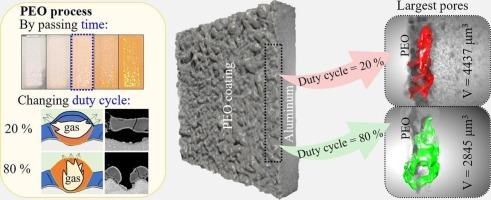
The porosity and microstructure of plasma electrolytic oxidation (PEO) coatings are key factors in determining their properties and applications. Despite advances in understanding the PEO process, the mechanisms driving pore formation and their correlation with process parameters remain unclear due to the complex interplay between these variables. This study investigates the effects of treatment time and duty cycle on the microstructure of PEO coatings produced on an aluminium alloy in an alkaline electrolyte, with a particular focus on pore formation. Our findings reveal that longer treatment durations lead to the significant development of sub-surface pores at the interface between the inner and outer layers. Additionally, a lower duty cycle leads to an increase in sub-surface pores, while a higher duty cycle favours the formation of surface pores. Morphological, 3D microstructural mapping, and chemical analyses reveal that pore formation is driven by the micro-discharges, gas generation, and the preferred gas escape path within the micro-melt pools formed during the PEO formation process. The preferred gas escape path is closely linked to the characteristics and lifetime of local micro-melt pools, elucidating the mechanisms behind pore formation.
期刊介绍:
Surface and Coatings Technology is an international archival journal publishing scientific papers on significant developments in surface and interface engineering to modify and improve the surface properties of materials for protection in demanding contact conditions or aggressive environments, or for enhanced functional performance. Contributions range from original scientific articles concerned with fundamental and applied aspects of research or direct applications of metallic, inorganic, organic and composite coatings, to invited reviews of current technology in specific areas. Papers submitted to this journal are expected to be in line with the following aspects in processes, and properties/performance:
A. Processes: Physical and chemical vapour deposition techniques, thermal and plasma spraying, surface modification by directed energy techniques such as ion, electron and laser beams, thermo-chemical treatment, wet chemical and electrochemical processes such as plating, sol-gel coating, anodization, plasma electrolytic oxidation, etc., but excluding painting.
B. Properties/performance: friction performance, wear resistance (e.g., abrasion, erosion, fretting, etc), corrosion and oxidation resistance, thermal protection, diffusion resistance, hydrophilicity/hydrophobicity, and properties relevant to smart materials behaviour and enhanced multifunctional performance for environmental, energy and medical applications, but excluding device aspects.




 京公网安备 11010802042870号
京ICP备2023020795号-1
京公网安备 11010802042870号
京ICP备2023020795号-1

 分享
分享
 求助内容:
求助内容: 应助结果提醒方式:
 扫码关注我们
