{"title":"用第一性原理计算揭示钨基难熔金属碳化物固态反应中的对称层次","authors":"Juan Ding, Wentan Zhu, Yunzhu Ma, Wensheng Liu, Qingshan Cai, Chaoping Liang","doi":"10.1016/j.ijrmhm.2024.106977","DOIUrl":null,"url":null,"abstract":"<div><div>Refractory metal carbides, usually fabricated via solid state reactions, require precise control of their reactants and temperature, especially when they enter a complex compositional space, like high-entropy (multi-component) carbides. In this work, the solid-state reactions of tungsten based refractory metal carbides M-W-C (M = Ti, Zr, Hf, V, Nb, Ta) are systematically studied through first-principles thermodynamic calculations and percolation simulations, and its relationship with symmetric principles is unraveled. Symmetric hierarchy is defined by the group-subgroup Bärnighausen tree and the gap in their space group number. It suggests MC and WC/W<sub>2</sub>C are two possible reactants to form the highest symmetric M-W-C ternary carbides, and indicates the larger the gap in their space group number, the harder the reactions. From the symmetric hierarchy, we found the reaction path from MC to M-W-C ternary carbides is the most probable, supported by the Gibbs reaction free energy. Carbon percolation within the metal framework plays another role in the solid-state reactions of tungsten based refractory metal carbides. It reveals the phase transition from M<sub>6</sub>W<sub>6</sub>C to M<sub>3</sub>W<sub>3</sub>C undergoes a transient M<sub>2</sub>W<sub>2</sub>C. The success in predicting the phase relationship of M-W-C ternary system offers a new paradigm for the design and synthesis of high-entropy carbides, nitrides, and oxides.</div></div>","PeriodicalId":14216,"journal":{"name":"International Journal of Refractory Metals & Hard Materials","volume":"127 ","pages":"Article 106977"},"PeriodicalIF":4.6000,"publicationDate":"2025-02-01","publicationTypes":"Journal Article","fieldsOfStudy":null,"isOpenAccess":false,"openAccessPdf":"","citationCount":"0","resultStr":"{\"title\":\"Unraveling symmetric hierarchy in solid-state reactions of tungsten-based refractory metal carbides through first-principles calculations\",\"authors\":\"Juan Ding, Wentan Zhu, Yunzhu Ma, Wensheng Liu, Qingshan Cai, Chaoping Liang\",\"doi\":\"10.1016/j.ijrmhm.2024.106977\",\"DOIUrl\":null,\"url\":null,\"abstract\":\"<div><div>Refractory metal carbides, usually fabricated via solid state reactions, require precise control of their reactants and temperature, especially when they enter a complex compositional space, like high-entropy (multi-component) carbides. In this work, the solid-state reactions of tungsten based refractory metal carbides M-W-C (M = Ti, Zr, Hf, V, Nb, Ta) are systematically studied through first-principles thermodynamic calculations and percolation simulations, and its relationship with symmetric principles is unraveled. Symmetric hierarchy is defined by the group-subgroup Bärnighausen tree and the gap in their space group number. It suggests MC and WC/W<sub>2</sub>C are two possible reactants to form the highest symmetric M-W-C ternary carbides, and indicates the larger the gap in their space group number, the harder the reactions. From the symmetric hierarchy, we found the reaction path from MC to M-W-C ternary carbides is the most probable, supported by the Gibbs reaction free energy. Carbon percolation within the metal framework plays another role in the solid-state reactions of tungsten based refractory metal carbides. It reveals the phase transition from M<sub>6</sub>W<sub>6</sub>C to M<sub>3</sub>W<sub>3</sub>C undergoes a transient M<sub>2</sub>W<sub>2</sub>C. The success in predicting the phase relationship of M-W-C ternary system offers a new paradigm for the design and synthesis of high-entropy carbides, nitrides, and oxides.</div></div>\",\"PeriodicalId\":14216,\"journal\":{\"name\":\"International Journal of Refractory Metals & Hard Materials\",\"volume\":\"127 \",\"pages\":\"Article 106977\"},\"PeriodicalIF\":4.6000,\"publicationDate\":\"2025-02-01\",\"publicationTypes\":\"Journal Article\",\"fieldsOfStudy\":null,\"isOpenAccess\":false,\"openAccessPdf\":\"\",\"citationCount\":\"0\",\"resultStr\":null,\"platform\":\"Semanticscholar\",\"paperid\":null,\"PeriodicalName\":\"International Journal of Refractory Metals & Hard Materials\",\"FirstCategoryId\":\"88\",\"ListUrlMain\":\"https://www.sciencedirect.com/science/article/pii/S0263436824004256\",\"RegionNum\":2,\"RegionCategory\":\"材料科学\",\"ArticlePicture\":[],\"TitleCN\":null,\"AbstractTextCN\":null,\"PMCID\":null,\"EPubDate\":\"2024/11/26 0:00:00\",\"PubModel\":\"Epub\",\"JCR\":\"Q2\",\"JCRName\":\"MATERIALS SCIENCE, MULTIDISCIPLINARY\",\"Score\":null,\"Total\":0}","platform":"Semanticscholar","paperid":null,"PeriodicalName":"International Journal of Refractory Metals & Hard Materials","FirstCategoryId":"88","ListUrlMain":"https://www.sciencedirect.com/science/article/pii/S0263436824004256","RegionNum":2,"RegionCategory":"材料科学","ArticlePicture":[],"TitleCN":null,"AbstractTextCN":null,"PMCID":null,"EPubDate":"2024/11/26 0:00:00","PubModel":"Epub","JCR":"Q2","JCRName":"MATERIALS SCIENCE, MULTIDISCIPLINARY","Score":null,"Total":0}
引用次数: 0
摘要
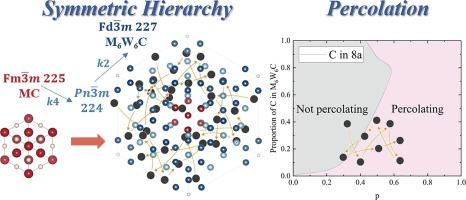
难熔金属碳化物通常通过固态反应制备,需要精确控制其反应物和温度,特别是当它们进入复杂的组成空间时,如高熵(多组分)碳化物。本文通过第一性原理热力学计算和渗流模拟,系统研究了钨基难熔金属碳化物M- w - c (M = Ti, Zr, Hf, V, Nb, Ta)的固相反应,揭示了其与对称原理的关系。对称层次结构由group-subgroup Bärnighausen树及其空间组号的间隙定义。MC和WC/W2C是形成对称度最高的M-W-C三元碳化物的两种可能的反应物,它们的空间基数间隙越大,反应越难进行。在吉布斯反应自由能的支持下,从MC到M-W-C三元碳化物的反应路径是最可能的。金属骨架内的碳渗透在钨基难熔金属碳化物的固态反应中起着另一个作用。它揭示了从M6W6C到M3W3C的相变经历了一个瞬态的M2W2C。成功预测了M-W-C三元体系的相关系,为高熵碳化物、氮化物和氧化物的设计和合成提供了新的范例。
Unraveling symmetric hierarchy in solid-state reactions of tungsten-based refractory metal carbides through first-principles calculations
Refractory metal carbides, usually fabricated via solid state reactions, require precise control of their reactants and temperature, especially when they enter a complex compositional space, like high-entropy (multi-component) carbides. In this work, the solid-state reactions of tungsten based refractory metal carbides M-W-C (M = Ti, Zr, Hf, V, Nb, Ta) are systematically studied through first-principles thermodynamic calculations and percolation simulations, and its relationship with symmetric principles is unraveled. Symmetric hierarchy is defined by the group-subgroup Bärnighausen tree and the gap in their space group number. It suggests MC and WC/W2C are two possible reactants to form the highest symmetric M-W-C ternary carbides, and indicates the larger the gap in their space group number, the harder the reactions. From the symmetric hierarchy, we found the reaction path from MC to M-W-C ternary carbides is the most probable, supported by the Gibbs reaction free energy. Carbon percolation within the metal framework plays another role in the solid-state reactions of tungsten based refractory metal carbides. It reveals the phase transition from M6W6C to M3W3C undergoes a transient M2W2C. The success in predicting the phase relationship of M-W-C ternary system offers a new paradigm for the design and synthesis of high-entropy carbides, nitrides, and oxides.
期刊介绍:
The International Journal of Refractory Metals and Hard Materials (IJRMHM) publishes original research articles concerned with all aspects of refractory metals and hard materials. Refractory metals are defined as metals with melting points higher than 1800 °C. These are tungsten, molybdenum, chromium, tantalum, niobium, hafnium, and rhenium, as well as many compounds and alloys based thereupon. Hard materials that are included in the scope of this journal are defined as materials with hardness values higher than 1000 kg/mm2, primarily intended for applications as manufacturing tools or wear resistant components in mechanical systems. Thus they encompass carbides, nitrides and borides of metals, and related compounds. A special focus of this journal is put on the family of hardmetals, which is also known as cemented tungsten carbide, and cermets which are based on titanium carbide and carbonitrides with or without a metal binder. Ceramics and superhard materials including diamond and cubic boron nitride may also be accepted provided the subject material is presented as hard materials as defined above.




 京公网安备 11010802042870号
京ICP备2023020795号-1
京公网安备 11010802042870号
京ICP备2023020795号-1

 分享
分享
 求助内容:
求助内容: 应助结果提醒方式:
 扫码关注我们
