Fan Yu , Qihai Shu , David R. Lentz , Qingfei Wang , Rongzhen Zhang , Xudong Niu , Qingwen Zeng , Kai Xing , Jun Deng
{"title":"玉库巨型钼钨矿床白钨矿结构与成分指纹矽卡岩成矿作用","authors":"Fan Yu , Qihai Shu , David R. Lentz , Qingfei Wang , Rongzhen Zhang , Xudong Niu , Qingwen Zeng , Kai Xing , Jun Deng","doi":"10.1016/j.oregeorev.2024.106361","DOIUrl":null,"url":null,"abstract":"<div><div>Scheelite is widely used to reveal ore-forming redox environments and track hydrothermal evolution processes in W-bearing deposits. Yuku, situated in Central China, is a typical skarn Mo-W deposit discovered recently in the Luanchuan Mo-W-Zn-Pb ore district. This study determined the compositions of the Yuku scheelite via laser ablation-inductively coupled plasma-mass spectrometry (LA-ICP-MS) and electron microprobe analysis (EMPA) techniques. Based on the textural characteristics and mineral assemblages, three types of scheelite were categorized, including Sch A1, Sch A2, and Sch B. In general, Sch A1 formed during the prograde stage, mostly occurring as euhedral grains that distributed discretely within the interstices of skarn minerals. Sch A2 predominantly formed as the rim of Sch A1 or crosscut Sch A1. It is commonly associated with sulfides, such as pyrrhotite, pyrite, and molybdenite. Sch B is primarily observed in the quartz-sulfide veins or within pyrrhotite crystals, occurring later than Sch A1 and Sch A2. Geochemically, Sch A1 contains a significantly higher Mo content (>14,300 ppm) and is characterized by a negative inclined chondrite-normalized rare earth element (REE) pattern, while Sch B has Mo contents lower than 10,300 ppm and exhibits an M-type tetrad REE pattern. Sch A2 contains a Mo content ranging from 146 ppm to 89,000 ppm (mean 27,900 ppm) and displays an intricate REE pattern that partially overlaps with Sch A1 and Sch B. The difference of REE concentrations among different scheelite generations is controlled by substitution mechanisms and also influenced by the precipitation of garnet and pyroxene. Sch A1 and Sch B exhibit a linear 1:1 trend between Na (atom) and ΣREE – Eu + Y (atom), indicating the important role of substitution via 2Ca<sup>2+</sup> = REE<sup>3+</sup> + Na<sup>+</sup>. The concentrations of Nb, Ta and V are notably low, supporting only a small amount of REE incorporation into Sch A1 through Ca<sup>2+</sup> + W<sup>6+</sup> = REE<sup>3+</sup> + (Nb + Ta + V)<sup>5+</sup>. The REE patterns of Sch A1 and partly Sch A2 resemble those of the causative intrusions, indicating that substituting the site vacancy in scheelite lattice is another crucial mechanism. All three substitution mechanisms play roles in REE incorporation during the scheelite mineralization process. Negative Eu anomalies prevail in Yuku scheelite (mean δEu = 0.77), although positive Eu anomalies are also observed, particularly in Sch B (mean δEu = 1.11). Additionally, there is a conspicuous decreasing trend in the Mo content from the prograde to late stage, suggesting that the Mo-W mineralization at Yuku likely experienced a decrease in oxygen fugacity and/or temperature. Furthermore, in a comparative analysis of scheelite Mo content and Eu anomaly with other deposits, it was observed that Mo content in skarn deposits is generally higher than that in orogenic deposits (mostly <100 ppm), providing a tool for distinguishing deposit types utilizing scheelite geochemical characteristics.</div></div>","PeriodicalId":19644,"journal":{"name":"Ore Geology Reviews","volume":"175 ","pages":"Article 106361"},"PeriodicalIF":4.3000,"publicationDate":"2024-12-01","publicationTypes":"Journal Article","fieldsOfStudy":null,"isOpenAccess":false,"openAccessPdf":"","citationCount":"0","resultStr":"{\"title\":\"Scheelite texture and composition fingerprint skarn mineralization of the giant Yuku Mo-W deposit, Central China\",\"authors\":\"Fan Yu , Qihai Shu , David R. Lentz , Qingfei Wang , Rongzhen Zhang , Xudong Niu , Qingwen Zeng , Kai Xing , Jun Deng\",\"doi\":\"10.1016/j.oregeorev.2024.106361\",\"DOIUrl\":null,\"url\":null,\"abstract\":\"<div><div>Scheelite is widely used to reveal ore-forming redox environments and track hydrothermal evolution processes in W-bearing deposits. Yuku, situated in Central China, is a typical skarn Mo-W deposit discovered recently in the Luanchuan Mo-W-Zn-Pb ore district. This study determined the compositions of the Yuku scheelite via laser ablation-inductively coupled plasma-mass spectrometry (LA-ICP-MS) and electron microprobe analysis (EMPA) techniques. Based on the textural characteristics and mineral assemblages, three types of scheelite were categorized, including Sch A1, Sch A2, and Sch B. In general, Sch A1 formed during the prograde stage, mostly occurring as euhedral grains that distributed discretely within the interstices of skarn minerals. Sch A2 predominantly formed as the rim of Sch A1 or crosscut Sch A1. It is commonly associated with sulfides, such as pyrrhotite, pyrite, and molybdenite. Sch B is primarily observed in the quartz-sulfide veins or within pyrrhotite crystals, occurring later than Sch A1 and Sch A2. Geochemically, Sch A1 contains a significantly higher Mo content (>14,300 ppm) and is characterized by a negative inclined chondrite-normalized rare earth element (REE) pattern, while Sch B has Mo contents lower than 10,300 ppm and exhibits an M-type tetrad REE pattern. Sch A2 contains a Mo content ranging from 146 ppm to 89,000 ppm (mean 27,900 ppm) and displays an intricate REE pattern that partially overlaps with Sch A1 and Sch B. The difference of REE concentrations among different scheelite generations is controlled by substitution mechanisms and also influenced by the precipitation of garnet and pyroxene. Sch A1 and Sch B exhibit a linear 1:1 trend between Na (atom) and ΣREE – Eu + Y (atom), indicating the important role of substitution via 2Ca<sup>2+</sup> = REE<sup>3+</sup> + Na<sup>+</sup>. The concentrations of Nb, Ta and V are notably low, supporting only a small amount of REE incorporation into Sch A1 through Ca<sup>2+</sup> + W<sup>6+</sup> = REE<sup>3+</sup> + (Nb + Ta + V)<sup>5+</sup>. The REE patterns of Sch A1 and partly Sch A2 resemble those of the causative intrusions, indicating that substituting the site vacancy in scheelite lattice is another crucial mechanism. All three substitution mechanisms play roles in REE incorporation during the scheelite mineralization process. Negative Eu anomalies prevail in Yuku scheelite (mean δEu = 0.77), although positive Eu anomalies are also observed, particularly in Sch B (mean δEu = 1.11). Additionally, there is a conspicuous decreasing trend in the Mo content from the prograde to late stage, suggesting that the Mo-W mineralization at Yuku likely experienced a decrease in oxygen fugacity and/or temperature. Furthermore, in a comparative analysis of scheelite Mo content and Eu anomaly with other deposits, it was observed that Mo content in skarn deposits is generally higher than that in orogenic deposits (mostly <100 ppm), providing a tool for distinguishing deposit types utilizing scheelite geochemical characteristics.</div></div>\",\"PeriodicalId\":19644,\"journal\":{\"name\":\"Ore Geology Reviews\",\"volume\":\"175 \",\"pages\":\"Article 106361\"},\"PeriodicalIF\":4.3000,\"publicationDate\":\"2024-12-01\",\"publicationTypes\":\"Journal Article\",\"fieldsOfStudy\":null,\"isOpenAccess\":false,\"openAccessPdf\":\"\",\"citationCount\":\"0\",\"resultStr\":null,\"platform\":\"Semanticscholar\",\"paperid\":null,\"PeriodicalName\":\"Ore Geology Reviews\",\"FirstCategoryId\":\"89\",\"ListUrlMain\":\"https://www.sciencedirect.com/science/article/pii/S0169136824004943\",\"RegionNum\":2,\"RegionCategory\":\"地球科学\",\"ArticlePicture\":[],\"TitleCN\":null,\"AbstractTextCN\":null,\"PMCID\":null,\"EPubDate\":\"2024/11/22 0:00:00\",\"PubModel\":\"Epub\",\"JCR\":\"Q1\",\"JCRName\":\"GEOLOGY\",\"Score\":null,\"Total\":0}","platform":"Semanticscholar","paperid":null,"PeriodicalName":"Ore Geology Reviews","FirstCategoryId":"89","ListUrlMain":"https://www.sciencedirect.com/science/article/pii/S0169136824004943","RegionNum":2,"RegionCategory":"地球科学","ArticlePicture":[],"TitleCN":null,"AbstractTextCN":null,"PMCID":null,"EPubDate":"2024/11/22 0:00:00","PubModel":"Epub","JCR":"Q1","JCRName":"GEOLOGY","Score":null,"Total":0}
Scheelite texture and composition fingerprint skarn mineralization of the giant Yuku Mo-W deposit, Central China
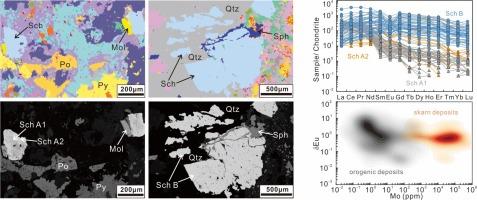
Scheelite is widely used to reveal ore-forming redox environments and track hydrothermal evolution processes in W-bearing deposits. Yuku, situated in Central China, is a typical skarn Mo-W deposit discovered recently in the Luanchuan Mo-W-Zn-Pb ore district. This study determined the compositions of the Yuku scheelite via laser ablation-inductively coupled plasma-mass spectrometry (LA-ICP-MS) and electron microprobe analysis (EMPA) techniques. Based on the textural characteristics and mineral assemblages, three types of scheelite were categorized, including Sch A1, Sch A2, and Sch B. In general, Sch A1 formed during the prograde stage, mostly occurring as euhedral grains that distributed discretely within the interstices of skarn minerals. Sch A2 predominantly formed as the rim of Sch A1 or crosscut Sch A1. It is commonly associated with sulfides, such as pyrrhotite, pyrite, and molybdenite. Sch B is primarily observed in the quartz-sulfide veins or within pyrrhotite crystals, occurring later than Sch A1 and Sch A2. Geochemically, Sch A1 contains a significantly higher Mo content (>14,300 ppm) and is characterized by a negative inclined chondrite-normalized rare earth element (REE) pattern, while Sch B has Mo contents lower than 10,300 ppm and exhibits an M-type tetrad REE pattern. Sch A2 contains a Mo content ranging from 146 ppm to 89,000 ppm (mean 27,900 ppm) and displays an intricate REE pattern that partially overlaps with Sch A1 and Sch B. The difference of REE concentrations among different scheelite generations is controlled by substitution mechanisms and also influenced by the precipitation of garnet and pyroxene. Sch A1 and Sch B exhibit a linear 1:1 trend between Na (atom) and ΣREE – Eu + Y (atom), indicating the important role of substitution via 2Ca2+ = REE3+ + Na+. The concentrations of Nb, Ta and V are notably low, supporting only a small amount of REE incorporation into Sch A1 through Ca2+ + W6+ = REE3+ + (Nb + Ta + V)5+. The REE patterns of Sch A1 and partly Sch A2 resemble those of the causative intrusions, indicating that substituting the site vacancy in scheelite lattice is another crucial mechanism. All three substitution mechanisms play roles in REE incorporation during the scheelite mineralization process. Negative Eu anomalies prevail in Yuku scheelite (mean δEu = 0.77), although positive Eu anomalies are also observed, particularly in Sch B (mean δEu = 1.11). Additionally, there is a conspicuous decreasing trend in the Mo content from the prograde to late stage, suggesting that the Mo-W mineralization at Yuku likely experienced a decrease in oxygen fugacity and/or temperature. Furthermore, in a comparative analysis of scheelite Mo content and Eu anomaly with other deposits, it was observed that Mo content in skarn deposits is generally higher than that in orogenic deposits (mostly <100 ppm), providing a tool for distinguishing deposit types utilizing scheelite geochemical characteristics.
期刊介绍:
Ore Geology Reviews aims to familiarize all earth scientists with recent advances in a number of interconnected disciplines related to the study of, and search for, ore deposits. The reviews range from brief to longer contributions, but the journal preferentially publishes manuscripts that fill the niche between the commonly shorter journal articles and the comprehensive book coverages, and thus has a special appeal to many authors and readers.




 京公网安备 11010802042870号
京ICP备2023020795号-1
京公网安备 11010802042870号
京ICP备2023020795号-1

 分享
分享
 求助内容:
求助内容: 应助结果提醒方式:
 扫码关注我们
