Johanna Schreiber, Natalie E. Göppert, Leanne M. Stafast, Christine Weber, Ulrich S. Schubert
{"title":"环辛基末端功能化聚-2,5-二酮。","authors":"Johanna Schreiber, Natalie E. Göppert, Leanne M. Stafast, Christine Weber, Ulrich S. Schubert","doi":"10.1002/marc.202400705","DOIUrl":null,"url":null,"abstract":"<p>The cyclooctyne-functionalized alcohol (1<i>R</i>,8<i>S</i>,9<i>S</i>)-bicyclo-[6.1.0]non-4-yn-9-ylmethanol (BCN-OH) is applied as initiator for the organo-catalyzed ring-opening polymerization (ROP) of morpholine-2,5-diones based on the <span>l</span>-amino acids valine, isoleucine, and phenylalanine. The ROP is catalyzed by a binary system of 1,8-diazabicyclo[5.4.0]undec-7-ene (DBU) and 1-(3,5-bis(trifluoromethyl)phenyl)-3-cyclohexylthiourea (TU) applying a feed ratio of [M]/[I]/[DBU]/[TU] of 100/1/1/10. Kinetic studies reveal that BCN-OH is capable to initiate the polymerization of morpholine-2,5-diones, which proceed in a controlled manner until monomer conversions of 80%. Characterization by means of <sup>1</sup>H NMR spectroscopy, size exclusion chromatography (SEC), and matrix-assisted laser desorption/ionization-time of flight-mass spectrometry confirm the covalent attachment of the cyclooctyne moiety as α-end group of the poly(morpholine-2,5-dione)s with maximum dispersities of 1.25. As a proof of concept, a vitamin A end-functionalized poly(2-ethyl-2-oxazoline) is coupled to a poly(ester amide) by strain-promoted azide-alkyne cycloaddition. Characterization of the block copolymer by SEC and DOSY NMR spectroscopy confirm the successful attachment of the two building blocks. The versatile cyclooctyne moiety shall facilitate a metal-free attachment of other polymer blocks, targeting ligands or dyes at the α-end group of well-defined poly(morpholine-2,5-dione)s. In consequence, the approach provides access to a new generation of functionalized poly(ester amide)s, which can be customized for specific needs.</p>","PeriodicalId":205,"journal":{"name":"Macromolecular Rapid Communications","volume":"46 3","pages":""},"PeriodicalIF":4.1000,"publicationDate":"2024-11-29","publicationTypes":"Journal Article","fieldsOfStudy":null,"isOpenAccess":false,"openAccessPdf":"https://onlinelibrary.wiley.com/doi/epdf/10.1002/marc.202400705","citationCount":"0","resultStr":"{\"title\":\"Cyclooctyne End-Functionalized Poly(morpholine-2,5-dione)s\",\"authors\":\"Johanna Schreiber, Natalie E. Göppert, Leanne M. Stafast, Christine Weber, Ulrich S. Schubert\",\"doi\":\"10.1002/marc.202400705\",\"DOIUrl\":null,\"url\":null,\"abstract\":\"<p>The cyclooctyne-functionalized alcohol (1<i>R</i>,8<i>S</i>,9<i>S</i>)-bicyclo-[6.1.0]non-4-yn-9-ylmethanol (BCN-OH) is applied as initiator for the organo-catalyzed ring-opening polymerization (ROP) of morpholine-2,5-diones based on the <span>l</span>-amino acids valine, isoleucine, and phenylalanine. The ROP is catalyzed by a binary system of 1,8-diazabicyclo[5.4.0]undec-7-ene (DBU) and 1-(3,5-bis(trifluoromethyl)phenyl)-3-cyclohexylthiourea (TU) applying a feed ratio of [M]/[I]/[DBU]/[TU] of 100/1/1/10. Kinetic studies reveal that BCN-OH is capable to initiate the polymerization of morpholine-2,5-diones, which proceed in a controlled manner until monomer conversions of 80%. Characterization by means of <sup>1</sup>H NMR spectroscopy, size exclusion chromatography (SEC), and matrix-assisted laser desorption/ionization-time of flight-mass spectrometry confirm the covalent attachment of the cyclooctyne moiety as α-end group of the poly(morpholine-2,5-dione)s with maximum dispersities of 1.25. As a proof of concept, a vitamin A end-functionalized poly(2-ethyl-2-oxazoline) is coupled to a poly(ester amide) by strain-promoted azide-alkyne cycloaddition. Characterization of the block copolymer by SEC and DOSY NMR spectroscopy confirm the successful attachment of the two building blocks. The versatile cyclooctyne moiety shall facilitate a metal-free attachment of other polymer blocks, targeting ligands or dyes at the α-end group of well-defined poly(morpholine-2,5-dione)s. In consequence, the approach provides access to a new generation of functionalized poly(ester amide)s, which can be customized for specific needs.</p>\",\"PeriodicalId\":205,\"journal\":{\"name\":\"Macromolecular Rapid Communications\",\"volume\":\"46 3\",\"pages\":\"\"},\"PeriodicalIF\":4.1000,\"publicationDate\":\"2024-11-29\",\"publicationTypes\":\"Journal Article\",\"fieldsOfStudy\":null,\"isOpenAccess\":false,\"openAccessPdf\":\"https://onlinelibrary.wiley.com/doi/epdf/10.1002/marc.202400705\",\"citationCount\":\"0\",\"resultStr\":null,\"platform\":\"Semanticscholar\",\"paperid\":null,\"PeriodicalName\":\"Macromolecular Rapid Communications\",\"FirstCategoryId\":\"92\",\"ListUrlMain\":\"https://onlinelibrary.wiley.com/doi/10.1002/marc.202400705\",\"RegionNum\":3,\"RegionCategory\":\"化学\",\"ArticlePicture\":[],\"TitleCN\":null,\"AbstractTextCN\":null,\"PMCID\":null,\"EPubDate\":\"\",\"PubModel\":\"\",\"JCR\":\"Q2\",\"JCRName\":\"POLYMER SCIENCE\",\"Score\":null,\"Total\":0}","platform":"Semanticscholar","paperid":null,"PeriodicalName":"Macromolecular Rapid Communications","FirstCategoryId":"92","ListUrlMain":"https://onlinelibrary.wiley.com/doi/10.1002/marc.202400705","RegionNum":3,"RegionCategory":"化学","ArticlePicture":[],"TitleCN":null,"AbstractTextCN":null,"PMCID":null,"EPubDate":"","PubModel":"","JCR":"Q2","JCRName":"POLYMER SCIENCE","Score":null,"Total":0}
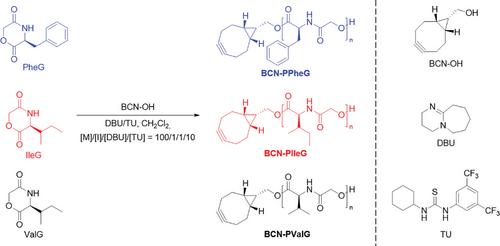
The cyclooctyne-functionalized alcohol (1R,8S,9S)-bicyclo-[6.1.0]non-4-yn-9-ylmethanol (BCN-OH) is applied as initiator for the organo-catalyzed ring-opening polymerization (ROP) of morpholine-2,5-diones based on the l-amino acids valine, isoleucine, and phenylalanine. The ROP is catalyzed by a binary system of 1,8-diazabicyclo[5.4.0]undec-7-ene (DBU) and 1-(3,5-bis(trifluoromethyl)phenyl)-3-cyclohexylthiourea (TU) applying a feed ratio of [M]/[I]/[DBU]/[TU] of 100/1/1/10. Kinetic studies reveal that BCN-OH is capable to initiate the polymerization of morpholine-2,5-diones, which proceed in a controlled manner until monomer conversions of 80%. Characterization by means of 1H NMR spectroscopy, size exclusion chromatography (SEC), and matrix-assisted laser desorption/ionization-time of flight-mass spectrometry confirm the covalent attachment of the cyclooctyne moiety as α-end group of the poly(morpholine-2,5-dione)s with maximum dispersities of 1.25. As a proof of concept, a vitamin A end-functionalized poly(2-ethyl-2-oxazoline) is coupled to a poly(ester amide) by strain-promoted azide-alkyne cycloaddition. Characterization of the block copolymer by SEC and DOSY NMR spectroscopy confirm the successful attachment of the two building blocks. The versatile cyclooctyne moiety shall facilitate a metal-free attachment of other polymer blocks, targeting ligands or dyes at the α-end group of well-defined poly(morpholine-2,5-dione)s. In consequence, the approach provides access to a new generation of functionalized poly(ester amide)s, which can be customized for specific needs.
期刊介绍:
Macromolecular Rapid Communications publishes original research in polymer science, ranging from chemistry and physics of polymers to polymers in materials science and life sciences.




 京公网安备 11010802042870号
京ICP备2023020795号-1
京公网安备 11010802042870号
京ICP备2023020795号-1

 分享
分享
 求助内容:
求助内容: 应助结果提醒方式:
 扫码关注我们
