{"title":"孟加拉常见烘焙食品中可能致癌物质溴酸钾的综合分析","authors":"Md. Mazharul Islam, Supath Xavier Besra, Shahnaz Akhtar Nishat, Abida Sultana","doi":"10.1002/fsn3.4546","DOIUrl":null,"url":null,"abstract":"<p>Potassium bromate (KBrO<sub>3</sub>), employed ubiquitously as an oxidizing agent in commonly consumed baked foods and as a flour improver to enhance dough quality, has been recognized as a possible human carcinogen. Despite stringent prohibitions in numerous nations eliciting substantial apprehension worldwide, notably in Bangladesh, the pervasive occurrence of KBrO<sub>3</sub> in baked foods persists as a formidable public health quandary. This study aimed to investigate the presence of KBrO<sub>3</sub> in five different popular baked foods comprising a total of 104 samples, such as bread (<i>n</i> = 39), cake (<i>n</i> = 33), burger buns (<i>n</i> = 13), pizza (<i>n</i> = 10), and naan (<i>n</i> = 9), collected from different districts across Bangladesh. The amounts of KBrO<sub>3</sub> were quantified using UV–visible spectrophotometric method. A calibration curve was obtained with a satisfactory linearity and a correlation coefficient (<i>R</i><sup>2</sup>) 0.998. The sensitivity was confirmed by limits of detection (LOD = 0.0180 mg L<sup>−1</sup>) and quantification (LOQ = 0.0548 mg L<sup>−1</sup>). The recovery rates for spiked samples were 87%–103%, ensuring the accuracy and reliability of the measurements. KBrO<sub>3</sub> concentrations varied significantly across the samples: BDL to 5.53 ± 0.24 mg kg<sup>−1</sup> in breads, BDL to 6.18 ± 0.01 mg kg<sup>−1</sup> in cakes, 0.86 ± 0.01 to 1.69 ± 0.01 mg kg<sup>−1</sup> in burger buns, 0.92 ± 0.01 to 4.35 ± 0.01 mg kg<sup>−1</sup> in pizzas, and BDL to 5.37 ± 0.02 mg kg<sup>−1</sup> in naans. The concentrations of KBrO<sub>3</sub> in bread, cake, burger buns, pizza, and naans surpass the recommended threshold established by the FDA factors of 276.5, 309.0, 84.5, 217.5, and 268.5, respectively. The study revealed particularly high levels of KBrO<sub>3</sub> presence in the targeted baked foods in all of the sampling districts, highlighting a serious food safety concern in Bangladesh.</p>","PeriodicalId":12418,"journal":{"name":"Food Science & Nutrition","volume":"12 11","pages":"9799-9809"},"PeriodicalIF":3.8000,"publicationDate":"2024-10-24","publicationTypes":"Journal Article","fieldsOfStudy":null,"isOpenAccess":false,"openAccessPdf":"https://onlinelibrary.wiley.com/doi/epdf/10.1002/fsn3.4546","citationCount":"0","resultStr":"{\"title\":\"A Comprehensive Analysis of Potassium Bromate, a Possible Carcinogen, in Popular Baked Foodstuffs of Bangladesh\",\"authors\":\"Md. Mazharul Islam, Supath Xavier Besra, Shahnaz Akhtar Nishat, Abida Sultana\",\"doi\":\"10.1002/fsn3.4546\",\"DOIUrl\":null,\"url\":null,\"abstract\":\"<p>Potassium bromate (KBrO<sub>3</sub>), employed ubiquitously as an oxidizing agent in commonly consumed baked foods and as a flour improver to enhance dough quality, has been recognized as a possible human carcinogen. Despite stringent prohibitions in numerous nations eliciting substantial apprehension worldwide, notably in Bangladesh, the pervasive occurrence of KBrO<sub>3</sub> in baked foods persists as a formidable public health quandary. This study aimed to investigate the presence of KBrO<sub>3</sub> in five different popular baked foods comprising a total of 104 samples, such as bread (<i>n</i> = 39), cake (<i>n</i> = 33), burger buns (<i>n</i> = 13), pizza (<i>n</i> = 10), and naan (<i>n</i> = 9), collected from different districts across Bangladesh. The amounts of KBrO<sub>3</sub> were quantified using UV–visible spectrophotometric method. A calibration curve was obtained with a satisfactory linearity and a correlation coefficient (<i>R</i><sup>2</sup>) 0.998. The sensitivity was confirmed by limits of detection (LOD = 0.0180 mg L<sup>−1</sup>) and quantification (LOQ = 0.0548 mg L<sup>−1</sup>). The recovery rates for spiked samples were 87%–103%, ensuring the accuracy and reliability of the measurements. KBrO<sub>3</sub> concentrations varied significantly across the samples: BDL to 5.53 ± 0.24 mg kg<sup>−1</sup> in breads, BDL to 6.18 ± 0.01 mg kg<sup>−1</sup> in cakes, 0.86 ± 0.01 to 1.69 ± 0.01 mg kg<sup>−1</sup> in burger buns, 0.92 ± 0.01 to 4.35 ± 0.01 mg kg<sup>−1</sup> in pizzas, and BDL to 5.37 ± 0.02 mg kg<sup>−1</sup> in naans. The concentrations of KBrO<sub>3</sub> in bread, cake, burger buns, pizza, and naans surpass the recommended threshold established by the FDA factors of 276.5, 309.0, 84.5, 217.5, and 268.5, respectively. The study revealed particularly high levels of KBrO<sub>3</sub> presence in the targeted baked foods in all of the sampling districts, highlighting a serious food safety concern in Bangladesh.</p>\",\"PeriodicalId\":12418,\"journal\":{\"name\":\"Food Science & Nutrition\",\"volume\":\"12 11\",\"pages\":\"9799-9809\"},\"PeriodicalIF\":3.8000,\"publicationDate\":\"2024-10-24\",\"publicationTypes\":\"Journal Article\",\"fieldsOfStudy\":null,\"isOpenAccess\":false,\"openAccessPdf\":\"https://onlinelibrary.wiley.com/doi/epdf/10.1002/fsn3.4546\",\"citationCount\":\"0\",\"resultStr\":null,\"platform\":\"Semanticscholar\",\"paperid\":null,\"PeriodicalName\":\"Food Science & Nutrition\",\"FirstCategoryId\":\"97\",\"ListUrlMain\":\"https://onlinelibrary.wiley.com/doi/10.1002/fsn3.4546\",\"RegionNum\":2,\"RegionCategory\":\"农林科学\",\"ArticlePicture\":[],\"TitleCN\":null,\"AbstractTextCN\":null,\"PMCID\":null,\"EPubDate\":\"\",\"PubModel\":\"\",\"JCR\":\"Q2\",\"JCRName\":\"FOOD SCIENCE & TECHNOLOGY\",\"Score\":null,\"Total\":0}","platform":"Semanticscholar","paperid":null,"PeriodicalName":"Food Science & Nutrition","FirstCategoryId":"97","ListUrlMain":"https://onlinelibrary.wiley.com/doi/10.1002/fsn3.4546","RegionNum":2,"RegionCategory":"农林科学","ArticlePicture":[],"TitleCN":null,"AbstractTextCN":null,"PMCID":null,"EPubDate":"","PubModel":"","JCR":"Q2","JCRName":"FOOD SCIENCE & TECHNOLOGY","Score":null,"Total":0}
引用次数: 0
摘要
溴酸钾(KBrO3)作为一种氧化剂广泛应用于常见的烘焙食品中,并作为面粉改良剂提高面团质量,已被认为是一种可能的人类致癌物。尽管许多国家(特别是孟加拉国)都有严格的禁令,引起了全世界的严重担忧,但烘焙食品中普遍存在的KBrO3仍然是一个令人生畏的公共卫生难题。本研究旨在调查五种不同的流行烘焙食品中KBrO3的存在,包括总共104个样本,如面包(n = 39)、蛋糕(n = 33)、汉堡面包(n = 13)、披萨(n = 10)和馕(n = 9),这些样本来自孟加拉国不同地区。用紫外可见分光光度法测定KBrO3的含量。建立了良好的线性关系,相关系数(R2)为0.998。通过检测限(LOD = 0.0180 mg L−1)和定量限(LOQ = 0.0548 mg L−1)验证了该方法的灵敏度。加样回收率为87% ~ 103%,保证了测定的准确性和可靠性。不同样品的KBrO3浓度差异显著:面包中的BDL为5.53±0.24 mg kg - 1,蛋糕中的BDL为6.18±0.01 mg kg - 1,汉堡面包中的BDL为0.86±0.01至1.69±0.01 mg kg - 1,比萨饼中的BDL为0.92±0.01至4.35±0.01 mg kg - 1,馕中的BDL为5.37±0.02 mg kg - 1。面包、蛋糕、汉堡、披萨和馕中的KBrO3浓度分别超过了FDA设定的推荐阈值276.5、309.0、84.5、217.5和268.5。该研究显示,在所有采样地区的目标烘焙食品中,KBrO3的含量特别高,突出了孟加拉国严重的食品安全问题。
A Comprehensive Analysis of Potassium Bromate, a Possible Carcinogen, in Popular Baked Foodstuffs of Bangladesh
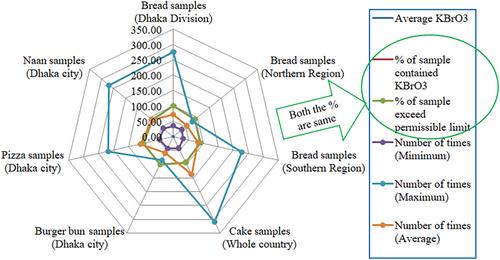
Potassium bromate (KBrO3), employed ubiquitously as an oxidizing agent in commonly consumed baked foods and as a flour improver to enhance dough quality, has been recognized as a possible human carcinogen. Despite stringent prohibitions in numerous nations eliciting substantial apprehension worldwide, notably in Bangladesh, the pervasive occurrence of KBrO3 in baked foods persists as a formidable public health quandary. This study aimed to investigate the presence of KBrO3 in five different popular baked foods comprising a total of 104 samples, such as bread (n = 39), cake (n = 33), burger buns (n = 13), pizza (n = 10), and naan (n = 9), collected from different districts across Bangladesh. The amounts of KBrO3 were quantified using UV–visible spectrophotometric method. A calibration curve was obtained with a satisfactory linearity and a correlation coefficient (R2) 0.998. The sensitivity was confirmed by limits of detection (LOD = 0.0180 mg L−1) and quantification (LOQ = 0.0548 mg L−1). The recovery rates for spiked samples were 87%–103%, ensuring the accuracy and reliability of the measurements. KBrO3 concentrations varied significantly across the samples: BDL to 5.53 ± 0.24 mg kg−1 in breads, BDL to 6.18 ± 0.01 mg kg−1 in cakes, 0.86 ± 0.01 to 1.69 ± 0.01 mg kg−1 in burger buns, 0.92 ± 0.01 to 4.35 ± 0.01 mg kg−1 in pizzas, and BDL to 5.37 ± 0.02 mg kg−1 in naans. The concentrations of KBrO3 in bread, cake, burger buns, pizza, and naans surpass the recommended threshold established by the FDA factors of 276.5, 309.0, 84.5, 217.5, and 268.5, respectively. The study revealed particularly high levels of KBrO3 presence in the targeted baked foods in all of the sampling districts, highlighting a serious food safety concern in Bangladesh.
期刊介绍:
Food Science & Nutrition is the peer-reviewed journal for rapid dissemination of research in all areas of food science and nutrition. The Journal will consider submissions of quality papers describing the results of fundamental and applied research related to all aspects of human food and nutrition, as well as interdisciplinary research that spans these two fields.




 京公网安备 11010802042870号
京ICP备2023020795号-1
京公网安备 11010802042870号
京ICP备2023020795号-1

 分享
分享
 求助内容:
求助内容: 应助结果提醒方式:
 扫码关注我们
