Jixiang Zheng MD, Ting Wang MD, Huaiming Wang MD, Botao Yan MD, Jianbo Lai MD, Kemao Qiu MM, Xinyi Zhou MM, Jie Tan MD, Shijie Wang MD, Hongli Ji MD, Mingyuan Feng MD, Wei Jiang MD, Hui Wang MD, Jun Yan MD
{"title":"应用病理形态图预测III期结直肠癌患者术后肝转移。","authors":"Jixiang Zheng MD, Ting Wang MD, Huaiming Wang MD, Botao Yan MD, Jianbo Lai MD, Kemao Qiu MM, Xinyi Zhou MM, Jie Tan MD, Shijie Wang MD, Hongli Ji MD, Mingyuan Feng MD, Wei Jiang MD, Hui Wang MD, Jun Yan MD","doi":"10.1245/s10434-024-16519-8","DOIUrl":null,"url":null,"abstract":"<div><h3>Background</h3><p>Approximately 25% of patients with stage III colorectal cancer experience liver metastasis after radical resection; however, there is currently a lack of methods to predict liver metastasis. This study aims to develop and validate a pathomics nomogram to predict liver metastasis in patients with stage III colorectal cancer.</p><h3>Methods</h3><p>A total of 318 enrolled patients were divided into three cohorts: a training cohort (<i>n</i> = 139), a validation cohort (<i>n</i> = 69), and an external cohort (<i>n</i> = 110). A competitive risk nomogram was established by the pathomics signature and clinicopathological characteristics and assessed by calibration, discrimination, and clinical usefulness.</p><h3>Results</h3><p>A significant correlation between the pathomics signature and liver metastasis in stage III colorectal cancer was found. Multivariate Fine–Gray analysis indicated that preoperative carcinoembryonic antigen level, postoperative chemotherapy, and pathomics signature were independent predictors of liver metastasis. A competitive risk nomogram was developed to predict liver metastasis in patients with stage III colorectal cancer. The predicting nomogram shows good discrimination and calibration, with C-indexes of 0.811 (95% confidence interval [CI] 0.651–0.971), 0.759 (95% CI 0.531–0.987), and 0.845 (95% CI 0.641–0.999), with area under the receiver operating characteristic (AUROC) curves at 5 years of 0.833 (95% CI 0.742–0.925), 0.760 (95% CI 0.652–0.893), and 0.812 (95% CI 0.692–0.931) in the training, validation, and external cohorts, respectively. Compared with the clinicopathological nomogram, the nomogram combined with the pathomics signature had better performance (AUROC 0.823 [95% CI 0.764–0.881] vs. 0.678 [95% CI 0.606–0.751]; <i>p</i> < 0.001).</p><h3>Conclusions</h3><p>The pathomics signature is a predictive indicator for liver metastasis in patients with stage III colorectal cancer, and the integrated nomogram can be used to predict liver metastasis better than the clinicopathological nomogram alone.</p></div>","PeriodicalId":8229,"journal":{"name":"Annals of Surgical Oncology","volume":"32 2","pages":"771 - 782"},"PeriodicalIF":3.5000,"publicationDate":"2024-11-29","publicationTypes":"Journal Article","fieldsOfStudy":null,"isOpenAccess":false,"openAccessPdf":"","citationCount":"0","resultStr":"{\"title\":\"Use of a Pathomics Nomogram to Predict Postoperative Liver Metastasis in Patients with Stage III Colorectal Cancer\",\"authors\":\"Jixiang Zheng MD, Ting Wang MD, Huaiming Wang MD, Botao Yan MD, Jianbo Lai MD, Kemao Qiu MM, Xinyi Zhou MM, Jie Tan MD, Shijie Wang MD, Hongli Ji MD, Mingyuan Feng MD, Wei Jiang MD, Hui Wang MD, Jun Yan MD\",\"doi\":\"10.1245/s10434-024-16519-8\",\"DOIUrl\":null,\"url\":null,\"abstract\":\"<div><h3>Background</h3><p>Approximately 25% of patients with stage III colorectal cancer experience liver metastasis after radical resection; however, there is currently a lack of methods to predict liver metastasis. This study aims to develop and validate a pathomics nomogram to predict liver metastasis in patients with stage III colorectal cancer.</p><h3>Methods</h3><p>A total of 318 enrolled patients were divided into three cohorts: a training cohort (<i>n</i> = 139), a validation cohort (<i>n</i> = 69), and an external cohort (<i>n</i> = 110). A competitive risk nomogram was established by the pathomics signature and clinicopathological characteristics and assessed by calibration, discrimination, and clinical usefulness.</p><h3>Results</h3><p>A significant correlation between the pathomics signature and liver metastasis in stage III colorectal cancer was found. Multivariate Fine–Gray analysis indicated that preoperative carcinoembryonic antigen level, postoperative chemotherapy, and pathomics signature were independent predictors of liver metastasis. A competitive risk nomogram was developed to predict liver metastasis in patients with stage III colorectal cancer. The predicting nomogram shows good discrimination and calibration, with C-indexes of 0.811 (95% confidence interval [CI] 0.651–0.971), 0.759 (95% CI 0.531–0.987), and 0.845 (95% CI 0.641–0.999), with area under the receiver operating characteristic (AUROC) curves at 5 years of 0.833 (95% CI 0.742–0.925), 0.760 (95% CI 0.652–0.893), and 0.812 (95% CI 0.692–0.931) in the training, validation, and external cohorts, respectively. Compared with the clinicopathological nomogram, the nomogram combined with the pathomics signature had better performance (AUROC 0.823 [95% CI 0.764–0.881] vs. 0.678 [95% CI 0.606–0.751]; <i>p</i> < 0.001).</p><h3>Conclusions</h3><p>The pathomics signature is a predictive indicator for liver metastasis in patients with stage III colorectal cancer, and the integrated nomogram can be used to predict liver metastasis better than the clinicopathological nomogram alone.</p></div>\",\"PeriodicalId\":8229,\"journal\":{\"name\":\"Annals of Surgical Oncology\",\"volume\":\"32 2\",\"pages\":\"771 - 782\"},\"PeriodicalIF\":3.5000,\"publicationDate\":\"2024-11-29\",\"publicationTypes\":\"Journal Article\",\"fieldsOfStudy\":null,\"isOpenAccess\":false,\"openAccessPdf\":\"\",\"citationCount\":\"0\",\"resultStr\":null,\"platform\":\"Semanticscholar\",\"paperid\":null,\"PeriodicalName\":\"Annals of Surgical Oncology\",\"FirstCategoryId\":\"3\",\"ListUrlMain\":\"https://link.springer.com/article/10.1245/s10434-024-16519-8\",\"RegionNum\":2,\"RegionCategory\":\"医学\",\"ArticlePicture\":[],\"TitleCN\":null,\"AbstractTextCN\":null,\"PMCID\":null,\"EPubDate\":\"\",\"PubModel\":\"\",\"JCR\":\"Q2\",\"JCRName\":\"ONCOLOGY\",\"Score\":null,\"Total\":0}","platform":"Semanticscholar","paperid":null,"PeriodicalName":"Annals of Surgical Oncology","FirstCategoryId":"3","ListUrlMain":"https://link.springer.com/article/10.1245/s10434-024-16519-8","RegionNum":2,"RegionCategory":"医学","ArticlePicture":[],"TitleCN":null,"AbstractTextCN":null,"PMCID":null,"EPubDate":"","PubModel":"","JCR":"Q2","JCRName":"ONCOLOGY","Score":null,"Total":0}
引用次数: 0
摘要
背景:大约25%的III期结直肠癌患者在根治性切除后出现肝转移;然而,目前缺乏预测肝转移的方法。本研究旨在建立并验证一种预测III期结直肠癌患者肝转移的病理图。方法:318例入组患者分为3个队列:训练队列(n = 139)、验证队列(n = 69)和外部队列(n = 110)。通过病理特征和临床病理特征建立竞争风险图,并通过校准、区分和临床有用性进行评估。结果:III期结直肠癌的病理特征与肝转移有显著相关性。多变量细灰色分析显示术前癌胚抗原水平、术后化疗和病理特征是肝转移的独立预测因素。竞争风险图用于预测III期结直肠癌患者的肝转移。预测nomogram具有较好的判别性和校准性,c -指数分别为0.811(95%可信区间[CI] 0.651-0.971)、0.759 (95% CI 0.531-0.987)和0.845 (95% CI 0.641-0.999), 5年受试者工作特征(AUROC)曲线下面积分别为0.833 (95% CI 0.742-0.925)、0.760 (95% CI 0.652-0.893)和0.812 (95% CI 0.692-0.931)。与临床病理特征图相比,病理特征图联合病理特征图表现更好(AUROC分别为0.823 [95% CI 0.764-0.881]和0.678 [95% CI 0.606-0.751];结论:病理特征是预测III期结直肠癌肝转移的一个指标,综合病理特征图比单纯临床病理特征图更能预测肝转移。
Use of a Pathomics Nomogram to Predict Postoperative Liver Metastasis in Patients with Stage III Colorectal Cancer
Background
Approximately 25% of patients with stage III colorectal cancer experience liver metastasis after radical resection; however, there is currently a lack of methods to predict liver metastasis. This study aims to develop and validate a pathomics nomogram to predict liver metastasis in patients with stage III colorectal cancer.
Methods
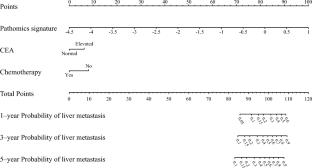
A total of 318 enrolled patients were divided into three cohorts: a training cohort (n = 139), a validation cohort (n = 69), and an external cohort (n = 110). A competitive risk nomogram was established by the pathomics signature and clinicopathological characteristics and assessed by calibration, discrimination, and clinical usefulness.
Results
A significant correlation between the pathomics signature and liver metastasis in stage III colorectal cancer was found. Multivariate Fine–Gray analysis indicated that preoperative carcinoembryonic antigen level, postoperative chemotherapy, and pathomics signature were independent predictors of liver metastasis. A competitive risk nomogram was developed to predict liver metastasis in patients with stage III colorectal cancer. The predicting nomogram shows good discrimination and calibration, with C-indexes of 0.811 (95% confidence interval [CI] 0.651–0.971), 0.759 (95% CI 0.531–0.987), and 0.845 (95% CI 0.641–0.999), with area under the receiver operating characteristic (AUROC) curves at 5 years of 0.833 (95% CI 0.742–0.925), 0.760 (95% CI 0.652–0.893), and 0.812 (95% CI 0.692–0.931) in the training, validation, and external cohorts, respectively. Compared with the clinicopathological nomogram, the nomogram combined with the pathomics signature had better performance (AUROC 0.823 [95% CI 0.764–0.881] vs. 0.678 [95% CI 0.606–0.751]; p < 0.001).
Conclusions
The pathomics signature is a predictive indicator for liver metastasis in patients with stage III colorectal cancer, and the integrated nomogram can be used to predict liver metastasis better than the clinicopathological nomogram alone.
期刊介绍:
The Annals of Surgical Oncology is the official journal of The Society of Surgical Oncology and is published for the Society by Springer. The Annals publishes original and educational manuscripts about oncology for surgeons from all specialities in academic and community settings.




 京公网安备 11010802042870号
京ICP备2023020795号-1
京公网安备 11010802042870号
京ICP备2023020795号-1

 分享
分享
 求助内容:
求助内容: 应助结果提醒方式:
 扫码关注我们
