Jia-Xiang Li, Song Wu, Li-Li Hao, Qun-Li Lei, Yu-Qiang Ma
{"title":"高分子拓扑工程中活性驱动的聚合物打结。","authors":"Jia-Xiang Li, Song Wu, Li-Li Hao, Qun-Li Lei, Yu-Qiang Ma","doi":"10.1126/sciadv.adr0716","DOIUrl":null,"url":null,"abstract":"<div >Macromolecules can gain special properties by adopting knotted conformations, but engineering knotted macromolecules is a challenging task. Here, we unexpectedly find that knots can be efficiently generated in active polymer systems. When one end of an actively reptative polymer is anchored, it undergoes continual self-knotting as a result of intermittent giant conformation fluctuations and the outward reptative motion. Once a knot is formed, it migrates to the anchoring point due to a nonequilibrium ratchet effect. Moreover, when the active polymer is grafted on a passive polymer, it can function as a self-propelling soft needle to either transfer its own knots or directly braid knots on the passive polymer. We further show that these active needles can create intermolecular bridging knots between two passive polymers. Our finding highlights the nonequilibrium effects in modifying the dynamic pathways of polymer systems, which have potential applications in macromolecular topology engineering.</div>","PeriodicalId":21609,"journal":{"name":"Science Advances","volume":"10 48","pages":""},"PeriodicalIF":12.5000,"publicationDate":"2024-11-29","publicationTypes":"Journal Article","fieldsOfStudy":null,"isOpenAccess":false,"openAccessPdf":"https://www.science.org/doi/reader/10.1126/sciadv.adr0716","citationCount":"0","resultStr":"{\"title\":\"Activity-driven polymer knotting for macromolecular topology engineering\",\"authors\":\"Jia-Xiang Li, Song Wu, Li-Li Hao, Qun-Li Lei, Yu-Qiang Ma\",\"doi\":\"10.1126/sciadv.adr0716\",\"DOIUrl\":null,\"url\":null,\"abstract\":\"<div >Macromolecules can gain special properties by adopting knotted conformations, but engineering knotted macromolecules is a challenging task. Here, we unexpectedly find that knots can be efficiently generated in active polymer systems. When one end of an actively reptative polymer is anchored, it undergoes continual self-knotting as a result of intermittent giant conformation fluctuations and the outward reptative motion. Once a knot is formed, it migrates to the anchoring point due to a nonequilibrium ratchet effect. Moreover, when the active polymer is grafted on a passive polymer, it can function as a self-propelling soft needle to either transfer its own knots or directly braid knots on the passive polymer. We further show that these active needles can create intermolecular bridging knots between two passive polymers. Our finding highlights the nonequilibrium effects in modifying the dynamic pathways of polymer systems, which have potential applications in macromolecular topology engineering.</div>\",\"PeriodicalId\":21609,\"journal\":{\"name\":\"Science Advances\",\"volume\":\"10 48\",\"pages\":\"\"},\"PeriodicalIF\":12.5000,\"publicationDate\":\"2024-11-29\",\"publicationTypes\":\"Journal Article\",\"fieldsOfStudy\":null,\"isOpenAccess\":false,\"openAccessPdf\":\"https://www.science.org/doi/reader/10.1126/sciadv.adr0716\",\"citationCount\":\"0\",\"resultStr\":null,\"platform\":\"Semanticscholar\",\"paperid\":null,\"PeriodicalName\":\"Science Advances\",\"FirstCategoryId\":\"103\",\"ListUrlMain\":\"https://www.science.org/doi/10.1126/sciadv.adr0716\",\"RegionNum\":1,\"RegionCategory\":\"综合性期刊\",\"ArticlePicture\":[],\"TitleCN\":null,\"AbstractTextCN\":null,\"PMCID\":null,\"EPubDate\":\"\",\"PubModel\":\"\",\"JCR\":\"Q1\",\"JCRName\":\"MULTIDISCIPLINARY SCIENCES\",\"Score\":null,\"Total\":0}","platform":"Semanticscholar","paperid":null,"PeriodicalName":"Science Advances","FirstCategoryId":"103","ListUrlMain":"https://www.science.org/doi/10.1126/sciadv.adr0716","RegionNum":1,"RegionCategory":"综合性期刊","ArticlePicture":[],"TitleCN":null,"AbstractTextCN":null,"PMCID":null,"EPubDate":"","PubModel":"","JCR":"Q1","JCRName":"MULTIDISCIPLINARY SCIENCES","Score":null,"Total":0}
Activity-driven polymer knotting for macromolecular topology engineering
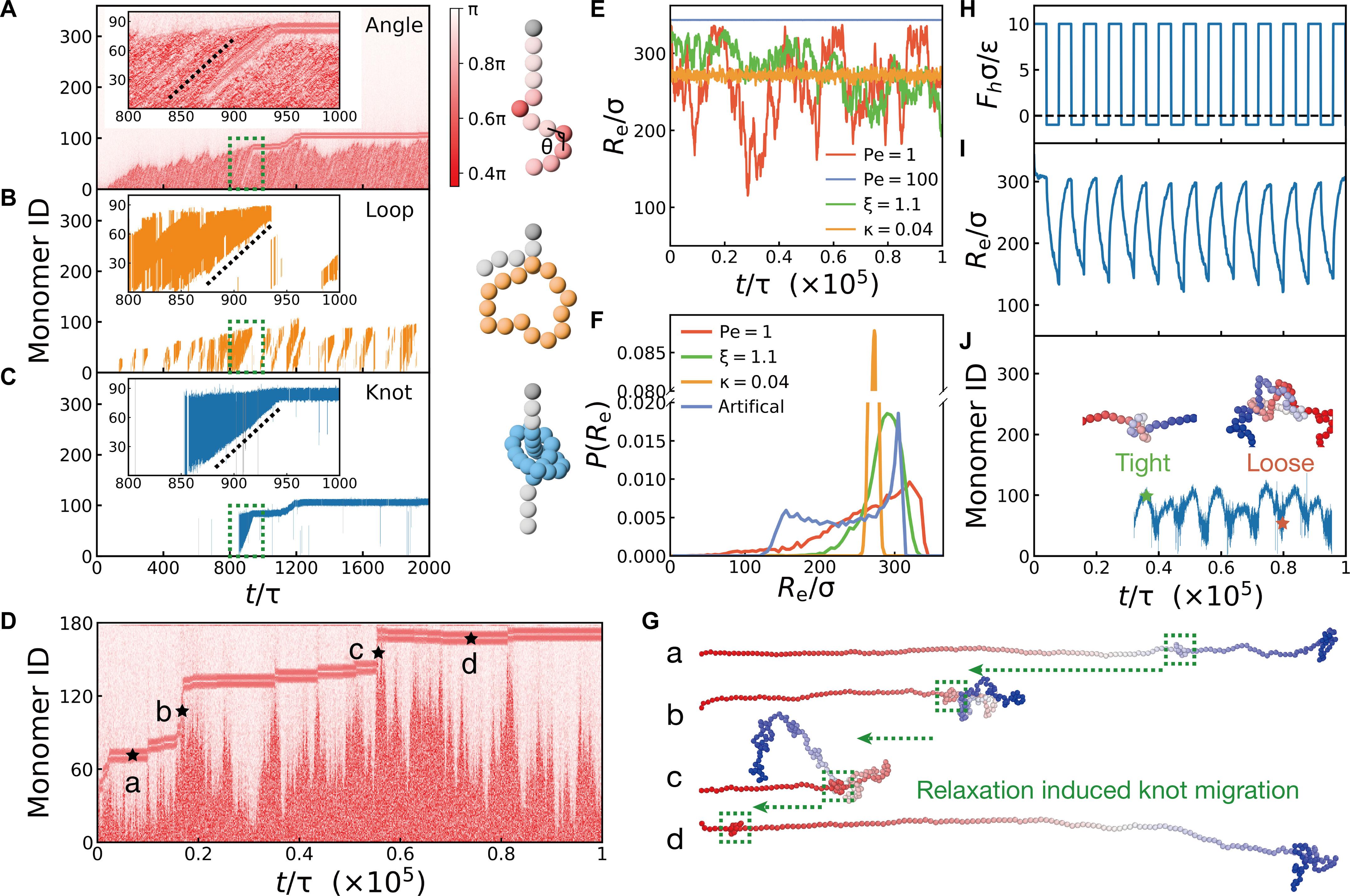
Macromolecules can gain special properties by adopting knotted conformations, but engineering knotted macromolecules is a challenging task. Here, we unexpectedly find that knots can be efficiently generated in active polymer systems. When one end of an actively reptative polymer is anchored, it undergoes continual self-knotting as a result of intermittent giant conformation fluctuations and the outward reptative motion. Once a knot is formed, it migrates to the anchoring point due to a nonequilibrium ratchet effect. Moreover, when the active polymer is grafted on a passive polymer, it can function as a self-propelling soft needle to either transfer its own knots or directly braid knots on the passive polymer. We further show that these active needles can create intermolecular bridging knots between two passive polymers. Our finding highlights the nonequilibrium effects in modifying the dynamic pathways of polymer systems, which have potential applications in macromolecular topology engineering.
期刊介绍:
Science Advances, an open-access journal by AAAS, publishes impactful research in diverse scientific areas. It aims for fair, fast, and expert peer review, providing freely accessible research to readers. Led by distinguished scientists, the journal supports AAAS's mission by extending Science magazine's capacity to identify and promote significant advances. Evolving digital publishing technologies play a crucial role in advancing AAAS's global mission for science communication and benefitting humankind.





 京公网安备 11010802042870号
京ICP备2023020795号-1
京公网安备 11010802042870号
京ICP备2023020795号-1

 分享
分享
 求助内容:
求助内容: 应助结果提醒方式:
 扫码关注我们
