Yang Song, Jennifer Soto, Xiao Lin, Tyler Hoffman, Erin Hu, Ninghao Zhu, Jana Zarubova, Yifan Wu, Jing Tian, Pak Kin Wong, Song Li
{"title":"纳米生物传感器在细胞重编程的早期阶段使用细胞内标记进行基于mrna的细胞分选","authors":"Yang Song, Jennifer Soto, Xiao Lin, Tyler Hoffman, Erin Hu, Ninghao Zhu, Jana Zarubova, Yifan Wu, Jing Tian, Pak Kin Wong, Song Li","doi":"10.1002/adfm.202410910","DOIUrl":null,"url":null,"abstract":"<p>Cell reprogramming and manufacturing have broad applications in tissue regeneration and disease treatment. However, many derived cell types lack unique cell surface markers for protein-based cell sorting, making it difficult to isolate these cells from mixed populations. Additionally, there is a need to identify and isolate cells of interest at the early stages of cell expansion. To address this challenge, a nucleic acid-based gold nanorod (NAGNR) fluorescent biosensor was engineered to detect the mRNA expression of intracellular markers for cell sorting. Its application is demonstrated in isolating induced neuronal (iN) cells from dermal fibroblast populations during the early stages of cell reprogramming. Cell sorting based on the mRNA of the neuronal transcriptional factor Ascl1 resulted in an enrichment of iN cells from 3% to 72%, and additional sorting with the transcriptional factor Scn2 further increased iN enrichment. Moreover, NAGNR biosensors can be used in conjunction with protein marker-based cell sorting. NAGNR-sorted iN cells show a functional response to electrical stimulation in a co-culture of iN cells and muscle cells. These findings demonstrate that NAGNR-based cell sorting offers great potential for cell identification and isolation at an early stage of cell reprogramming and manufacturing.</p>","PeriodicalId":112,"journal":{"name":"Advanced Functional Materials","volume":"35 1","pages":""},"PeriodicalIF":19.0000,"publicationDate":"2024-11-30","publicationTypes":"Journal Article","fieldsOfStudy":null,"isOpenAccess":false,"openAccessPdf":"","citationCount":"0","resultStr":"{\"title\":\"Nano-Biosensors for mRNA-Based Cell Sorting Using Intracellular Markers at the Early Stage of Cell Reprogramming\",\"authors\":\"Yang Song, Jennifer Soto, Xiao Lin, Tyler Hoffman, Erin Hu, Ninghao Zhu, Jana Zarubova, Yifan Wu, Jing Tian, Pak Kin Wong, Song Li\",\"doi\":\"10.1002/adfm.202410910\",\"DOIUrl\":null,\"url\":null,\"abstract\":\"<p>Cell reprogramming and manufacturing have broad applications in tissue regeneration and disease treatment. However, many derived cell types lack unique cell surface markers for protein-based cell sorting, making it difficult to isolate these cells from mixed populations. Additionally, there is a need to identify and isolate cells of interest at the early stages of cell expansion. To address this challenge, a nucleic acid-based gold nanorod (NAGNR) fluorescent biosensor was engineered to detect the mRNA expression of intracellular markers for cell sorting. Its application is demonstrated in isolating induced neuronal (iN) cells from dermal fibroblast populations during the early stages of cell reprogramming. Cell sorting based on the mRNA of the neuronal transcriptional factor Ascl1 resulted in an enrichment of iN cells from 3% to 72%, and additional sorting with the transcriptional factor Scn2 further increased iN enrichment. Moreover, NAGNR biosensors can be used in conjunction with protein marker-based cell sorting. NAGNR-sorted iN cells show a functional response to electrical stimulation in a co-culture of iN cells and muscle cells. These findings demonstrate that NAGNR-based cell sorting offers great potential for cell identification and isolation at an early stage of cell reprogramming and manufacturing.</p>\",\"PeriodicalId\":112,\"journal\":{\"name\":\"Advanced Functional Materials\",\"volume\":\"35 1\",\"pages\":\"\"},\"PeriodicalIF\":19.0000,\"publicationDate\":\"2024-11-30\",\"publicationTypes\":\"Journal Article\",\"fieldsOfStudy\":null,\"isOpenAccess\":false,\"openAccessPdf\":\"\",\"citationCount\":\"0\",\"resultStr\":null,\"platform\":\"Semanticscholar\",\"paperid\":null,\"PeriodicalName\":\"Advanced Functional Materials\",\"FirstCategoryId\":\"88\",\"ListUrlMain\":\"https://advanced.onlinelibrary.wiley.com/doi/10.1002/adfm.202410910\",\"RegionNum\":1,\"RegionCategory\":\"材料科学\",\"ArticlePicture\":[],\"TitleCN\":null,\"AbstractTextCN\":null,\"PMCID\":null,\"EPubDate\":\"\",\"PubModel\":\"\",\"JCR\":\"Q1\",\"JCRName\":\"CHEMISTRY, MULTIDISCIPLINARY\",\"Score\":null,\"Total\":0}","platform":"Semanticscholar","paperid":null,"PeriodicalName":"Advanced Functional Materials","FirstCategoryId":"88","ListUrlMain":"https://advanced.onlinelibrary.wiley.com/doi/10.1002/adfm.202410910","RegionNum":1,"RegionCategory":"材料科学","ArticlePicture":[],"TitleCN":null,"AbstractTextCN":null,"PMCID":null,"EPubDate":"","PubModel":"","JCR":"Q1","JCRName":"CHEMISTRY, MULTIDISCIPLINARY","Score":null,"Total":0}
Nano-Biosensors for mRNA-Based Cell Sorting Using Intracellular Markers at the Early Stage of Cell Reprogramming
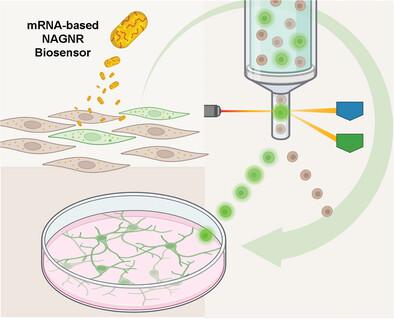
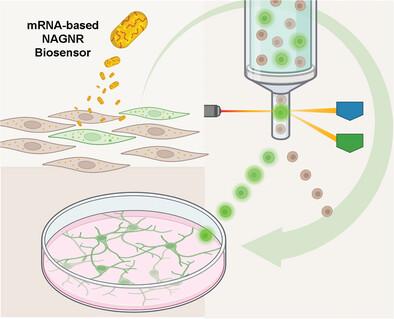
Cell reprogramming and manufacturing have broad applications in tissue regeneration and disease treatment. However, many derived cell types lack unique cell surface markers for protein-based cell sorting, making it difficult to isolate these cells from mixed populations. Additionally, there is a need to identify and isolate cells of interest at the early stages of cell expansion. To address this challenge, a nucleic acid-based gold nanorod (NAGNR) fluorescent biosensor was engineered to detect the mRNA expression of intracellular markers for cell sorting. Its application is demonstrated in isolating induced neuronal (iN) cells from dermal fibroblast populations during the early stages of cell reprogramming. Cell sorting based on the mRNA of the neuronal transcriptional factor Ascl1 resulted in an enrichment of iN cells from 3% to 72%, and additional sorting with the transcriptional factor Scn2 further increased iN enrichment. Moreover, NAGNR biosensors can be used in conjunction with protein marker-based cell sorting. NAGNR-sorted iN cells show a functional response to electrical stimulation in a co-culture of iN cells and muscle cells. These findings demonstrate that NAGNR-based cell sorting offers great potential for cell identification and isolation at an early stage of cell reprogramming and manufacturing.
期刊介绍:
Firmly established as a top-tier materials science journal, Advanced Functional Materials reports breakthrough research in all aspects of materials science, including nanotechnology, chemistry, physics, and biology every week.
Advanced Functional Materials is known for its rapid and fair peer review, quality content, and high impact, making it the first choice of the international materials science community.







 京公网安备 11010802042870号
京ICP备2023020795号-1
京公网安备 11010802042870号
京ICP备2023020795号-1

 分享
分享
 求助内容:
求助内容: 应助结果提醒方式:
 扫码关注我们
