Jamil Ur Rahman, Shuping Guo, Nicolás Pérez, Kyuseon Jang, Chanwon Jung, Pingjun Ying, Christina Scheu, Duncan Zavanelli, Siyuan Zhang, Andrei Sotnikov, Gerald Jeffrey Snyder, Jeroen van den Brink, Kornelius Nielsch, Ran He
{"title":"晶界工程提高了Y2Te3的热电性能","authors":"Jamil Ur Rahman, Shuping Guo, Nicolás Pérez, Kyuseon Jang, Chanwon Jung, Pingjun Ying, Christina Scheu, Duncan Zavanelli, Siyuan Zhang, Andrei Sotnikov, Gerald Jeffrey Snyder, Jeroen van den Brink, Kornelius Nielsch, Ran He","doi":"10.1002/aenm.202404243","DOIUrl":null,"url":null,"abstract":"<p>The performance of thermoelectric materials is typically assessed using the dimensionless figure of merit, <i>zT</i>. Increasing <i>zT</i> is challenging due to the intricate relationships between electrical and thermal transport properties. This study focuses on Y<sub>2</sub>Te<sub>3</sub>-based thermoelectric materials, which are predicted to be promising for high-temperature applications due to their inherently low lattice thermal conductivity. A series of Y<sub>2+</sub><i><sub>x</sub></i>Te<sub>3</sub> compositions with excess Y is synthesized to explore the effects on electronic and structural characteristics. Density functional theory calculations suggest that additional Y atoms increase charge carriers, thereby enhancing electrical conductivity and boosting thermoelectric performance. X-ray diffraction analysis reveals that the presence of excess Y reduces lattice volume and alters bonding structures. Furthermore, the addition of Bi significantly enhances the power factor by promoting the segregation of elemental Bi particles and the formation of Y-Bi-rich grain boundaries, which improve weighted mobility. This microstructural optimization leads to a fourfold increase in the Seebeck coefficient, resulting in a peak <i>zT</i> of 1.23 at 973 K and a predicted maximum conversion efficiency of 10.3% under a temperature difference of 673 K. These findings highlight the potential of Y<sub>2</sub>Te<sub>3</sub> for high-temperature thermoelectric applications and demonstrate the effectiveness of grain boundary engineering in enhancing thermoelectric performance.</p>","PeriodicalId":111,"journal":{"name":"Advanced Energy Materials","volume":"15 14","pages":""},"PeriodicalIF":25.5000,"publicationDate":"2024-12-01","publicationTypes":"Journal Article","fieldsOfStudy":null,"isOpenAccess":false,"openAccessPdf":"https://onlinelibrary.wiley.com/doi/epdf/10.1002/aenm.202404243","citationCount":"0","resultStr":"{\"title\":\"Grain Boundary Engineering Enhances the Thermoelectric Properties of Y2Te3\",\"authors\":\"Jamil Ur Rahman, Shuping Guo, Nicolás Pérez, Kyuseon Jang, Chanwon Jung, Pingjun Ying, Christina Scheu, Duncan Zavanelli, Siyuan Zhang, Andrei Sotnikov, Gerald Jeffrey Snyder, Jeroen van den Brink, Kornelius Nielsch, Ran He\",\"doi\":\"10.1002/aenm.202404243\",\"DOIUrl\":null,\"url\":null,\"abstract\":\"<p>The performance of thermoelectric materials is typically assessed using the dimensionless figure of merit, <i>zT</i>. Increasing <i>zT</i> is challenging due to the intricate relationships between electrical and thermal transport properties. This study focuses on Y<sub>2</sub>Te<sub>3</sub>-based thermoelectric materials, which are predicted to be promising for high-temperature applications due to their inherently low lattice thermal conductivity. A series of Y<sub>2+</sub><i><sub>x</sub></i>Te<sub>3</sub> compositions with excess Y is synthesized to explore the effects on electronic and structural characteristics. Density functional theory calculations suggest that additional Y atoms increase charge carriers, thereby enhancing electrical conductivity and boosting thermoelectric performance. X-ray diffraction analysis reveals that the presence of excess Y reduces lattice volume and alters bonding structures. Furthermore, the addition of Bi significantly enhances the power factor by promoting the segregation of elemental Bi particles and the formation of Y-Bi-rich grain boundaries, which improve weighted mobility. This microstructural optimization leads to a fourfold increase in the Seebeck coefficient, resulting in a peak <i>zT</i> of 1.23 at 973 K and a predicted maximum conversion efficiency of 10.3% under a temperature difference of 673 K. These findings highlight the potential of Y<sub>2</sub>Te<sub>3</sub> for high-temperature thermoelectric applications and demonstrate the effectiveness of grain boundary engineering in enhancing thermoelectric performance.</p>\",\"PeriodicalId\":111,\"journal\":{\"name\":\"Advanced Energy Materials\",\"volume\":\"15 14\",\"pages\":\"\"},\"PeriodicalIF\":25.5000,\"publicationDate\":\"2024-12-01\",\"publicationTypes\":\"Journal Article\",\"fieldsOfStudy\":null,\"isOpenAccess\":false,\"openAccessPdf\":\"https://onlinelibrary.wiley.com/doi/epdf/10.1002/aenm.202404243\",\"citationCount\":\"0\",\"resultStr\":null,\"platform\":\"Semanticscholar\",\"paperid\":null,\"PeriodicalName\":\"Advanced Energy Materials\",\"FirstCategoryId\":\"88\",\"ListUrlMain\":\"https://advanced.onlinelibrary.wiley.com/doi/10.1002/aenm.202404243\",\"RegionNum\":1,\"RegionCategory\":\"材料科学\",\"ArticlePicture\":[],\"TitleCN\":null,\"AbstractTextCN\":null,\"PMCID\":null,\"EPubDate\":\"\",\"PubModel\":\"\",\"JCR\":\"Q1\",\"JCRName\":\"CHEMISTRY, PHYSICAL\",\"Score\":null,\"Total\":0}","platform":"Semanticscholar","paperid":null,"PeriodicalName":"Advanced Energy Materials","FirstCategoryId":"88","ListUrlMain":"https://advanced.onlinelibrary.wiley.com/doi/10.1002/aenm.202404243","RegionNum":1,"RegionCategory":"材料科学","ArticlePicture":[],"TitleCN":null,"AbstractTextCN":null,"PMCID":null,"EPubDate":"","PubModel":"","JCR":"Q1","JCRName":"CHEMISTRY, PHYSICAL","Score":null,"Total":0}
引用次数: 0
摘要
热电材料的性能通常是用无因次优值zT来评估的。由于电和热输运性质之间复杂的关系,增加zT是具有挑战性的。本研究的重点是基于Y2Te3的热电材料,由于其固有的低晶格热导率,预计其在高温应用中很有前景。合成了一系列含有过量Y的Y2+xTe3化合物,探讨其电子和结构特性的影响。密度泛函理论计算表明,额外的Y原子增加载流子,从而提高电导率和提高热电性能。X射线衍射分析表明,过量Y的存在减少了晶格体积,改变了键合结构。此外,Bi的加入通过促进元素Bi粒子的偏析和Y - Bi -富晶界的形成显著提高了功率因数,从而提高了加权迁移率。这种微观结构优化导致Seebeck系数增加了4倍,在973 K时zT峰值为1.23,在673 K温差下预测的最大转换效率为10.3%。这些发现突出了Y2Te3在高温热电应用中的潜力,并证明了晶界工程在提高热电性能方面的有效性。
Grain Boundary Engineering Enhances the Thermoelectric Properties of Y2Te3
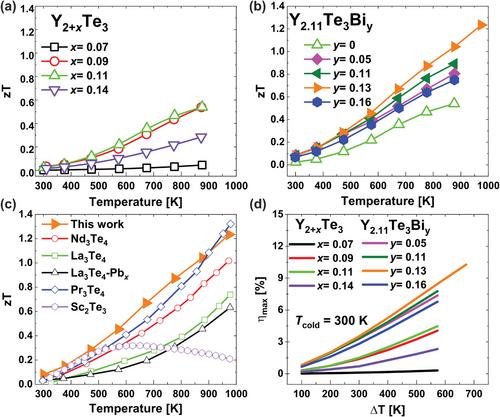
The performance of thermoelectric materials is typically assessed using the dimensionless figure of merit, zT. Increasing zT is challenging due to the intricate relationships between electrical and thermal transport properties. This study focuses on Y2Te3-based thermoelectric materials, which are predicted to be promising for high-temperature applications due to their inherently low lattice thermal conductivity. A series of Y2+xTe3 compositions with excess Y is synthesized to explore the effects on electronic and structural characteristics. Density functional theory calculations suggest that additional Y atoms increase charge carriers, thereby enhancing electrical conductivity and boosting thermoelectric performance. X-ray diffraction analysis reveals that the presence of excess Y reduces lattice volume and alters bonding structures. Furthermore, the addition of Bi significantly enhances the power factor by promoting the segregation of elemental Bi particles and the formation of Y-Bi-rich grain boundaries, which improve weighted mobility. This microstructural optimization leads to a fourfold increase in the Seebeck coefficient, resulting in a peak zT of 1.23 at 973 K and a predicted maximum conversion efficiency of 10.3% under a temperature difference of 673 K. These findings highlight the potential of Y2Te3 for high-temperature thermoelectric applications and demonstrate the effectiveness of grain boundary engineering in enhancing thermoelectric performance.
期刊介绍:
Established in 2011, Advanced Energy Materials is an international, interdisciplinary, English-language journal that focuses on materials used in energy harvesting, conversion, and storage. It is regarded as a top-quality journal alongside Advanced Materials, Advanced Functional Materials, and Small.
With a 2022 Impact Factor of 27.8, Advanced Energy Materials is considered a prime source for the best energy-related research. The journal covers a wide range of topics in energy-related research, including organic and inorganic photovoltaics, batteries and supercapacitors, fuel cells, hydrogen generation and storage, thermoelectrics, water splitting and photocatalysis, solar fuels and thermosolar power, magnetocalorics, and piezoelectronics.
The readership of Advanced Energy Materials includes materials scientists, chemists, physicists, and engineers in both academia and industry. The journal is indexed in various databases and collections, such as Advanced Technologies & Aerospace Database, FIZ Karlsruhe, INSPEC (IET), Science Citation Index Expanded, Technology Collection, and Web of Science, among others.






 京公网安备 11010802042870号
京ICP备2023020795号-1
京公网安备 11010802042870号
京ICP备2023020795号-1

 分享
分享
 求助内容:
求助内容: 应助结果提醒方式:
 扫码关注我们
