Aditya Singh, Karan Singh, Ram Ji Dixit, Biswajit Samir De, Suddhasatwa Basu
{"title":"生物质基HMF在3d打印流动电解槽中热电联产氢和FDCA","authors":"Aditya Singh, Karan Singh, Ram Ji Dixit, Biswajit Samir De, Suddhasatwa Basu","doi":"10.1021/acs.iecr.4c01213","DOIUrl":null,"url":null,"abstract":"Among all the available resources, biomass is the key renewable resource to capture carbon dioxide from the atmosphere and produce fuels, chemicals, and other value-added products. This work uses an electrochemical process to generate value-added chemicals and hydrogen simultaneously from a biomass-derived platform chemical. A 3D-printed flow electrolyzer is used to study the generation of hydrogen and FDCA (2,5-furandicarboxylic acid) from HMF (5-(hydroxymethyl)furan-2-carbaldehyde) using an alkaline electrolyte based on the principles of electrochemical oxidation. A 3D-printed electrolytic cell is designed with a channel size of 55 mm × 55 mm × 6 mm and an electrocatalyst area of 6.25 cm<sup>2</sup> in the form of an anode and cathode. In this work, gold-sputtered nickel foam is used as an anode, while platinum-sputtered nickel foam is used as a cathode. A single pass through the electrolyzer yields 130 μmol/(h cm<sup>2</sup>) of hydrogen gas at ambient temperature and pressure, along with 46 μmol/(h cm<sup>2</sup>) of FDCA. A maximum value of 80% conversion of HMF is obtained at a flow rate of 0.5 mL/min in a single pass with a potential bias of 3.5 V. This work opens the pathways for incorporating a microflow electrolyzer to coproduce FDCA and hydrogen from biomass-derived HMF.","PeriodicalId":39,"journal":{"name":"Industrial & Engineering Chemistry Research","volume":"18 1","pages":""},"PeriodicalIF":3.9000,"publicationDate":"2024-12-02","publicationTypes":"Journal Article","fieldsOfStudy":null,"isOpenAccess":false,"openAccessPdf":"","citationCount":"0","resultStr":"{\"title\":\"Co-Generation of Hydrogen and FDCA from Biomass-Based HMF in a 3D-Printed Flow Electrolyzer\",\"authors\":\"Aditya Singh, Karan Singh, Ram Ji Dixit, Biswajit Samir De, Suddhasatwa Basu\",\"doi\":\"10.1021/acs.iecr.4c01213\",\"DOIUrl\":null,\"url\":null,\"abstract\":\"Among all the available resources, biomass is the key renewable resource to capture carbon dioxide from the atmosphere and produce fuels, chemicals, and other value-added products. This work uses an electrochemical process to generate value-added chemicals and hydrogen simultaneously from a biomass-derived platform chemical. A 3D-printed flow electrolyzer is used to study the generation of hydrogen and FDCA (2,5-furandicarboxylic acid) from HMF (5-(hydroxymethyl)furan-2-carbaldehyde) using an alkaline electrolyte based on the principles of electrochemical oxidation. A 3D-printed electrolytic cell is designed with a channel size of 55 mm × 55 mm × 6 mm and an electrocatalyst area of 6.25 cm<sup>2</sup> in the form of an anode and cathode. In this work, gold-sputtered nickel foam is used as an anode, while platinum-sputtered nickel foam is used as a cathode. A single pass through the electrolyzer yields 130 μmol/(h cm<sup>2</sup>) of hydrogen gas at ambient temperature and pressure, along with 46 μmol/(h cm<sup>2</sup>) of FDCA. A maximum value of 80% conversion of HMF is obtained at a flow rate of 0.5 mL/min in a single pass with a potential bias of 3.5 V. This work opens the pathways for incorporating a microflow electrolyzer to coproduce FDCA and hydrogen from biomass-derived HMF.\",\"PeriodicalId\":39,\"journal\":{\"name\":\"Industrial & Engineering Chemistry Research\",\"volume\":\"18 1\",\"pages\":\"\"},\"PeriodicalIF\":3.9000,\"publicationDate\":\"2024-12-02\",\"publicationTypes\":\"Journal Article\",\"fieldsOfStudy\":null,\"isOpenAccess\":false,\"openAccessPdf\":\"\",\"citationCount\":\"0\",\"resultStr\":null,\"platform\":\"Semanticscholar\",\"paperid\":null,\"PeriodicalName\":\"Industrial & Engineering Chemistry Research\",\"FirstCategoryId\":\"5\",\"ListUrlMain\":\"https://doi.org/10.1021/acs.iecr.4c01213\",\"RegionNum\":3,\"RegionCategory\":\"工程技术\",\"ArticlePicture\":[],\"TitleCN\":null,\"AbstractTextCN\":null,\"PMCID\":null,\"EPubDate\":\"\",\"PubModel\":\"\",\"JCR\":\"Q2\",\"JCRName\":\"ENGINEERING, CHEMICAL\",\"Score\":null,\"Total\":0}","platform":"Semanticscholar","paperid":null,"PeriodicalName":"Industrial & Engineering Chemistry Research","FirstCategoryId":"5","ListUrlMain":"https://doi.org/10.1021/acs.iecr.4c01213","RegionNum":3,"RegionCategory":"工程技术","ArticlePicture":[],"TitleCN":null,"AbstractTextCN":null,"PMCID":null,"EPubDate":"","PubModel":"","JCR":"Q2","JCRName":"ENGINEERING, CHEMICAL","Score":null,"Total":0}
引用次数: 0
摘要
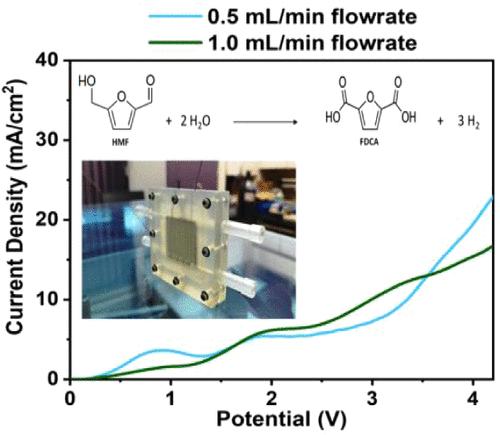
在所有可用资源中,生物质是从大气中捕获二氧化碳并生产燃料、化学品和其他增值产品的关键可再生资源。这项工作使用电化学过程从生物质衍生的平台化学品同时产生增值化学品和氢气。利用3d打印流动电解槽,研究了基于电化学氧化原理的碱性电解质从HMF(5-(羟甲基)呋喃-2-乙醛)生成氢气和FDCA(2,5-呋喃二羧酸)。设计了一个3d打印电解槽,通道尺寸为55 mm × 55 mm × 6 mm,阳极和阴极形式的电催化剂面积为6.25 cm2。在这项工作中,金溅射泡沫镍被用作阳极,而铂溅射泡沫镍被用作阴极。在环境温度和压力下,单次通过电解槽产生130 μmol/(h cm2)的氢气,以及46 μmol/(h cm2)的FDCA。在流量为0.5 mL/min,电压为3.5 V时,HMF的转化率最高可达80%。这项工作为整合微流电解槽以从生物质衍生的HMF中共同生产FDCA和氢开辟了途径。
Co-Generation of Hydrogen and FDCA from Biomass-Based HMF in a 3D-Printed Flow Electrolyzer
Among all the available resources, biomass is the key renewable resource to capture carbon dioxide from the atmosphere and produce fuels, chemicals, and other value-added products. This work uses an electrochemical process to generate value-added chemicals and hydrogen simultaneously from a biomass-derived platform chemical. A 3D-printed flow electrolyzer is used to study the generation of hydrogen and FDCA (2,5-furandicarboxylic acid) from HMF (5-(hydroxymethyl)furan-2-carbaldehyde) using an alkaline electrolyte based on the principles of electrochemical oxidation. A 3D-printed electrolytic cell is designed with a channel size of 55 mm × 55 mm × 6 mm and an electrocatalyst area of 6.25 cm2 in the form of an anode and cathode. In this work, gold-sputtered nickel foam is used as an anode, while platinum-sputtered nickel foam is used as a cathode. A single pass through the electrolyzer yields 130 μmol/(h cm2) of hydrogen gas at ambient temperature and pressure, along with 46 μmol/(h cm2) of FDCA. A maximum value of 80% conversion of HMF is obtained at a flow rate of 0.5 mL/min in a single pass with a potential bias of 3.5 V. This work opens the pathways for incorporating a microflow electrolyzer to coproduce FDCA and hydrogen from biomass-derived HMF.
期刊介绍:
ndustrial & Engineering Chemistry, with variations in title and format, has been published since 1909 by the American Chemical Society. Industrial & Engineering Chemistry Research is a weekly publication that reports industrial and academic research in the broad fields of applied chemistry and chemical engineering with special focus on fundamentals, processes, and products.




 京公网安备 11010802042870号
京ICP备2023020795号-1
京公网安备 11010802042870号
京ICP备2023020795号-1

 分享
分享
 求助内容:
求助内容: 应助结果提醒方式:
 扫码关注我们
