Weiyin Su, Zhonghui Guo, Zeyu Chang, Yuyu E, Wen Li, Jie Li, Shengguang Yuan, Xi Yao, Shengkun Yan, Mingguo Ma, Kun Wang, Jianxin Jiang
{"title":"自封装超软微通道,高导热和被动辐射冷却","authors":"Weiyin Su, Zhonghui Guo, Zeyu Chang, Yuyu E, Wen Li, Jie Li, Shengguang Yuan, Xi Yao, Shengkun Yan, Mingguo Ma, Kun Wang, Jianxin Jiang","doi":"10.1016/j.cej.2024.158220","DOIUrl":null,"url":null,"abstract":"Oriented towards the industrialization of micro-electronic products, micro-channels suitable for micro and small electronic devices are committed to solving the issue of efficient thermal dissipation in the systems. Accordingly, research on integrating multifunctional thermal management composite materials for designing micro-channels has become a hot development trend. Notably, the design concept of efficient thermal dissipation micro-channel with the dual functional synergy of high thermal conductivity and passive radiation cooling was advanced. The compound of high thermal conductivity hexagonal boron nitride (h-BN) and high-elastic thermoplastic polyurethane (TPU) entrusts the micro-channel with a superb substrate with flexibility, stretchability, hydrophobicity, and high thermal conductivity. Draw support from a zero-energy consumption and environmentally friendly passive radiation cooling strategy, the micro-channel with a polyvinylidene fluoride/cellulose acetate (PVDF/CA) nanofiber film acquires an ultra-high reflectivity of up to 99.50 % (0.2–2.5 μm) and a high emissivity of 94.81 % (8–13 μm). The programmable patterned graphene oxide (GO) ink is assisted with high-viscosity natural <em>Gleditsia sinensis</em> polysaccharide (GSP) through 3D printing. Ultimately, a self-encapsulated, flexible, high thermal conductivity (0.42 W m<sup>-1</sup>K<sup>−1</sup>), passive radiation cooling micro-channel accumulated a temperature difference of 10.76 °C, potentially making a promising thermal management micro-channel system for development.","PeriodicalId":270,"journal":{"name":"Chemical Engineering Journal","volume":"8 1","pages":""},"PeriodicalIF":13.2000,"publicationDate":"2024-12-03","publicationTypes":"Journal Article","fieldsOfStudy":null,"isOpenAccess":false,"openAccessPdf":"","citationCount":"0","resultStr":"{\"title\":\"Self-encapsulation ultra-soft micro-channel with high thermal conductivity and passive radiation cooling\",\"authors\":\"Weiyin Su, Zhonghui Guo, Zeyu Chang, Yuyu E, Wen Li, Jie Li, Shengguang Yuan, Xi Yao, Shengkun Yan, Mingguo Ma, Kun Wang, Jianxin Jiang\",\"doi\":\"10.1016/j.cej.2024.158220\",\"DOIUrl\":null,\"url\":null,\"abstract\":\"Oriented towards the industrialization of micro-electronic products, micro-channels suitable for micro and small electronic devices are committed to solving the issue of efficient thermal dissipation in the systems. Accordingly, research on integrating multifunctional thermal management composite materials for designing micro-channels has become a hot development trend. Notably, the design concept of efficient thermal dissipation micro-channel with the dual functional synergy of high thermal conductivity and passive radiation cooling was advanced. The compound of high thermal conductivity hexagonal boron nitride (h-BN) and high-elastic thermoplastic polyurethane (TPU) entrusts the micro-channel with a superb substrate with flexibility, stretchability, hydrophobicity, and high thermal conductivity. Draw support from a zero-energy consumption and environmentally friendly passive radiation cooling strategy, the micro-channel with a polyvinylidene fluoride/cellulose acetate (PVDF/CA) nanofiber film acquires an ultra-high reflectivity of up to 99.50 % (0.2–2.5 μm) and a high emissivity of 94.81 % (8–13 μm). The programmable patterned graphene oxide (GO) ink is assisted with high-viscosity natural <em>Gleditsia sinensis</em> polysaccharide (GSP) through 3D printing. Ultimately, a self-encapsulated, flexible, high thermal conductivity (0.42 W m<sup>-1</sup>K<sup>−1</sup>), passive radiation cooling micro-channel accumulated a temperature difference of 10.76 °C, potentially making a promising thermal management micro-channel system for development.\",\"PeriodicalId\":270,\"journal\":{\"name\":\"Chemical Engineering Journal\",\"volume\":\"8 1\",\"pages\":\"\"},\"PeriodicalIF\":13.2000,\"publicationDate\":\"2024-12-03\",\"publicationTypes\":\"Journal Article\",\"fieldsOfStudy\":null,\"isOpenAccess\":false,\"openAccessPdf\":\"\",\"citationCount\":\"0\",\"resultStr\":null,\"platform\":\"Semanticscholar\",\"paperid\":null,\"PeriodicalName\":\"Chemical Engineering Journal\",\"FirstCategoryId\":\"5\",\"ListUrlMain\":\"https://doi.org/10.1016/j.cej.2024.158220\",\"RegionNum\":1,\"RegionCategory\":\"工程技术\",\"ArticlePicture\":[],\"TitleCN\":null,\"AbstractTextCN\":null,\"PMCID\":null,\"EPubDate\":\"\",\"PubModel\":\"\",\"JCR\":\"Q1\",\"JCRName\":\"ENGINEERING, CHEMICAL\",\"Score\":null,\"Total\":0}","platform":"Semanticscholar","paperid":null,"PeriodicalName":"Chemical Engineering Journal","FirstCategoryId":"5","ListUrlMain":"https://doi.org/10.1016/j.cej.2024.158220","RegionNum":1,"RegionCategory":"工程技术","ArticlePicture":[],"TitleCN":null,"AbstractTextCN":null,"PMCID":null,"EPubDate":"","PubModel":"","JCR":"Q1","JCRName":"ENGINEERING, CHEMICAL","Score":null,"Total":0}
引用次数: 0
摘要
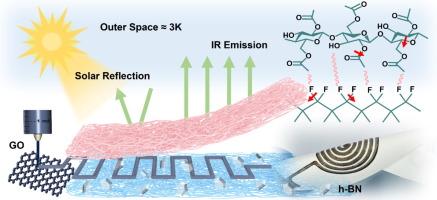
面向微电子产品产业化,适用于微小型电子器件的微通道致力于解决系统的高效散热问题。因此,研究集成多功能热管理复合材料设计微通道已成为一个热门的发展趋势。值得注意的是,提出了具有高导热和被动辐射冷却双重功能协同作用的高效散热微通道的设计理念。高导热六方氮化硼(h-BN)和高弹性热塑性聚氨酯(TPU)的化合物赋予微通道具有柔韧性、可拉伸性、疏水性和高导热性的极好的衬底。利用零能耗和环保的被动辐射冷却策略,采用聚偏氟乙烯/醋酸纤维素(PVDF/CA)纳米纤维薄膜的微通道获得了高达99.50 %(0.2-2.5 μm)的超高反射率和94.81 %(8-13 μm)的高发射率。通过3D打印,可编程的氧化石墨烯(GO)墨水加入了高粘度的天然皂角多糖(GSP)。最终,一个自封装的、柔性的、高导热系数(0.42 W m-1K−1)的被动辐射冷却微通道积累了10.76 °C的温差,有可能成为一个有发展前景的热管理微通道系统。
Self-encapsulation ultra-soft micro-channel with high thermal conductivity and passive radiation cooling
Oriented towards the industrialization of micro-electronic products, micro-channels suitable for micro and small electronic devices are committed to solving the issue of efficient thermal dissipation in the systems. Accordingly, research on integrating multifunctional thermal management composite materials for designing micro-channels has become a hot development trend. Notably, the design concept of efficient thermal dissipation micro-channel with the dual functional synergy of high thermal conductivity and passive radiation cooling was advanced. The compound of high thermal conductivity hexagonal boron nitride (h-BN) and high-elastic thermoplastic polyurethane (TPU) entrusts the micro-channel with a superb substrate with flexibility, stretchability, hydrophobicity, and high thermal conductivity. Draw support from a zero-energy consumption and environmentally friendly passive radiation cooling strategy, the micro-channel with a polyvinylidene fluoride/cellulose acetate (PVDF/CA) nanofiber film acquires an ultra-high reflectivity of up to 99.50 % (0.2–2.5 μm) and a high emissivity of 94.81 % (8–13 μm). The programmable patterned graphene oxide (GO) ink is assisted with high-viscosity natural Gleditsia sinensis polysaccharide (GSP) through 3D printing. Ultimately, a self-encapsulated, flexible, high thermal conductivity (0.42 W m-1K−1), passive radiation cooling micro-channel accumulated a temperature difference of 10.76 °C, potentially making a promising thermal management micro-channel system for development.
期刊介绍:
The Chemical Engineering Journal is an international research journal that invites contributions of original and novel fundamental research. It aims to provide an international platform for presenting original fundamental research, interpretative reviews, and discussions on new developments in chemical engineering. The journal welcomes papers that describe novel theory and its practical application, as well as those that demonstrate the transfer of techniques from other disciplines. It also welcomes reports on carefully conducted experimental work that is soundly interpreted. The main focus of the journal is on original and rigorous research results that have broad significance. The Catalysis section within the Chemical Engineering Journal focuses specifically on Experimental and Theoretical studies in the fields of heterogeneous catalysis, molecular catalysis, and biocatalysis. These studies have industrial impact on various sectors such as chemicals, energy, materials, foods, healthcare, and environmental protection.




 京公网安备 11010802042870号
京ICP备2023020795号-1
京公网安备 11010802042870号
京ICP备2023020795号-1

 分享
分享
 求助内容:
求助内容: 应助结果提醒方式:
 扫码关注我们
