Yuqing Zhong, Yunzheng Zhang, Jiajian Wang, Huile Jin, Shuang Pan, Shun Wang and Yihuang Chen
{"title":"通过光热过渡金属硫化物异质结构推进耐极端温度锌-空气电池","authors":"Yuqing Zhong, Yunzheng Zhang, Jiajian Wang, Huile Jin, Shuang Pan, Shun Wang and Yihuang Chen","doi":"10.1039/D4EE03240C","DOIUrl":null,"url":null,"abstract":"<p >The development of cost-effective, high-performance bifunctional oxygen catalysts shows significant potential for the commercialization of zinc–air batteries (ZABs). In this study, photothermal electrocatalysts consisting of NiCo<small><sub>2</sub></small>S<small><sub>4</sub></small>@NiFe layered double hydroxides on a graphene oxide (NiCo<small><sub>2</sub></small>S<small><sub>4</sub></small>@NiFe LDH/N-rGO) were crafted. The NiCo<small><sub>2</sub></small>S<small><sub>4</sub></small>@NiFe LDH/N-rGO electrocatalyst displayed remarkable bifunctional activity with an impressive Δ<em>E</em> value of 0.636 V under the influence of photothermal effects, far exceeding most advanced systems (generally >0.68 V). At a high current density of 25 mA cm<small><sup>−2</sup></small>, the NiCo<small><sub>2</sub></small>S<small><sub>4</sub></small>@NiFe LDH/N-rGO-based ZAB exhibited an impressive cycling performance, reaching 3410 cycles and extending further to an extraordinary 8285 cycles under illumination conditions. Moreover, when considering flexible all-solid-state ZABs, photothermally-assisted rechargeable batteries displayed outstanding attributes, including exceptional maximum power density (<em>e.g.</em>, 151.7 mW cm<small><sup>−2</sup></small> at 25 °C), remarkable cycle stability (<em>e.g.</em>, over 3480 cycles at −40 °C), and remarkable flexibility, spanning from high temperature (60 °C) to extremely low temperature (−40 °C). Through <em>operando</em> Raman and simulation investigation, it was revealed that the photothermal effect facilitates the generation of oxyhydroxide, underscoring the beneficial impact of light on the electrocatalysis.</p>","PeriodicalId":72,"journal":{"name":"Energy & Environmental Science","volume":" 2","pages":" 991-1001"},"PeriodicalIF":30.5000,"publicationDate":"2024-12-03","publicationTypes":"Journal Article","fieldsOfStudy":null,"isOpenAccess":false,"openAccessPdf":"","citationCount":"0","resultStr":"{\"title\":\"Advancing extreme-temperature-tolerant zinc–air batteries through photothermal transition metal sulfide heterostructures†\",\"authors\":\"Yuqing Zhong, Yunzheng Zhang, Jiajian Wang, Huile Jin, Shuang Pan, Shun Wang and Yihuang Chen\",\"doi\":\"10.1039/D4EE03240C\",\"DOIUrl\":null,\"url\":null,\"abstract\":\"<p >The development of cost-effective, high-performance bifunctional oxygen catalysts shows significant potential for the commercialization of zinc–air batteries (ZABs). In this study, photothermal electrocatalysts consisting of NiCo<small><sub>2</sub></small>S<small><sub>4</sub></small>@NiFe layered double hydroxides on a graphene oxide (NiCo<small><sub>2</sub></small>S<small><sub>4</sub></small>@NiFe LDH/N-rGO) were crafted. The NiCo<small><sub>2</sub></small>S<small><sub>4</sub></small>@NiFe LDH/N-rGO electrocatalyst displayed remarkable bifunctional activity with an impressive Δ<em>E</em> value of 0.636 V under the influence of photothermal effects, far exceeding most advanced systems (generally >0.68 V). At a high current density of 25 mA cm<small><sup>−2</sup></small>, the NiCo<small><sub>2</sub></small>S<small><sub>4</sub></small>@NiFe LDH/N-rGO-based ZAB exhibited an impressive cycling performance, reaching 3410 cycles and extending further to an extraordinary 8285 cycles under illumination conditions. Moreover, when considering flexible all-solid-state ZABs, photothermally-assisted rechargeable batteries displayed outstanding attributes, including exceptional maximum power density (<em>e.g.</em>, 151.7 mW cm<small><sup>−2</sup></small> at 25 °C), remarkable cycle stability (<em>e.g.</em>, over 3480 cycles at −40 °C), and remarkable flexibility, spanning from high temperature (60 °C) to extremely low temperature (−40 °C). Through <em>operando</em> Raman and simulation investigation, it was revealed that the photothermal effect facilitates the generation of oxyhydroxide, underscoring the beneficial impact of light on the electrocatalysis.</p>\",\"PeriodicalId\":72,\"journal\":{\"name\":\"Energy & Environmental Science\",\"volume\":\" 2\",\"pages\":\" 991-1001\"},\"PeriodicalIF\":30.5000,\"publicationDate\":\"2024-12-03\",\"publicationTypes\":\"Journal Article\",\"fieldsOfStudy\":null,\"isOpenAccess\":false,\"openAccessPdf\":\"\",\"citationCount\":\"0\",\"resultStr\":null,\"platform\":\"Semanticscholar\",\"paperid\":null,\"PeriodicalName\":\"Energy & Environmental Science\",\"FirstCategoryId\":\"88\",\"ListUrlMain\":\"https://pubs.rsc.org/en/content/articlelanding/2025/ee/d4ee03240c\",\"RegionNum\":1,\"RegionCategory\":\"材料科学\",\"ArticlePicture\":[],\"TitleCN\":null,\"AbstractTextCN\":null,\"PMCID\":null,\"EPubDate\":\"\",\"PubModel\":\"\",\"JCR\":\"Q1\",\"JCRName\":\"CHEMISTRY, MULTIDISCIPLINARY\",\"Score\":null,\"Total\":0}","platform":"Semanticscholar","paperid":null,"PeriodicalName":"Energy & Environmental Science","FirstCategoryId":"88","ListUrlMain":"https://pubs.rsc.org/en/content/articlelanding/2025/ee/d4ee03240c","RegionNum":1,"RegionCategory":"材料科学","ArticlePicture":[],"TitleCN":null,"AbstractTextCN":null,"PMCID":null,"EPubDate":"","PubModel":"","JCR":"Q1","JCRName":"CHEMISTRY, MULTIDISCIPLINARY","Score":null,"Total":0}
引用次数: 0
摘要
生产具有成本效益的高性能双功能氧催化剂的潜力为锌空气电池(ZABs)的商业化带来了巨大的希望。在本研究中,制备了由NiCo2S4@NiFe层状双氢氧化物在氧化石墨烯(NiCo2S4@NiFe LDH/N-rGO)上组成的光热电催化剂。NiCo2S4@NiFe LDH/N-rGO电催化剂在光热作用下表现出了显著的双功能活性,其ΔE值为0.636 V,远远超过了大多数先进的体系(一般为>;0.68 v)。在25 mA cm-2的高电流密度下,NiCo2S4@NiFe LDH/ n - rgo基ZAB表现出令人印象深刻的循环性能,达到3410次循环,在照明条件下进一步扩展到惊人的8285次循环。此外,当考虑柔性全固态ZABs时,光热辅助可充电电池显示出出色的特性,包括卓越的最大功率密度(例如,在25℃下,151.7 mW cm-2),卓越的循环稳定性(例如,在-40℃下,超过3480次循环),以及从高温(60℃)到极低温(-40℃)的卓越灵活性。通过operando Raman和模拟研究,揭示了光热效应有利于氢氧化物的生成,强调了光对电催化的有利影响。
Advancing extreme-temperature-tolerant zinc–air batteries through photothermal transition metal sulfide heterostructures†
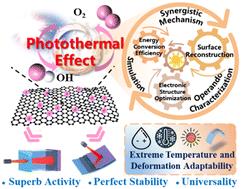
The development of cost-effective, high-performance bifunctional oxygen catalysts shows significant potential for the commercialization of zinc–air batteries (ZABs). In this study, photothermal electrocatalysts consisting of NiCo2S4@NiFe layered double hydroxides on a graphene oxide (NiCo2S4@NiFe LDH/N-rGO) were crafted. The NiCo2S4@NiFe LDH/N-rGO electrocatalyst displayed remarkable bifunctional activity with an impressive ΔE value of 0.636 V under the influence of photothermal effects, far exceeding most advanced systems (generally >0.68 V). At a high current density of 25 mA cm−2, the NiCo2S4@NiFe LDH/N-rGO-based ZAB exhibited an impressive cycling performance, reaching 3410 cycles and extending further to an extraordinary 8285 cycles under illumination conditions. Moreover, when considering flexible all-solid-state ZABs, photothermally-assisted rechargeable batteries displayed outstanding attributes, including exceptional maximum power density (e.g., 151.7 mW cm−2 at 25 °C), remarkable cycle stability (e.g., over 3480 cycles at −40 °C), and remarkable flexibility, spanning from high temperature (60 °C) to extremely low temperature (−40 °C). Through operando Raman and simulation investigation, it was revealed that the photothermal effect facilitates the generation of oxyhydroxide, underscoring the beneficial impact of light on the electrocatalysis.
期刊介绍:
Energy & Environmental Science, a peer-reviewed scientific journal, publishes original research and review articles covering interdisciplinary topics in the (bio)chemical and (bio)physical sciences, as well as chemical engineering disciplines. Published monthly by the Royal Society of Chemistry (RSC), a not-for-profit publisher, Energy & Environmental Science is recognized as a leading journal. It boasts an impressive impact factor of 8.500 as of 2009, ranking 8th among 140 journals in the category "Chemistry, Multidisciplinary," second among 71 journals in "Energy & Fuels," second among 128 journals in "Engineering, Chemical," and first among 181 scientific journals in "Environmental Sciences."
Energy & Environmental Science publishes various types of articles, including Research Papers (original scientific work), Review Articles, Perspectives, and Minireviews (feature review-type articles of broad interest), Communications (original scientific work of an urgent nature), Opinions (personal, often speculative viewpoints or hypotheses on current topics), and Analysis Articles (in-depth examination of energy-related issues).




 京公网安备 11010802042870号
京ICP备2023020795号-1
京公网安备 11010802042870号
京ICP备2023020795号-1

 分享
分享
 求助内容:
求助内容: 应助结果提醒方式:
 扫码关注我们
